
Coffee Bag Sizes for Roasters: Sustainable Choices

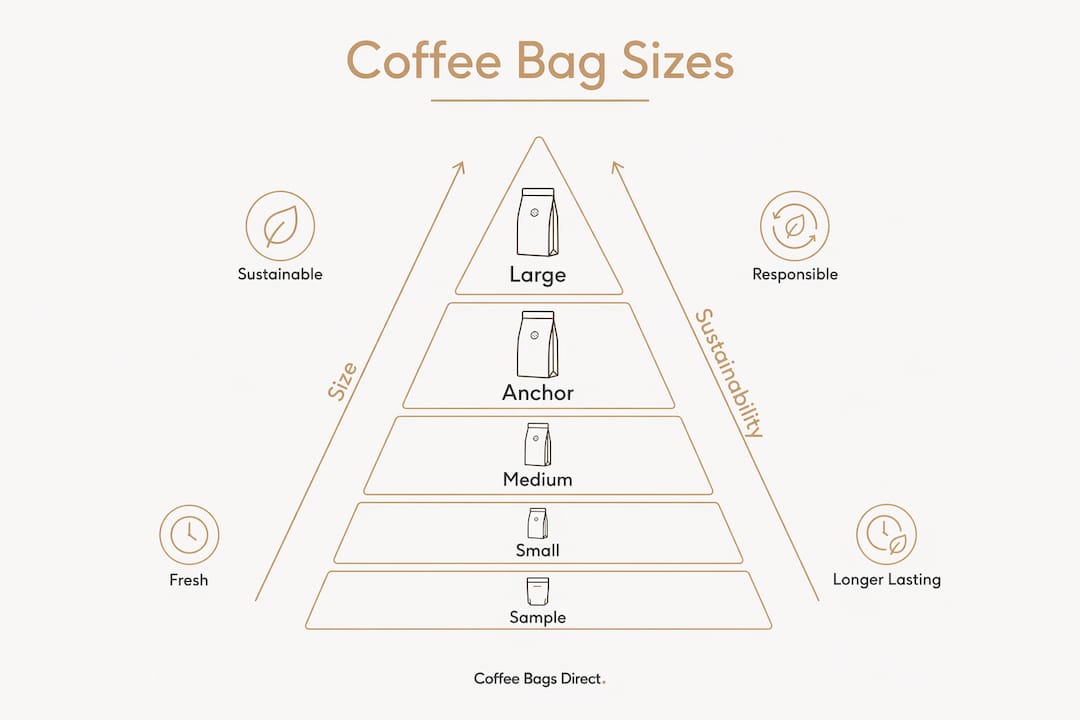
The standard coffee bag size tiers cover five practical categories, each matched to a specific channel and customer type:
- Sample / tasting (25–100 g): trial packs, subscription gift inserts, and tasting events; rarely need a degassing valve
- Specialty retail entry (250 g / ~8.8 oz): premium single-origin retail; the leading entry size in specialty shops
- North American retail standard (340 g / 12 oz): the most ordered size in North America; planogram-friendly for U.S. grocery and specialty retail
- Subscription / household (454 g / 1 lb): repeat buyers, DTC subscriptions, and home daily drinkers
- Wholesale / café bulk (1 kg–2.3 kg / 2–5 lb): back-of-house café use, restaurant accounts, and high-volume wholesale
For U.S. roasters planning a SKU lineup, the 12 oz / 340 g bag is the most practical anchor. Coffeebagsdirect offers compostable and recyclable options across all these tiers, with ASTM D6400-certified compostable materials available for roasters making verified sustainability claims.
Table of Contents
- What do the coffee bag sizes actually mean for your operation?
- How do you choose the right bag size for your customers?
- How bag style changes your shelf presence and capacity
- Materials, valves, and sustainability trade-offs
- Ordering logistics: MOQ, lead times, printing, and samples
- Packaging plans by seller type
- Key Takeaways
- A note on sustainability and practical support
- Coffeebagsdirect helps you order the right size with confidence
- Useful sources and spec standards
What do the coffee bag sizes actually mean for your operation?
| Size class | Weight | Common label | Best channel | Typical dimensions (side gusset) |
|---|---|---|---|---|
| Sample | 25–100 g | 25–100 g | Tasting, gift insert | Small flat pouch |
| Specialty retail | 250 g | ~8.8 oz | Specialty shop, online | 90 + 55 × 250 mm |
| Retail standard | 340 g | 12 oz | U.S. grocery, specialty | 90 + 55 × 250 mm |
| Subscription / home | 454 g | 1 lb | DTC, subscription box | 130 + 80 × 410 mm |
| Wholesale / café | 1 kg–2.3 kg | 2–5 lb | Café, restaurant, bulk | 130 + 80 × 410 mm |
Freshness expectations shift noticeably across these tiers. A retail customer buying a single 250 g or 340 g bag ideally finishes it within about two weeks for peak flavor. Subscription buyers who receive regular shipments tolerate 454 g bags well because replenishment is predictable. Wholesale customers at 1 kg and above rely on high-barrier materials and degassing valves to extend usable freshness across higher-volume drawdown.
The unit-cost trade-off is real but often misread. Larger bags lower cost per pound, but they raise the risk of stale product for low-consumption customers. A 1 lb bag sold to an occasional drinker who takes three weeks to finish it is a freshness problem, not a savings.
Pro Tip: Match retail bag size to the expected consumption window for your customer, not just to your margin target. A 250 g bag that a customer finishes fresh in 10 days builds more repeat purchases than a 1 lb bag that goes stale.
The 12 oz footprint is specifically planogram-friendly for U.S. supermarket facings. Vendors that ignore planogram constraints risk SKUs that don’t face correctly and are less likely to be accepted by supermarkets.
How do you choose the right bag size for your customers?
Start with this: pick sizes that align with customer consumption rate, channel constraints, and margin targets. Then work through this checklist.
- Define your target customer and average weekly consumption. A daily home brewer uses roughly 50–70 g per week; a household of two doubles that. Map consumption to the size tier that empties within two weeks.
- Map your channel. Retail shelf demands planogram compliance (12 oz is the U.S. anchor). DTC and subscription boxes are constrained by shipping box dimensions and dimensional-weight pricing. Wholesale accounts want 1 kg and up.
- Select a core size ladder. Most roasters start with three: a sample size (50–100 g), a core retail size (250 g or 340 g), and a subscription or wholesale size (454 g or 1 kg). The 250 g is the leading entry size for specialty retail, while 340 g (12 oz) is the dominant U.S. retail size. Adding more SKUs too early fragments inventory and raises MOQ costs.
- Validate against shelf or box dimensions. A flat-bottom 12 oz bag is typically around 5" × 3" × 9". Confirm your DTC shipping box fits your chosen size without excessive void fill.
- Order samples and test fill and valve placement. Fill the bag to roughly 70–80% of its internal volume. That headspace allows proper degassing and keeps the bag looking full without straining seals.
Two additional decision rules matter here. Whole beans occupy 8–12% more internal volume than the same weight of ground coffee, so size up slightly for whole-bean SKUs. Bags over approximately 8 oz (whole-bean, i.e. 250 g and 340 g) typically need a one-way degassing valve; smaller formats and ground coffee can often skip it.
Pro Tip: Run a small A/B test with one design in 250 g versus 340 g before committing to a full SKU rollout. Measure conversion and perceived value at point of sale before scaling production.
How bag style changes your shelf presence and capacity
Bag style affects usable volume, printable surface, and how your product reads on a shelf, often as much as weight capacity does for specialty roasters.
Stand-up pouch (doypack)
- Best for 250 g–500 g retail
- Good printable front panel; stands independently on shelf
- Moderate structural rigidity; can lean or tip when partially empty
- Most accessible price point across materials
Flat-bottom (box pouch)
- Holds 10–15% more usable volume than a comparable stand-up pouch
- Four printable panels; strong shelf presence and premium appearance
- Best for retail display and higher price-point products
- Slightly more complex to fill on automated lines
Side-gusset bag
- Preferred for 1 kg and above; stacks efficiently in back-of-house storage
- Less printable surface on the front panel
- Lower per-unit cost at wholesale volumes
- Practical dimension examples: 250 g at 90 + 55 × 250 mm; 1 kg at 130 + 80 × 410 mm
Pro Tip: For a premium retail launch, the flat-bottom bag’s four-panel print area gives you the most branding real estate per square inch of shelf space. Pair it with a matte finish and spot UV for a high-end look without changing the bag size.
When you’re building a packaging lineup, match style to channel: flat-bottom for specialty retail and gift sets, stand-up pouches for 250 g–340 g everyday retail, and side-gusset for wholesale accounts.
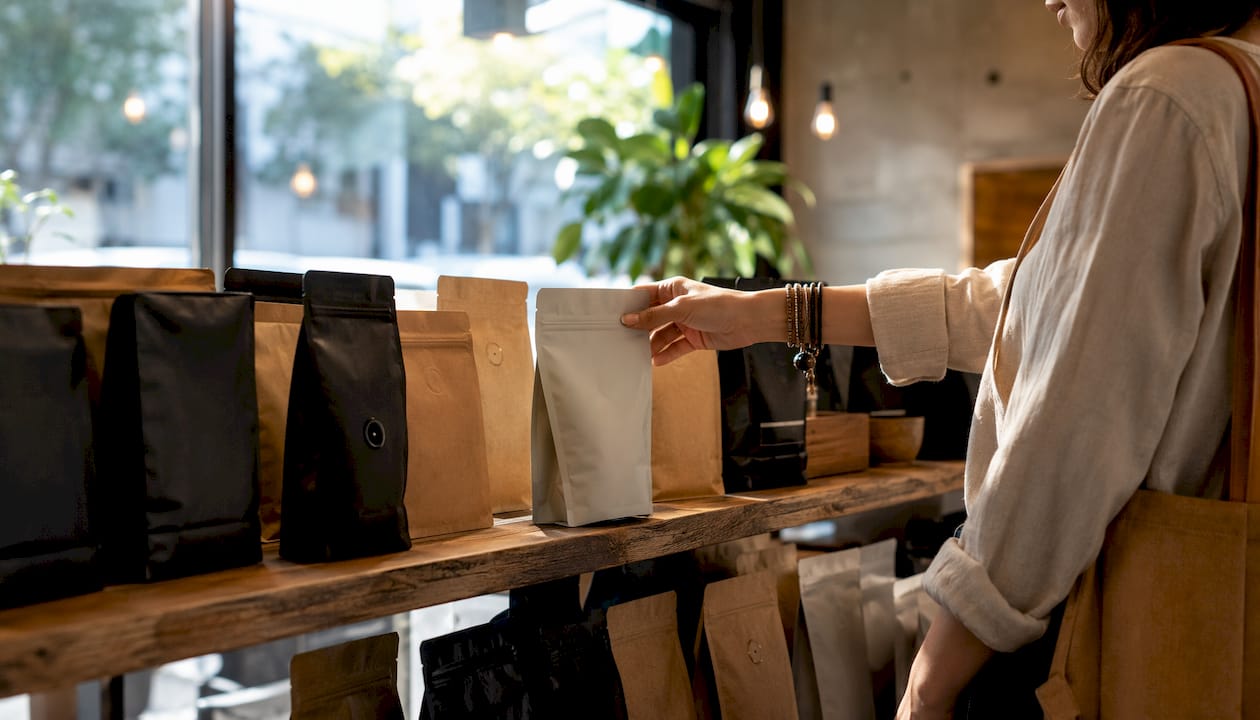
Pro Tip: Always request a physical sample filled to your target weight before approving production. A bag that looks right empty can look underfilled or overstuffed at actual fill weight.
Materials, valves, and sustainability trade-offs
Barrier performance and recyclability pull in opposite directions. Choose the minimal barrier that preserves your roast profile and shelf life for the chosen bag size, then select the most sustainable material that meets that barrier threshold.
Common material options:
- Multi-layer foil laminate: best oxygen and moisture barrier; not recyclable in standard streams; suited for long shelf-life or export SKUs
- PET/PE laminate: widely used; moderate barrier; recyclable in some municipal streams depending on local infrastructure
- Mono-material PE or PLA-based films: better end-of-life story when certified; lower barrier than foil; best paired with shorter shelf-life SKUs or high-turnover accounts
- Kraft paper with barrier liner: natural aesthetic; compostable options available when certified to ASTM D6400
The 12 oz / 340 g bag is the dominant U.S. retail size and generally requires a one-way degassing valve when packed with whole-bean coffee. Bags under approximately 5 oz rarely need a valve.
Valve placement matters. For 250 g–340 g bags, the valve should sit 30–45 mm from the top of the bag to clear the heat-seal area and maintain integrity during packing and shipping. Incorrect placement compromises seal integrity and can cause staling or leaks.
Material thickness also affects your actual fill dimensions. Standard guidance runs 100–120 micron for bags under 250 g, 130–160 micron for 250 g–500 g retail flat-bottom bags, and 160–180+ micron for 1 kg and above. When using higher-micron films for small formats, increase bag dimensions by roughly 3–5 mm to maintain the same fill percentage.
Pro Tip: Always request supplier spec sheets and physical print proofs before finalizing a material choice. Compostability claims require certification documentation, not just marketing language. ASTM D6400 is the U.S. standard to look for.
For roasters thinking about coffee freshness and how it interacts with material choice, the barrier level you need scales directly with how quickly your customer turns over the bag.
Ordering logistics: MOQ, lead times, printing, and samples
Plan MOQ and lead-time decisions around expected SKU velocity. Smaller order minimums reduce waste and financial risk but raise unit cost. Larger runs lower per-unit cost but require confident demand forecasting.
Key cost drivers:
- MOQ tier (digital runs typically start lower than rotogravure)
- Printing method: digital printing suits small runs and fast turnarounds; rotogravure suits high-volume, consistent-color production
- Number of ink colors and finish type (matte, gloss, spot UV)
- Barrier layer count and material micron
- Express turnaround premiums
Cost shape at a glance:
| Run type | MOQ | Per-unit cost | Lead time |
|---|---|---|---|
| Digital print | Low | Higher | Shorter |
| Rotogravure / offset | High | Lower | Longer |
Before committing to a production run, work through this checklist:
- Request physical samples filled to your target weight at 70–80% fill volume.
- Confirm valve position (30–45 mm from top for 250 g–340 g bags) and zipper or tin-tie specs.
- Verify the bag looks visually full and the seal area is clear.
- Check shipping carton dimensions against your DTC box to avoid dimensional-weight penalties.
- Confirm material certifications (ASTM D6400 for compostable claims) are documented.
Pro Tip: Use Coffeebagsdirect’s express digital printing for small test runs. Validate your size, artwork, and material before committing to a higher-MOQ rotogravure order.
Packaging plans by seller type
| Seller type | Core sizes | Freshness window | Bag style | Sustainability option |
|---|---|---|---|---|
| Small roaster (retail) | 250 g + 340 g | 2 weeks | Stand-up or flat-bottom | Kraft compostable, ASTM D6400 |
| DTC subscription | 340 g + 454 g | 1–2 weeks | Stand-up pouch | Mono-material PE or compostable |
| Café retail shelf | 250 g + 340 g | 2 weeks | Flat-bottom | Recyclable PET/PE or kraft |
| Wholesale / café bulk | 1 kg + 2.3 kg | 3–4 weeks | Side-gusset | High-barrier foil or recyclable laminate |
A few short rationales worth noting. Small roasters should start with two SKUs maximum to keep MOQ costs manageable. DTC subscription operators often cap their largest bag at 2 lb / 907 g to avoid dimensional-weight shipping penalties on standard mailer boxes. Café retail benefits most from the flat-bottom format’s shelf stability and four-panel print area. Wholesale accounts prioritize the side-gusset bag’s stacking efficiency and lower per-unit cost at 1 kg and above.
For custom branding across these formats, the bag size you choose directly shapes how much print real estate you have to tell your story.
Key Takeaways
Matching bag size to customer consumption rate is the single most important decision a roaster makes when building a sustainable, profitable packaging lineup.
| Point | Details |
|---|---|
| Size by consumption rate | Choose the size your customer finishes within two weeks for peak freshness and repeat purchases. |
| Match style to channel | Use flat-bottom for retail display, stand-up for 250 g–340 g everyday SKUs, and side-gusset for 1 kg+ wholesale. |
| Test at 70–80% fill | Order physical samples and fill to 70–80% volume to confirm visual fill and seal integrity before production. |
| Balance barrier and sustainability | Select the minimal barrier that preserves shelf life, then choose the most sustainable certified material that meets it. |
| Coffeebagsdirect for samples and test runs | Use Coffeebagsdirect’s express digital printing and sample proofs to validate sizes and materials before scaling. |
A note on sustainability and practical support
At Coffeebagsdirect, we work with roasters and cafés who want packaging that performs and aligns with their environmental commitments. We offer compostable and recyclable options across all major size tiers, and our partnership with the Australian Packaging Covenant Organisation (APCO) reflects the seriousness with which we approach material claims. Express digital printing means you can test a new size or sustainable material on a small run before committing to volume. Request samples and supplier spec sheets to confirm valve position, micron thickness, and material certifications before you finalize any order.
Coffeebagsdirect helps you order the right size with confidence
Choosing between a 250 g compostable kraft bag and a 340 g recyclable flat-bottom pouch is easier when you can hold both in your hands at your actual fill weight. Coffeebagsdirect offers custom coffee packaging across all major size tiers, with compostable, recyclable, kraft, metallic, and foil material options. Low MOQ digital printing lets you test a new size or artwork before scaling to rotogravure. Physical print proofs and sample orders are available so you can confirm valve placement, fill volume, and visual finish before committing to production.
Browse stock eco bags for ready-to-order sustainable options, or request a custom quote sized to your roast weight and channel. Start with a sample order and scale from there.
Useful sources and spec standards
- Side gusset bag dimensions for 250 g coffee (VP Packaging) — practical dimension reference for 250 g whole-bean side-gusset bags
- Standard coffee bag size guide (BN Pack) — size chart covering 8 oz through 5 lb with use-case guidance
- Coffee bag sizes explained (Mai Bao Pak) — U.S. retail planogram guidance and DTC shipping trade-offs
- Side gusset coffee bag sizes and valve options (JMei Packing) — dimension examples and whole-bean vs. ground volume guidance
- Coffee bag sizes and material thickness (CustomShinePack) — valve placement specs, micron guidelines, and fill-volume recommendations
- ASTM D6400 standard for compostable plastics (ASTM International) — the U.S. certification standard for compostable packaging claims
Supplier spec sheets and physical proofs are the most reliable way to verify valve position, fill percentage, and material certification before committing to a full production order.