
Soft Plastics Recycling in Australia: Where and How

Soft plastics recycling in Australia is genuinely accessible again. Your two best routes right now are dropping off at a participating supermarket or checking whether your council runs a kerbside pilot. Over 700 collection points across Australia that give almost 70% of Australians access to a drop-off site, and kerbside trials have expanded to at least nine council areas since July 2025.
Two immediate actions:
- Find your nearest drop-off: Use the SPSA collection locator or check your local Woolworths, which has reintroduced in-store bins at more than 700 stores nationally.
- Prepare your plastics correctly: Clean, dry, and empty every item before you go. Contaminated or wet material is the single most common reason loads get rejected.
Key Takeaways
Correct sorting and consistent consumer participation are what keep Australia’s soft-plastics recycling system economically viable, and businesses that choose mono-material film packaging strengthen the demand side of that system.
| Point | Details |
|---|---|
| Find a drop-off point | Use the SPSA locator or visit a participating Woolworths; over 700 collection points cover almost 70% of Australians. |
| Prepare materials correctly | Clean, dry, and empty every item; remove non-plastic parts and check local bundling rules before dropping off. |
| Understand what happens next | The SPEC/iQRenew facility at Taree processes 14,000 t/yr; output becomes pellets, paneling, and recycled-content bread bags. |
| No local option? Act upstream | Reduce packaging at source, store material for a batch trip, and contact your council about SPSA’s kerbside commercialization program. |
| Coffeebagsdirect for businesses | Coffeebagsdirect offers mono-material recyclable pouches with APCO-aligned film data and express digital printing for coffee roasters and food brands. |
Table of Contents
- Where can you drop off soft plastics in Australia?
- Which soft plastics are accepted and which are not?
- How to prepare soft plastics before dropping them off
- What actually happens to soft plastics after collection?
- Who runs soft-plastics recycling and what are the recent governance updates?
- What to do when there’s no local collection point near you
- Guidance for coffee roasters and food businesses on packaging choices
- Why correct sorting is the lever most people underestimate
- Recyclable flexible packaging options from Coffeebagsdirect
- Sources
Where can you drop off soft plastics in Australia?
The most reliable option for most Australians is a supermarket bin. Woolworths has reinstated collection points at the front of more than 700 stores, and Coles has participated in collection programs at various points. Check each retailer’s store locator or call ahead before making a special trip, since bin availability can vary by location.
Retailer drop-off points are typically positioned near the store entrance or customer service desk. Bins are clearly labeled and accept a broad range of clean, dry flexible plastics. Staff can usually confirm whether a bin is active.
Kerbside pilots are a newer development. SPSA commenced kerbside commercialization activities in several council areas across NSW, SA, and VIC from July 2025. These trials use a bag-in-a-bin model: residents place soft plastics inside a designated bag, then put that sealed bag into their recycling bin on collection day. Rules vary by council, so check your local authority’s website before participating.
Council drop-off events are another option in some areas. The City of Kingston in Victoria, for example, publishes local rules and drop-off details for residents.
How to find your nearest location:
- Use the SPSA collection locator at spsa.au/collection-locations
- Check the Woolworths store finder and filter for soft-plastics collection
- Download RecycleMate, which maps local recycling options by material type and postcode
- Search your council’s waste and recycling page directly
Pro Tip: Before driving to a store, check the retailer’s website or call the store. Bins can temporarily fill or be removed for maintenance, and a quick check saves a wasted trip.
Which soft plastics are accepted and which are not?
The simplest rule is the scrunch test: if you can scrunch the plastic into a ball and it stays scrunched, it is generally accepted. Stiff or rigid plastics that spring back are not soft plastics and belong in your kerbside recycling bin or general waste.
The Australian Packaging Covenant Organisation (APCO) and SPSA both publish acceptance thresholds for borderline items. When in doubt, check the SPSA FAQ or the signage at your collection point.
Commonly accepted items:
- Bread bags and bread bags with twist ties removed
- Chip packets, lolly wrappers, and confectionery bags
- Cling wrap and stretch wrap (clean)
- Frozen food bags
- Cereal box liners
- Pasta and rice bags
- Courier satchels and bubble wrap (check locally)
- Newspaper and magazine wrap
Items generally not accepted:
- Hard plastic containers, lids, or trays
- Coffee bags with foil or metalized layers (multi-layer laminate construction)
- Compostable or biodegradable plastics labeled “compostable” — these contaminate the soft-plastics stream
- Heavily soiled or wet packaging with food residue
- Polystyrene foam
- Degradable plastics with oxo-degradable additives
A note on coffee bags: Most standard coffee pouches use multi-layer construction combining foil, metalized film, or mixed polymers to achieve the high-barrier properties that protect freshness. These are not mechanically recyclable in the soft-plastics stream. Businesses choosing recyclable and compostable packaging should verify mono-material construction before making any recyclability claims.
Always confirm acceptance with your local collection point, since APCO thresholds and retailer rules can differ slightly by program.
How to prepare soft plastics before dropping them off
Clean, dry, and empty is the standard. Contaminated loads can cause an entire batch to be rejected at the processing facility, which undermines the economics of the whole system. Retailers and industry bodies have consistently flagged contamination as one of the main reasons past schemes struggled.
Step-by-step preparation:
- Empty completely. Shake out crumbs, pour out any liquid, and remove all food residue.
- Rinse if needed. A quick rinse under cold water is enough for items like cling wrap or frozen-food bags. You do not need to wash them like dishes.
- Let them dry. Lay items flat or hang them briefly. Wet plastics create mold and contaminate other material in the collection bag.
- Remove non-plastic parts. Take off bread tags, pull out cardboard stiffeners, and remove paper labels where they peel off easily.
- Bundle or bag them. Many collection points ask you to place loose soft plastics inside one larger plastic bag before dropping off. Check the signage at your specific bin for the preferred method.
- Seal the bag. If you are using a kerbside bag-in-a-bin system, tie or seal the bag as instructed by your council.
Common mistakes to avoid:
- Dropping off wet items or bags with pooled liquid
- Including polystyrene or rigid plastics in the soft-plastics bag
- Mixing in compostable packaging (it looks similar but contaminates the stream)
- Leaving coffee grounds or food residue inside pouches
Pro Tip: Keep a small dedicated bin or bag in your kitchen pantry for soft plastics. Once it fills, do a quick check before your next supermarket run. This routine takes less than two minutes and keeps your collection clean.
What actually happens to soft plastics after collection?
Collected material is either mechanically recycled into flakes and pellets or sent through advanced chemical recycling processes that convert it into feedstock or oil for new plastic manufacturing. Both pathways are active in Australia, and SPSA is working with recyclers on both approaches to build a sustainable national system.
Mechanical recycling
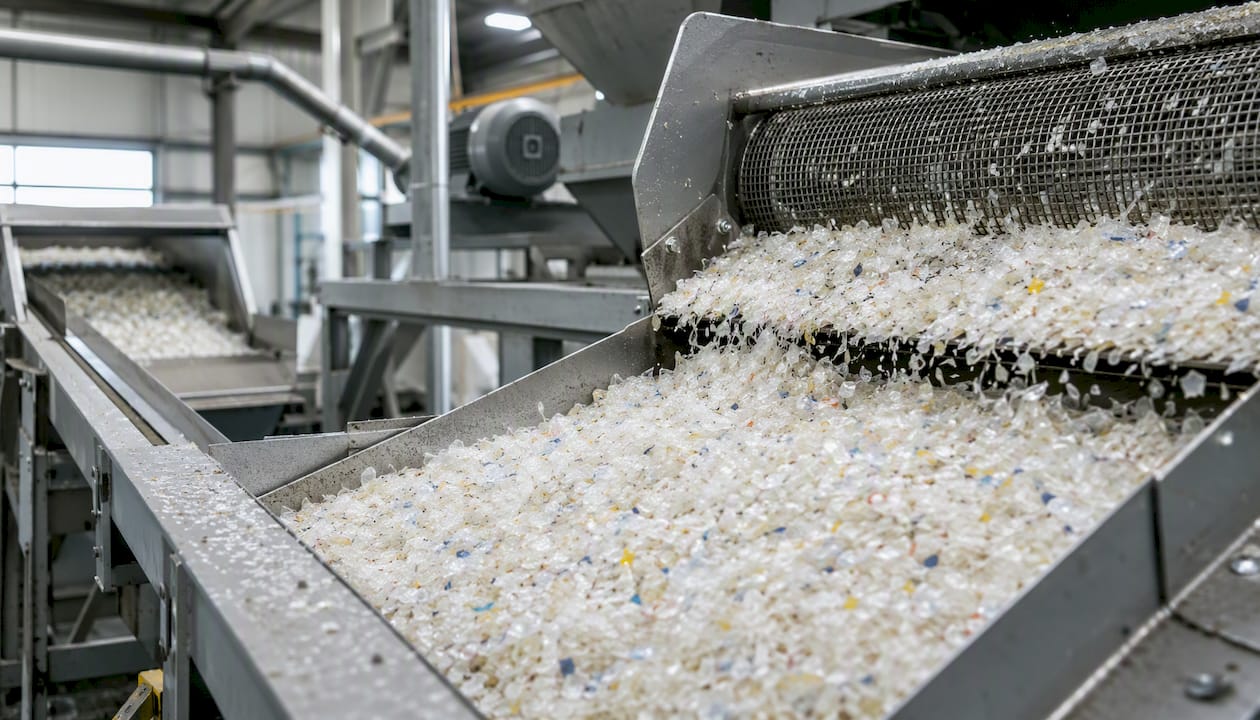
Sorting, washing, shredding, and extrusion are the core steps. Clean soft plastics are sorted by polymer type, shredded into flakes, washed again, then melted and extruded into pellets. Those pellets are sold to manufacturers as a raw material. Woolworths reports that collected material is being converted into in-store wall paneling and bread bags with recycled content. This closed-loop example strengthens buyer confidence in the material.
Advanced chemical recycling
Chemical recycling uses depolymerization or pyrolysis to break mixed or contaminated plastics down into oil or chemical feedstock. This handles material that mechanical processes cannot, particularly mixed-layer films. The output feeds back into petrochemical manufacturing as a substitute for virgin feedstock.
Processing capacity in Australia
The SPEC/iQRenew facility near Taree in NSW currently holds the status as the most significant dedicated soft-plastics processing site in the country. It can handle a substantial amount of tonnes per year, with plans to increase capacity. That expansion matters because the system’s bottleneck is no longer just collection — it is securing enough domestic buyers for recycled pellets and feedstock to make processing economically viable.
| Facility | Process type | Current capacity | Known end uses |
|---|---|---|---|
| SPEC/iQRenew, Taree NSW | Mechanical + chemical | 14,000 t/yr | Pellets for manufacturing, recycled feedstock |
| Woolworths in-store program | Mechanical (via partners) | Part of 700+ store network | In-store wall paneling, bread bags with recycled content |
Who runs soft-plastics recycling and what are the recent governance updates?
Soft Plastics Stewardship Australia (SPSA) leads the coordinated national rollout. It manages the collection network, works with recyclers, and publishes the collection locator and program FAQs. APCO (the Australian Packaging Covenant Organisation) sets packaging design thresholds and recyclability standards that influence which materials qualify for the soft-plastics stream. Retailers including Woolworths operate the physical collection infrastructure, and councils run kerbside pilots under SPSA’s commercialization framework.
The governance picture became clearer after the collapse of REDcycle in late 2022. The ACCC authorized supermarkets to cooperate in a joint taskforce to re-establish collection systems, enabling coordinated retail action that would otherwise raise competition concerns. That authorization underpins the current SPSA model.
Key organizations and what they do:
- SPSA — coordinates collection, manages the locator, and drives kerbside expansion
- APCO — sets packaging recyclability thresholds and design standards
- Woolworths and Coles — operate in-store collection bins and fund collection logistics
- Local councils — run kerbside pilots and publish local acceptance rules
- ACCC — authorized the retailer cooperation that makes joint collection programs legally viable
SPSA notes that scaling a sustainable national system requires not just collection infrastructure but a strong domestic market for recycled content. Without manufacturers actively buying recycled pellets and feedstock, processors face economic bottlenecks regardless of how much material consumers bring in.
How to track local changes:
- Subscribe to SPSA program updates at spsa.au
- Check your council’s waste and recycling page regularly
- Monitor retailer newsroom pages (Woolworths Group, for example, publishes program updates)
- Use RecycleMate, which updates its database as new collection points come online
Pro Tip: If your council is not yet running a kerbside pilot, contacting your local waste officer directly is more effective than waiting. SPSA’s kerbside commercialization framework is actively seeking new council partners, and a formal request from residents carries weight.
What to do when there’s no local collection point near you
Not every postcode has a convenient drop-off yet. If your nearest collection point is impractical, here are realistic alternatives.
Immediate options:
- Store and batch: Keep a bag at home and make one drop-off trip per month when you are already near a participating supermarket.
- Reduce at source: Buy products in bulk or in packaging formats that generate less soft-plastic waste. Buying loose produce, choosing cardboard over plastic film, and using reusable bags all reduce the volume you need to manage.
- Reuse where possible: Bread bags work well as bin liners for small bins. Bubble wrap and courier satchels can be reused for packing and posting.
Practical steps to push for local collection:
- Contact your council’s waste team and ask about SPSA’s kerbside commercialization program.
- Use RecycleMate’s “suggest a location” feature to flag your area as underserved.
- Join local sustainability groups or Facebook community pages — coordinated requests from residents are more likely to prompt retailer or council action.
Behavior-change options that reduce the problem:
- Switch to reusable produce bags and shopping bags.
- Choose products packaged in mono-material film where available, since these have a clearer recycling path.
- When buying coffee or food products, look for packaging that carries an Australasian Recycling Label (ARL) with a “soft plastics — drop off at store” designation.
Contacting brands directly is also worth doing. Ask whether their packaging uses mono-material film construction and whether they plan to transition to formats compatible with the soft-plastics stream. Brands respond to customer demand, and a short email to a customer service team takes two minutes.
Guidance for coffee roasters and food businesses on packaging choices
For businesses, the packaging decision is upstream of the recycling question. Choosing the right film construction now means your customers can actually recycle the packaging later, and it positions your brand ahead of tightening APCO requirements.
The short answer: prefer mono-material films. A pouch made from a single polymer type (such as PE or PP) is far more compatible with mechanical recycling than a multi-layer laminate combining foil, metalized film, and adhesives. Multi-layer constructions deliver excellent barrier performance but are not accepted in the soft-plastics stream.
Checklist for specifying recyclable flexible packaging:
- Confirm the film is a single polymer type (PE, PP, or other mono-material)
- Avoid foil liners and metalized layers if recyclability is a priority
- Check whether any window, seal, or valve material is compatible with the base film
- Ask your supplier for a formal recyclability statement or APCO-aligned data sheet
- Request a physical sample and verify the scrunch test yourself before ordering at volume
- Review the Australasian Recycling Label requirements so your packaging carries the correct end-of-life instruction
Barrier needs vs. recyclability trade-offs are real. High-barrier materials that protect freshness over long shelf lives often require multi-layer construction. For coffee roasters, this is a genuine tension. The practical path is to work with a supplier who can provide technical data on film composition and advise on barrier solutions that stay within mono-material constraints. Reviewing ground coffee bag options with a focus on film construction is a good starting point.
For food service operators, the sustainability guidance for food service businesses covers procurement strategies for reducing single-use plastics across operations, which complements packaging decisions at the product level.
Why correct sorting is the lever most people underestimate
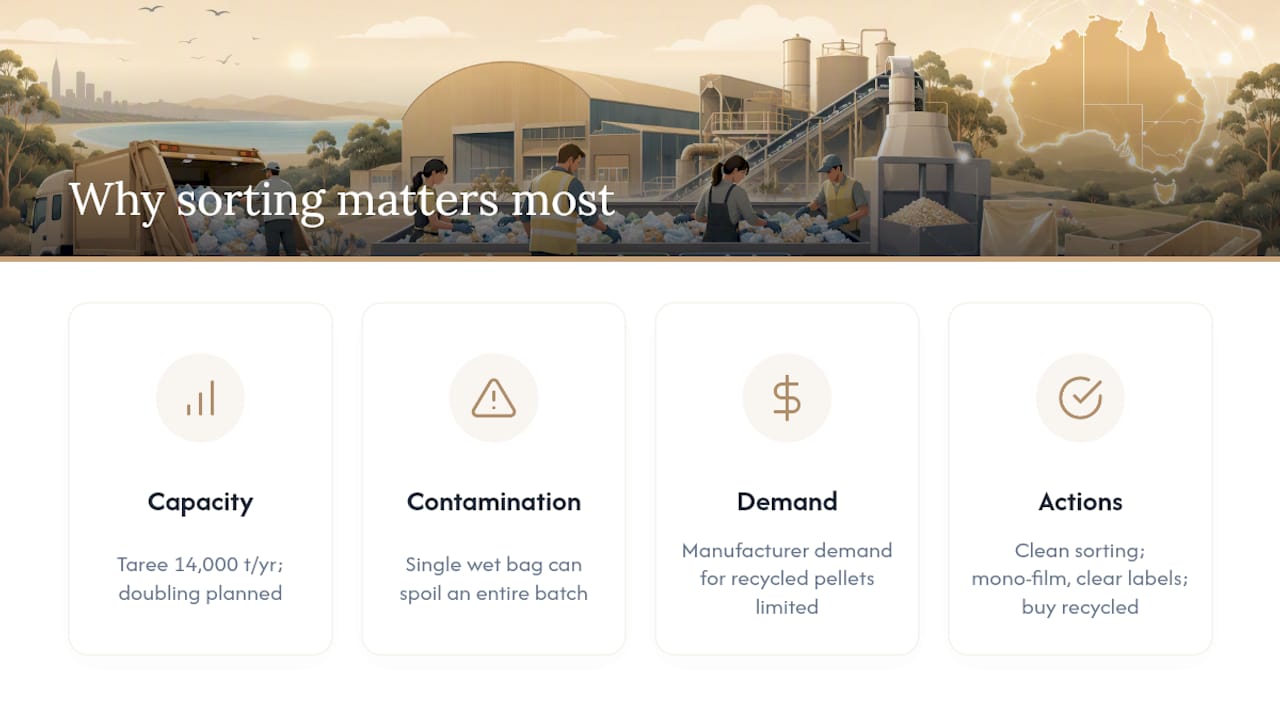
The recycling system’s weakest point is not processing capacity. The Taree facility can handle 14,000 tonnes per year and is planning to double that. The weak point is what goes into the collection bin and who buys the output.
Contaminated loads cost processors money to sort and dispose of. A single bag of wet food waste or a handful of compostable packaging mixed into a soft-plastics collection can degrade an entire batch. Past schemes, including REDcycle, suffered partly because consumer participation was inconsistent and contamination rates were high. The current SPSA model is more tightly managed, but the same vulnerability exists.
On the demand side, the ABC’s reporting on the Taree facility highlights that processing capacity has expanded while demand for recycled soft-plastic feedstock from manufacturers remains limited. That gap is the real constraint. Businesses that actively specify recycled content in their packaging procurement — asking suppliers for pellets with recycled soft-plastic content — directly strengthen the economics of the whole system.
For packaging businesses and coffee roasters, the implication is clear: choosing mono-material film and labeling it correctly is not just a compliance exercise. It increases the material’s value at the end of its life and gives processors a cleaner, more marketable output. SPSA’s FAQ on packaging design makes the same point: smarter packaging design reduces sorting difficulty and increases material value, which is as important as collection volumes.
The most durable contribution any business or household can make is consistency: clean material, correct sorting, and active demand for recycled content in new purchases.
Recyclable flexible packaging options from Coffeebagsdirect
If you are a coffee roaster or food brand evaluating your packaging’s end-of-life path, Coffeebagsdirect offers recyclable flexible packaging options designed to be compatible with Australia’s soft-plastics recycling systems. The range includes mono-material film pouches and custom-printed options with technical data on film composition available on request, so you can verify recyclability before committing to a run.
What sets the offering apart is the combination of express digital printing with low minimum order quantities, which means you can test a recyclable film format without a large upfront commitment. Coffeebagsdirect’s APCO partnership also means the team understands the packaging thresholds that determine whether a pouch qualifies for the soft-plastics stream. Request a sample, review the film spec sheet, and confirm the ARL designation before scaling.
Browse recyclable coffee packaging options or request a custom-printed sample to get started.
Sources
- Locations for Collections – Soft Plastics Stewardship Australia
- Soft plastics recycling is back in Australia. How does it work and where does it go? - ABC News
- Woolworths brings back in-store soft plastics collection
- Supermarkets can cooperate in soft plastics taskforce after REDcycle pauses recycling program — ACCC
Recommended
- Are Paper Cups Recyclable in Australia? A Cafe Guide – Coffee Bags Direct
- Commercial Composting in Australia: A Business Guide – Coffee Bags Direct
- Recyclable and Compostable Packaging: Australia Guide – Coffee Bags Direct
- Waste Management for Cafes: A Practical Guide for Roasters – Coffee Bags Direct