
Ground Coffee Bags for Australian Roasters: 2026 Guide

For most Australian roasters, the best choice is a high-barrier, certified compostable ground coffee bag with a degassing valve and resealable zip, provided your customers have access to a FOGO or industrial composting service. If your customer base is spread across states with limited composting infrastructure, a mono-polyolefin recyclable bag is the more honest option. Either way, prioritize suppliers who can provide AS 4736 or TÜV/OK Compost certification, oxygen transmission rate (OTR) data, and physical samples before you commit to a print run. Coffeebagsdirect, an APCO-aligned supplier, offers both material paths with express digital printing and sample support.
Pro Tip: Ask every supplier for their OTR and moisture vapor transmission rate (MVTR) data sheet before ordering samples. A bag that looks sustainable on paper but lacks barrier data is a freshness risk.
Table of Contents
- What do ground coffee bags need to protect?
- Which material is right for your coffee packaging bags?
- What bag style fits your product and channel?
- How do you match your bag to Australian end-of-life realities?
- Digital vs rotogravure: which printing method suits your run?
- Budgeting, MOQs, and shelf-life testing for your bags
- What certifications and claims should you verify in Australia?
- Supplier checklist: questions to ask before you order
- Key Takeaways
- What roasters often get wrong about sustainable packaging
- Coffeebagsdirect: sustainable coffee packaging with real support
- Further reading and sources
What do ground coffee bags need to protect?
Ground coffee is more vulnerable than whole beans. The increased surface area means oxygen, moisture, and light degrade flavor faster, so your packaging has to work harder from the moment the bag is sealed.
- Oxygen barrier: The single most critical function. High OTR (poor barrier) accelerates staling; target materials with OTR below 10 cc/m²/day for specialty coffee.
- Moisture barrier: Humidity causes clumping and mold. MVTR should be low, especially for humid Australian climates like Queensland and the Northern Territory.
- Degassing valve: Freshly roasted ground coffee releases CO₂. Without a one-way valve, bags bloat and seal integrity fails.
- Aroma retention: A tight barrier keeps volatile aromatics inside the bag, which directly affects the customer’s first impression at opening.
- Resealability: A zip or press-to-close seal lets consumers re-close the bag between uses, extending perceived freshness.
- Light barrier: UV and visible light accelerate oxidation. Opaque or metallized layers protect against light exposure on retail shelves.
Pro Tip: Compostable films often have higher OTR than foil laminates. If you choose a compostable bag, confirm the OTR figure in writing and factor in your typical shelf life before committing.
Which material is right for your coffee packaging bags?
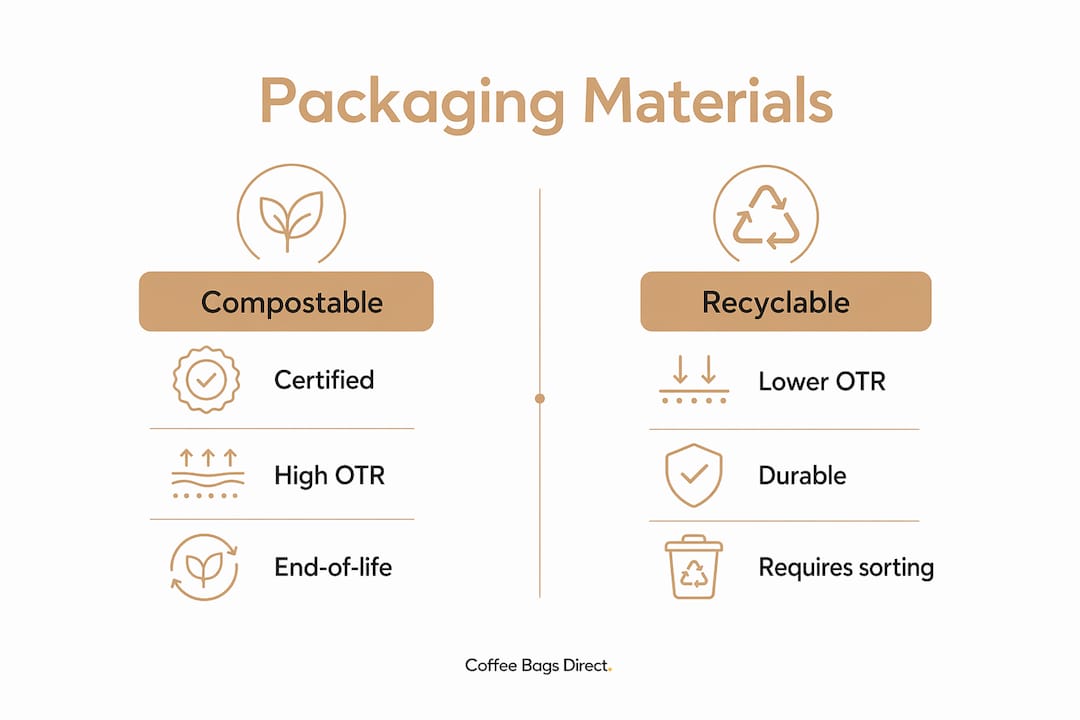
The honest answer is that no single material wins on every dimension. The right choice depends on your shelf-life target, your customers’ location, and the disposal infrastructure available to them. As industry coverage confirms, local composting and recycling infrastructure determines real-world outcomes far more than the material claim alone.

| Material | Barrier performance | End-of-life in Australia | Valve/zip compatible | Print options |
|---|---|---|---|---|
| Certified compostable (industrial) | Moderate OTR; lower than foil | FOGO/industrial composting where available; not kerbside recycling | Yes | Digital and rotogravure |
| Mono-polyolefin recyclable | Good OTR; improving with newer film tech | Soft plastics drop-off (REDcycle-style programs); check current state availability | Yes | Digital and rotogravure |
| Foil/multi-layer laminate | Highest barrier; best for long shelf life | Landfill in most cases; not recyclable or compostable | Yes | Rotogravure preferred for long runs |
| Kraft/paper composite | Low barrier alone; needs liner | Limited; depends on liner material | Limited | Digital; good for short runs |
Certification callouts to know:
- AS 4736: Australia’s standard for industrial compostability. A bag certified to this standard will break down in a commercial composting facility, not in your home bin.
- TÜV / OK Compost (Industrial): European third-party mark widely recognized by Australian composting operators. Equivalent in intent to AS 4736 but issued by TÜV Austria.
- Home Compostable marks: Require a separate certification (AS 5810 in Australia). Do not assume an industrially certified bag will break down at home.
- ACCC green-claims guidance: Australia’s consumer law requires that sustainability claims be accurate and substantiated. Vague terms like “eco-friendly” without certification backing can attract scrutiny.
Newer recyclable mono-polyolefin films align material melting points to improve recyclability without foil layers, making them a credible alternative for roasters who want a recyclable story.
By roaster profile:
- Small-batch specialty roaster: Certified compostable bag with valve and zip, digital print run, short MOQ. Prioritize AS 4736 or TÜV/OK Compost mark.
- High-volume retail brand: Mono-polyolefin recyclable or foil laminate for maximum barrier and cost efficiency; rotogravure printing for long runs.
Pro Tip: Check compostable vs recyclable end-of-life pathways specific to Australia before finalizing your material. State infrastructure varies significantly.
What bag style fits your product and channel?
Style affects shelf presence, logistics, and how customers interact with your product daily.
- Stand-up pouch: The most common retail format. Stable on shelf, compatible with valves and zips, and available in a wide range of sizes from 100g to 1kg.
- Side-gusset bag: Preferred for wholesale and café bulk supply. Holds larger volumes and stacks efficiently in storage.
- Flat-bottom / box-bottom bag: Premium shelf presence; stands upright without a display stand. Popular for specialty retail and subscription boxes.
- Sample sachets: Small single-serve or trial packs, typically 10–50g. Useful for subscription onboarding or café sampling programs.
- Bulk bags: Large food-grade bags for restaurant or wholesale channels, often 1–5kg. Barrier requirements are the same; reseal features matter less at this scale.
Feature checklist:
- One-way degassing valve (standard or micro) positioned away from the zip to avoid interference
- Resealable zip (press-to-close or slider) matched to bag width
- Tear notch for easy opening, especially on foil or thick laminate bags
- Matte or gloss finish chosen for brand alignment, not just aesthetics (matte hides fingerprints; gloss amplifies color vibrancy)
- Window panel (clear or frosted) if your brand story benefits from showing the product
Pro Tip: For ground coffee with a shelf life beyond six months, a full-barrier laminate with valve and zip outperforms kraft or compostable films on aroma retention. Reserve compostable films for shorter shelf-life SKUs or local café supply where composting infrastructure is confirmed.
How do you match your bag to Australian end-of-life realities?
Start with your customer base, not the material. A large majority of Australian coffee consumers are willing to pay more for sustainable packaging, but that willingness only translates to real environmental benefit when the disposal pathway actually exists where your customers live.
State-by-state reality check:
- Victoria and ACT: Broader FOGO rollout; certified compostable bags have a realistic pathway in many metro areas.
- NSW: FOGO expanding but not universal; check your specific customer postcodes.
- Queensland, WA, SA, TAS, NT: More variable; confirm with local councils before making compostability claims.
Practical steps:
- Map your top customer postcodes against current FOGO/kerbside availability using your state’s waste authority website.
- Choose a certified material (AS 4736 or TÜV/OK Compost) that matches the dominant disposal pathway in your distribution area.
- Print clear disposal instructions directly on the bag, including the certification logo and a short instruction (“Place in your FOGO bin” or “Return to soft plastics drop-off”).
- Partner with a local composting service or café collection program if your customer base is concentrated enough to make it viable.
Compostable packaging can divert packaging from landfill when matched to real composting systems, but the match has to be deliberate. Customer education is not optional.
Pro Tip: Include a small QR code on your bag linking to a disposal guide on your website. It costs nothing to add at print time and significantly improves correct disposal rates.
Digital vs rotogravure: which printing method suits your run?
Choose express digital printing for small runs and fast proofing. Rotogravure is cost-effective for high-volume, long-run SKUs once you have a proven design.
- Digital printing: Low MOQ (often 50–500 units), fast turnaround (typically 5–10 business days), no plate costs, ideal for seasonal SKUs or new product launches.
- Rotogravure: Higher MOQ (typically 5,000+ units), longer lead time (4–8 weeks), lower per-unit cost at scale, superior color consistency for established brands.
Process flow:
- Submit artwork in the supplier’s required format (usually AI or PDF with bleed and safe zones specified)
- Confirm material selection and barrier spec
- Request a physical sample or digital proof before approving the run
- Conduct a barrier and seal test on the sample before full production
- Confirm freight method and lead time to your warehouse
Small-batch creative packaging upgrades can lift perceived premium quality without large cost increases, making digital print a practical entry point for roasters testing new designs.
Pro Tip: Order a short digital run first, even if you plan to move to rotogravure. Real-world shelf testing and customer feedback before committing to a large plate-cost run saves money and avoids costly redesigns.
Budgeting, MOQs, and shelf-life testing for your bags
Cost per unit is shaped by more variables than most buyers expect.
Key cost drivers:
- Material type and barrier lamination (compostable films typically cost more per unit than standard laminates)
- Printing method and number of colors
- Valve and zip additions (each adds to unit cost and assembly time)
- Freight and customs (especially relevant for imported materials or overseas print runs)
- Sample and testing costs (budget for OTR/MVTR testing if your supplier does not provide data)
Shelf-life testing: what to request from your supplier:
- OTR (oxygen transmission rate) in cc/m²/day at standard conditions
- MVTR (moisture vapor transmission rate) in g/m²/day
- Degassing valve performance data (cracking pressure and back-flow resistance)
- Seal strength test results for the specific material and heat-seal parameters
| MOQ tier | Typical print method | Approx. lead time | Best for |
|---|---|---|---|
| 50–500 units | Digital | 5–10 business days | New SKUs, seasonal, samples |
| 500–5,000 units | Digital or short-run | 2–4 weeks | Growing brands, subscription |
| 5,000+ units | Rotogravure | 4–8 weeks | Established retail, wholesale |
Pro Tip: Run a simple roast-to-pack aging check: seal a batch of your ground coffee in the candidate bag, store at ambient temperature, and cup-test at 4, 8, and 12 weeks. This catches barrier failures before they reach your customers.
What certifications and claims should you verify in Australia?
Prioritize third-party certification over self-declared claims. AS 4736 for industrial compostability and TÜV/OK Compost are the marks that composting operators in Australia actually recognize and process.
- AS 4736: Confirms industrial compostability under Australian conditions. Ask your supplier for the certificate number, not just the logo.
- TÜV / OK Compost (Industrial): Widely accepted by Australian composting facilities. Verify the certificate is current and covers the specific film used in your bag.
- Seedling logo: The European industrial compostability mark (EN 13432). Accepted by some Australian operators but confirm with your local facility.
- AS 5810: Australia’s home compostability standard. A separate certification from AS 4736; do not conflate the two.
- APCO alignment: Suppliers who are APCO members have committed to Australia’s national packaging targets. This signals a baseline of accountability.
- Food contact compliance: Under Australian food safety standards, all food-contact packaging materials must be suitable for their intended use. Ask your supplier for a food-contact compliance declaration for the specific film.
A large majority of Australian consumers are willing to pay more for genuinely sustainable packaging. Verified certification is what makes that claim defensible under ACCC guidelines.
Pro Tip: Request the actual certificate document, not just a logo on a product page. A certificate should show the issuing body, certificate number, scope, and expiry date.
Supplier checklist: questions to ask before you order
Use this list on your first call or email with any new supplier.
Documentation to request:
- OTR and MVTR data sheet for the specific film
- Degassing valve performance test results
- Compostability certificate (AS 4736 or TÜV/OK Compost) with certificate number and expiry
- Food-contact compliance declaration
- Print proof or physical sample before production approval
- MOQ table by printing method
- Lead time by order size and current production schedule
- Freight options and estimated landed cost to your Australian address
Quick yes/no prompts:
- Does the supplier stock the material locally, or is it imported per order?
- Can they provide express digital samples within two weeks?
- Do they offer short-run MOQs below 500 units for new SKUs?
- Is APCO membership or alignment documented?
Pro Tip: Ask for a green packaging implementation guide or supplier FAQ on disposal pathways. Suppliers who have thought through end-of-life will have this material ready; those who haven’t are a risk.
Key Takeaways
For Australian roasters, the right ground coffee bag combines verified barrier performance, a realistic end-of-life pathway for your customer base, and third-party certification you can defend under ACCC guidelines.
| Point | Details |
|---|---|
| Match material to disposal pathway | Choose certified compostable (AS 4736/TÜV) only where FOGO infrastructure exists for your customers. |
| Barrier data is non-negotiable | Always request OTR and MVTR figures in writing before approving any bag material. |
| Digital print for speed, rotogravure for scale | Use express digital for runs under 500 units; move to rotogravure only after design is proven. |
| Verify certifications, not just logos | Ask for the certificate number, issuing body, and expiry date for every compostability or recyclability claim. |
| Coffeebagsdirect as your starting point | Coffeebagsdirect offers APCO-aligned compostable and recyclable options with express digital printing and sample support. |
What roasters often get wrong about sustainable packaging
The most common mistake is choosing a material based on its label rather than its end-of-life pathway. A certified compostable bag is not inherently better than a recyclable one. It is only better if your customers can actually compost it. In states where FOGO is still patchy, a compostable bag that ends up in general waste achieves nothing, while a mono-polyolefin bag returned to a soft plastics drop-off point has a real recovery pathway.
The second mistake is treating certification as a marketing exercise rather than a supply-chain discipline. The ACCC has made clear that vague green claims without substantiation carry legal risk. Certification documents, not logos, are what protect you.
Coffeebagsdirect’s approach of pairing APCO alignment with sample-first ordering and barrier data support reflects what good supplier practice looks like.
Coffeebagsdirect: sustainable coffee packaging with real support
Coffeebagsdirect gives Australian roasters and cafés a direct path to packaging that performs on freshness and holds up under scrutiny on sustainability. The range covers certified compostable bags (AS 4736 and TÜV/OK Compost), mono-polyolefin recyclable options, kraft, metallic, and foil laminates, all with degassing valves and resealable zips available. APCO membership backs every sustainability claim. Express digital printing means you can have a custom-printed sample in hand within days, not weeks, which matters when you are launching a new SKU or testing a seasonal design.
Request a sample kit or get a custom quote through the coffee packaging page. Bring your barrier spec requirements and your customer distribution map, and the team will match you to the right material and print method for your volume and timeline.
Further reading and sources
- Breaking down compostable packaging questions — BeanScene
- Packaging for the planet — BeanScene
- A sustainable switch-up — BeanScene
- Why Aussie coffee shops are upgrading packaging — Pakio
- Compostable vs recyclable coffee bags: what Australian roasters need to know — Coffeebagsdirect
- How to choose the best coffee bags — Coffeebagsdirect
- Sustainable packaging insights — Coffeebagsdirect
This article is general information for packaging buyers and does not constitute legal or regulatory advice. Confirm current certification requirements, ACCC guidelines, and state waste regulations with the relevant authorities or a qualified professional for your specific situation.