
Foil Coffee Bags Recyclable: A Roaster's Sourcing Guide

Yes, foil-lined and metallized retail coffee pouches can be manufactured as recyclable or certified compostable finished bags — but only when the complete construction is designed and verified for that end-of-life route. That means every component: film, barrier layers, inks, adhesives, zipper, and degassing valve. A recyclable base film alone does not make a recyclable bag.
Before you commit to any supplier claim, request three things upfront:
- A finished-bag recyclability assessment (How2Recycle or equivalent) covering the complete construction, not just the base film
- A compostability certificate to ASTM D6400 or ASTM D6868 if the bag is positioned as compostable, with the exact certificate number and scope
- Finished-package barrier test data: oxygen transmission rate (OTR), water vapor transmission rate (WVTR), seal strength, and filled-sample shelf-life results
Pro Tip: Ask your supplier whether the certificate covers the finished bag or only the base substrate. Those are two very different things, and the distinction determines whether your on-pack claim is defensible.
Key Takeaways
Recyclable and compostable foil-style coffee bags are available, but only finished-bag verification, not film-level claims, makes the sustainability case defensible.
| Point | Details |
|---|---|
| Finished-bag testing is required | Recyclability or compostability must be verified for the complete construction, including zippers, valves, inks, and adhesives. |
| Mono-PE and mono-PP are the practical recyclable options | These constructions, with compatible closures, can qualify for US store-drop film-collection programs when properly assessed. |
| Compostable bags need full-bag ASTM certification | ASTM D6400 or D6868 certificates must cover the finished bag, not just the base film, and composting infrastructure must be realistic for your customers. |
| EPR documentation starts now | Track packaging material composition and sales by state to reduce future reporting friction as US EPR laws expand. |
| Coffeebagsdirect | Offers recyclable and compostable coffee bag options with express digital printing, sample programs, and finished-package documentation support. |
Table of Contents
- What does “foil” actually mean in coffee packaging?
- Are foil coffee bags recyclable in mono-material formats?
- When should you choose certified compostable pouches?
- How do barrier performance and recyclability trade off?
- What documents should you request to verify recyclability or compostability?
- Practical sourcing checklist: samples, printing, lead times, and costs
- What US roasters should know about EPR regulations
- Recommended next steps for sourcing recyclable or compostable foil bags
- The case for getting the evidence before the bag
- Coffeebagsdirect supports your recyclable packaging program
- Sources
What does “foil” actually mean in coffee packaging?
When roasters ask for a “foil bag,” they typically mean one of three distinct material classes, and each has different implications for recyclability.
- Foil-lined laminates: A paper or film substrate thermally bonded to a layer of aluminum foil. These provide excellent barrier performance but are almost always incompatible with standard flexible-film recycling streams because the bonded aluminum cannot be separated from the polymer layers.
- Metallized PET or multi-layer films: Vacuum-metallized polyester or similar multi-layer constructions that look silver and foil-like but contain no solid aluminum sheet. They still present recyclability challenges because of mixed-polymer lamination, but they are a different material class than true foil.
- Mono-material metallized films: A single polymer (typically PP or PE) with a thin metallized coating applied to it. These can be compatible with certain film-recycling streams when the full construction, including closures and inks, is assessed and verified.
Appearance is not a reliable guide to recyclability. A bag can look identical to an aluminum-foil pouch yet be a metallized mono-PP film with a very different end-of-life pathway. Suppliers should provide finished-package specifications and testing data including OTR, WVTR, and seal strength so you can evaluate the actual construction, not just the visual finish.
Features that most commonly affect recyclability decisions: bonded laminates with mixed polymers, aluminum foil layers, solvent-based adhesives, high print coverage, non-compatible zipper resins, degassing valves, and pressure-sensitive labels.
Are foil coffee bags recyclable in mono-material formats?
Some flexible pouches with predominantly PE or PP composition can be recyclable when the finished package is compatible with a recognized film-collection and reprocessing stream. The key word is “finished package.” Here are the practical options for US roasters:
- Mono-PE pouches: Designed with PE-compatible zippers and valves, these are the most widely accepted recyclable flexible format in US store-drop film-collection programs. Request the percentage of PE by weight and confirm zipper and valve resin compatibility.
- Mono-PP pouches: Similar logic applies. PP-based constructions with compatible closures can qualify for certain recycling streams, though collection infrastructure for PP films is less developed in the US than for PE.
- Metallized mono-film options: A metallized PP or PE film where the metallization is applied to a single polymer substrate can retain a foil-like appearance while remaining compatible with film recycling, subject to a How2Recycle assessment or equivalent finished-package test.
- High-barrier coated mono-polymer films: These use functional coatings (SiOx, AlOx, or PVOH-based) instead of aluminum foil to achieve barrier performance, preserving aroma while improving recyclability. Always ask for OTR and WVTR values specific to your target shelf life before specifying.
What to ask suppliers to prove recyclability: a finished-bag recyclability test report, material weight fraction by polymer type, confirmation that zippers and valves use compatible resins, and the recommended collection route (store-drop vs. curbside film collection).
Pro Tip: Store-drop film programs (like those at major US grocery retailers) are currently the most realistic collection route for recyclable flexible coffee pouches. Confirm your bag qualifies before printing “recyclable” on the label.
When should you choose certified compostable pouches?
Compostable coffee bags are a legitimate option, but the conditions that make them work are specific. Compostable claims must cover the full finished product: substrate, barrier, inks, adhesives, closures, valves, and labels. FTC guidance requires competent evidence for compostable packaging claims, which means a certificate number tied to the complete bag construction, not just the base film.
The relevant US standards are ASTM D6400 (for industrial compostability of plastics) and ASTM D6868 (for compostable packaging with coatings or laminates on paper). Ask suppliers for the exact certificate number, the certifying body, the scope of the certificate, the test methods used, and the disposal instructions you should print for customers.
Practical criteria for choosing compostable over recyclable:
- Your customers have realistic, consistent access to accepted commercial or industrial composting facilities
- You participate in a coffee-pod or packaging take-back program that routes bags to certified composters
- Your local market or retail partner requires compostable packaging as a condition of listing
Compostable films typically have lower barrier performance than foil laminates, so they suit roasters with fast turnover and short supply chains better than export programs. Compostable packaging should never enter conventional plastic recycling streams, which contaminates the recyclate.
How do barrier performance and recyclability trade off?
The core tension in sustainable coffee packaging is straightforward: the constructions that deliver the best barrier performance are usually the hardest to recycle, and the constructions easiest to recycle require more careful shelf-life management.
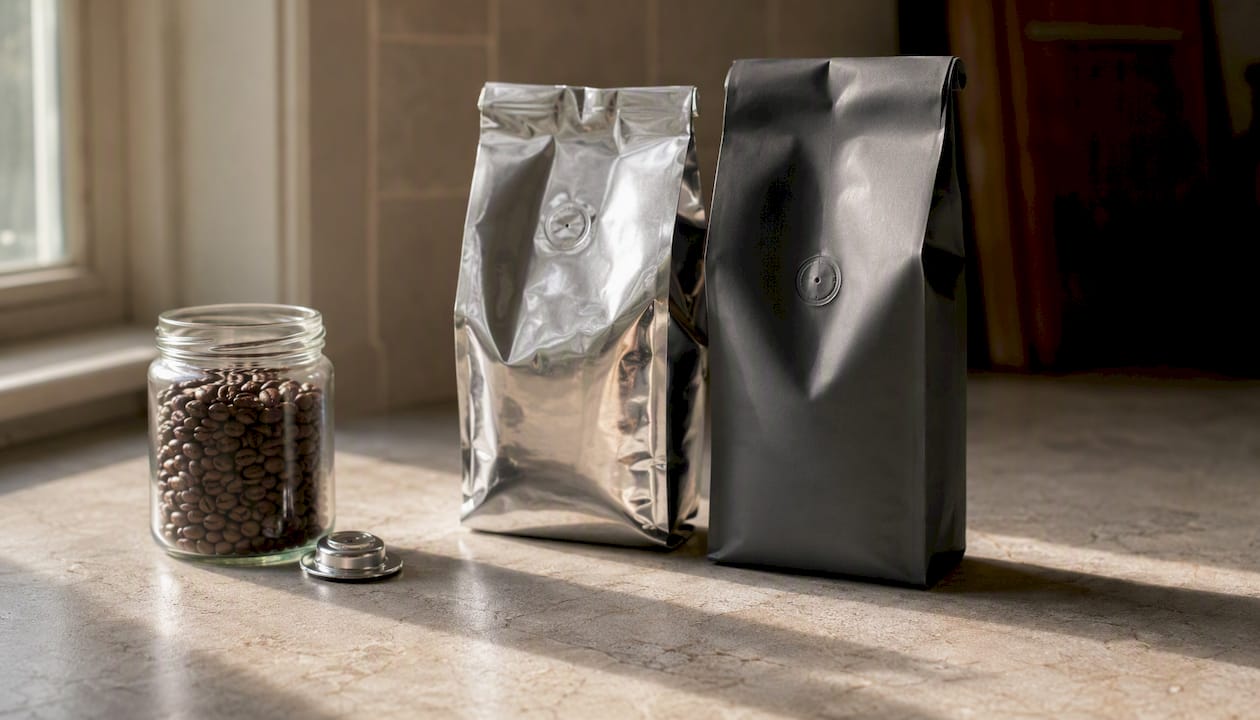
The barrier metrics that matter most for roasted coffee are OTR, WVTR, aroma retention, seal strength, and degassing valve performance. A foil laminate typically delivers OTR values well below 1 cc/m²/day, which is why it has been the default for export and long shelf-life programs. Mono-PE and mono-PP films with functional coatings can achieve competitive barrier performance, but the specific values vary by film grade and coating type. Get the numbers from your supplier and compare them against your target shelf life.
Scenario planning helps here. A local roastery selling through its own café with two-week turnover can often use a lower-barrier recyclable mono-PE pouch without any quality compromise. An export program shipping to retail with a 12-month shelf-life requirement needs higher barrier, and recyclable packaging that integrates with existing recovery systems is usually the more practical choice over compostable for broad distribution, where composting infrastructure cannot be guaranteed.
Pro Tip: Always validate with a filled-sample accelerated shelf-life test using your specific roast, valve configuration, and fill weight before switching bag structures. A lab test on empty bags tells you almost nothing about real-world performance.
What documents should you request to verify recyclability or compostability?
A supplier’s verbal claim or a marketing sheet is not sufficient evidence. Here is the concrete checklist:
- Finished-bag recyclability assessment (How2Recycle or equivalent), covering the complete construction including closures and valve
- Material composition by weight (% PE, % PP, or other polymer) for the full finished bag
- Compostability certificate with standard (ASTM D6400 / D6868 or equivalent), certificate number, certifying body, and scope statement
- Finished-package OTR and WVTR test reports
- Seal-strength and leakage test reports
- Filled-sample shelf-life validation data
Finished-package recyclability assessments should include material percentage by weight, barrier layer details, zipper and valve resin compatibility, ink and adhesive compatibility, and a recommended collection route. A certificate that covers only the base film and excludes closures, inks, or valves does not support a finished-bag recyclability or compostability claim.
Red flags to watch for:
- Supplier claims “recyclable film” without a finished-bag test report
- Certificate numbers are missing or cannot be verified with the certifying body
- Scope statement excludes zippers, valves, or printed layers
- Supplier cannot confirm the recommended collection route for the finished bag
Practical sourcing checklist: samples, printing, lead times, and costs
Moving from specification to production involves a predictable sequence. Here is the stepwise checklist:
- Request a preproduction filled sample with your roast, fill weight, and valve configuration
- Verify finished-bag barrier tests (OTR, WVTR) and recyclability or compostability certificate against your shelf-life target
- Confirm printing method: digital for short runs (faster turnaround, higher unit cost, no plate fees) or rotogravure for larger volumes (lower unit cost, longer setup, plate costs apply)
- Confirm minimum order quantity (MOQ) and whether it aligns with your run size
- Obtain the exact material spec sheet and certificate scope in writing
- Sign off on the filled sample after shelf-life validation
- Schedule production and confirm lead time in writing
Suppliers offering both digital and rotogravure printing can support rapid sample programs and scaled production, with each route carrying different setup costs and lead times. Digital printing suits sample runs and seasonal SKUs; rotogravure becomes economical at higher volumes.
Cost drivers to budget for: film grade and barrier coating type, metallization or functional coating, printing complexity and number of spot colors, zipper and valve components, sample and testing fees, and freight or import duties for overseas suppliers.
Practical timeline estimate:
- Sample request to filled preproduction sample: 2–4 weeks
- Filled shelf-life validation (accelerated): 2–6 weeks depending on test protocol
- Digital production run after sample approval: 2–3 weeks
- Rotogravure production run after plate approval: 4–8 weeks
Pro Tip: Run your sample program and shelf-life test in parallel with the production quote process. You save 2–4 weeks on your overall timeline without adding risk.
What US roasters should know about EPR regulations
Extended Producer Responsibility regulations in the United States can assign reporting and fee obligations to producers for packaging waste, and the policy goal is to incentivize improved packaging design and recyclability. Several states have enacted or are advancing EPR legislation for packaging, and the trend is accelerating.
The practical implication for roasters: packaging that is lighter, mono-material, or certified recyclable may carry lower fee exposure under future EPR programs than multi-layer foil laminates. Documenting your material composition and sales volume by state now positions you to respond quickly when a state program applies to your business.
Short-term compliance steps:
- Obtain material spec sheets and finished-package recyclability or compostability certificates from every packaging supplier
- Track packaging SKU volumes by state of sale
- Evaluate mono-material or certified recyclable alternatives now, before fee schedules are set
- Keep records organized so EPR reporting does not require a retroactive audit of your supply chain
Recommended next steps for sourcing recyclable or compostable foil bags
Start with a filled-sample program. Order samples in the material class you are targeting (mono-PE recyclable, mono-PP recyclable, or certified compostable), fill them with your roast, and run an accelerated shelf-life test before committing to a production run. Prefer mono-polymer recyclable structures for broad US distribution unless you can verify industrial composting access and full-bag certification for your specific market.
Coffeebagsdirect supports this process with sample ordering, express digital printing for short-run validation, and guidance on collecting the certificates and test reports you need. For roasters evaluating sustainable packaging choices across material classes, having a supplier who can provide finished-package documentation alongside the bags themselves reduces the verification workload significantly.
Next steps:
- Request a filled preproduction sample with finished-package recyclability or compostability documentation
- Ask for OTR and WVTR values specific to your shelf-life target
- Compare a digital short-run sample before committing to rotogravure plate costs
- Confirm the recommended collection route is realistic for your customers before printing an end-of-life claim on the bag
Understanding why sustainable packaging choices matter to consumers can also help you communicate your packaging decisions more effectively at retail.
The case for getting the evidence before the bag
The most common mistake roasters make when switching to eco-friendly coffee packaging is accepting a supplier’s material description as proof of recyclability. A film described as “mono-PE” can still fail a finished-bag recyclability assessment if the zipper resin is incompatible, the valve is not PE-based, or the ink system is not approved for the recycling stream. The claim lives on the finished bag, and the evidence must cover the finished bag.
For small local roasters, the practical path is usually a recyclable mono-PE pouch with a store-drop collection route, validated with a filled shelf-life test. For export-focused programs, barrier performance comes first, and the documentation trail for EPR compliance is worth building now rather than under deadline pressure.
Be skeptical of any supplier who cannot provide a finished-bag certificate with a verifiable certificate number. That is the single clearest signal that a sustainability claim is marketing copy rather than verified performance.
Coffeebagsdirect supports your recyclable packaging program
Roasters who need verified recyclable or compostable coffee bags without the guesswork of sourcing documentation from scratch have a direct path with Coffeebagsdirect. The offering covers custom printed coffee bags in compostable, recyclable, kraft, metallic, and foil materials, with express digital printing for short-run sample validation and rotogravure for scaled production. You get material specification guidance, finished-package documentation support, and flexible MOQs that let you test before you commit.
Whether you are specifying a mono-PE recyclable pouch for domestic retail or a certified compostable bag for a take-back program, Coffeebagsdirect can help you match the right construction to your shelf-life target and end-of-life claim. Request samples and a quote directly at Coffeebagsdirect.
Sources
- Understanding Extended Producer (EPR)
- Biodegradable vs Compostable Coffee Bags: What Is the Difference? | MBPAK
- Coffee Packaging Regulations & What You Need To Know - ePac
- Compostable vs recyclable coffee bags: What specialty coffee brands overlook - FernPack