
Are Paper Cups Recyclable in Australia? A Cafe Guide

Standard single-use hot paper cups are not suitable for kerbside recycling in Australia. The plastic (polyethylene) lining bonded to the paperboard prevents most Materials Recovery Facilities (MRFs) from separating and recovering the fiber. Sustainability Victoria confirms that disposable hot cups should not go in the mixed recycling bin, and that even many compostable-labelled cups are not accepted in food and garden organics collections.
Scale of the problem: Australians use approximately 1.5 billion single-use hot beverage cups each year, the vast majority of which end up in landfill.
Your business can act on this today:
- Introduce a reuse discount. Offer a price reduction (e.g., $0.50 off) for customers who bring their own cup. Sustainability Victoria cites this as one of the most effective behavior-change strategies available to cafes.
- Check your local council’s drop-off options. Specialist cup drop-off points exist in Victoria and some other states. Kerbside is not the route; a drop-off network is.
- Contact your packaging supplier. Ask for written evidence of a local end-market for any cup labeled “recyclable” before you pay a premium for that claim.
- Request samples of certified alternatives. Reusable cup programs and verified recyclable coffee cups are available now.
Table of Contents
- Why are paper cups not recyclable through kerbside bins?
- Where can cups actually be recycled in Australia?
- Practical alternatives your cafe or roastery can implement now
- How do you verify “recyclable” and “compostable” claims from suppliers?
- A procurement checklist for switching cups or launching a reuse program
- Key Takeaways
- Why businesses need to lead on cup stewardship, not wait for infrastructure
- Coffeebagsdirect can help you make the switch
- Useful sources and further reading
Why are paper cups not recyclable through kerbside bins?
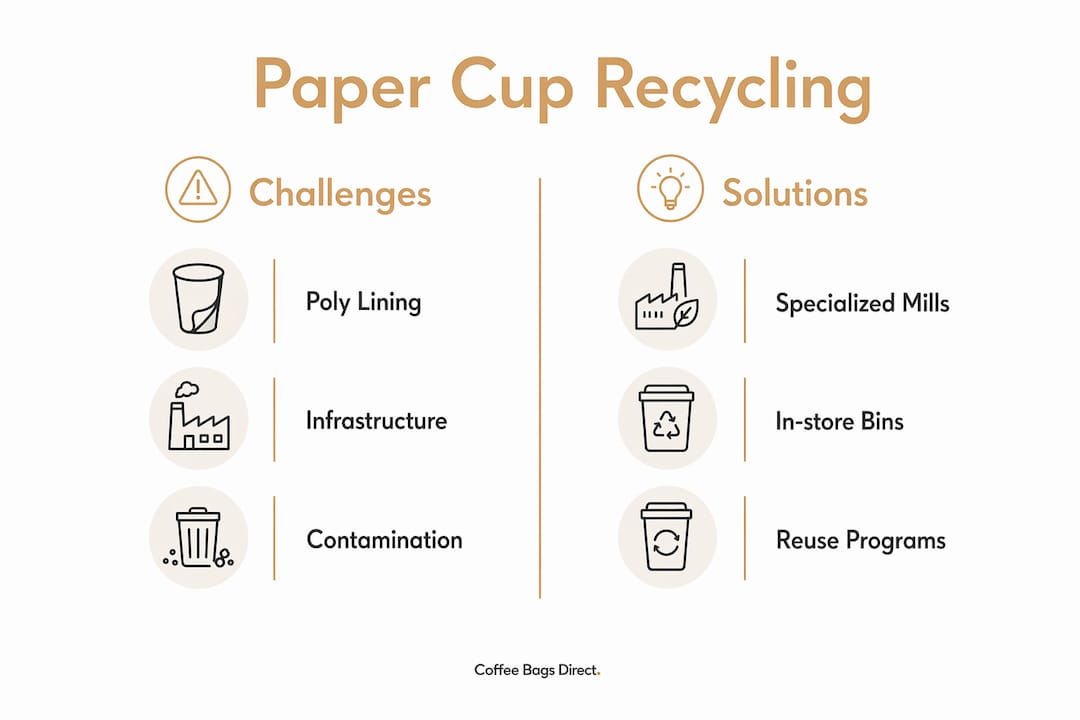
The core issue is construction, not intent. A standard hot paper cup is made from paperboard bonded to a thin polyethylene (PE) coating on the inside. That coating keeps liquid from soaking through, but it also makes the cup structurally different from the plain paper and cardboard your MRF is designed to process.
When a poly-lined cup enters a standard MRF sorting line, the facility cannot reliably separate the PE layer from the fiber. Without a repulping process specifically configured for coated cups, and a downstream buyer willing to purchase the resulting fiber, the cup has no recovery pathway. Most Australian MRFs currently lack both. The cup is either rejected at sorting or contaminates a paper bale, reducing its value and potentially causing the whole bale to be rejected.
Contamination compounds the problem:
- Liquid residue and coffee oils left in cups degrade paper bale quality and can cause mold in storage.
- Lids (typically polystyrene or polypropylene) are a separate material stream and are rarely accepted in standard kerbside collections.
- Compostable-labeled cups require specific thermal and microbial conditions found only in commercial composting facilities. Many Australian commercial composting systems still lack the capacity or acceptance criteria to process them reliably, so a “compostable” cup in a general organics bin often goes to landfill anyway.
The contrast with North America is instructive. More than 40 paper mills now accept poly-coated cups in mixed paper bales across North America, driven by industry programs like the NextGen Consortium and Closed Loop Partners. Australia has not yet built equivalent mill infrastructure or end-market demand at scale, which is why a “recyclable” claim that holds true in parts of the U.S. or Canada does not automatically translate here.
Where can cups actually be recycled in Australia?
Options exist, but they are limited and geographically uneven.
- Specialist drop-off networks. Victoria has the most developed network of cup drop-off recycling points, where cups are collected separately and sent to facilities equipped to handle them. Check Sustainability Victoria’s locator for the nearest point.
- Council pilot programs. A small number of councils in other states have trialed cup collection, but coverage is inconsistent. Confirm with your local council before communicating any recycling claim to customers.
- In-store collection points. Some cafes run their own collection bins that feed into specialist processors. This requires a contracted collection partner, not just a labeled bin.
Availability drops sharply outside metropolitan Victoria. For most cafes in regional areas or other states, a verified drop-off route simply does not exist yet. Sustainability Victoria is clear: avoidance through reuse remains the most reliable sustainability outcome because current Australian municipal infrastructure cannot consistently process poly-lined cups.
Pro Tip: If you set up an in-store drop-off bin, post clear signage specifying that cups must be empty and rinsed. Even one contaminated cup with liquid residue can compromise an entire collection bag, sending the whole batch to landfill. A simple “empty and rinse before dropping” instruction at the bin reduces rejection rates significantly.
Practical alternatives your cafe or roastery can implement now
Ranked by impact and ease of implementation:
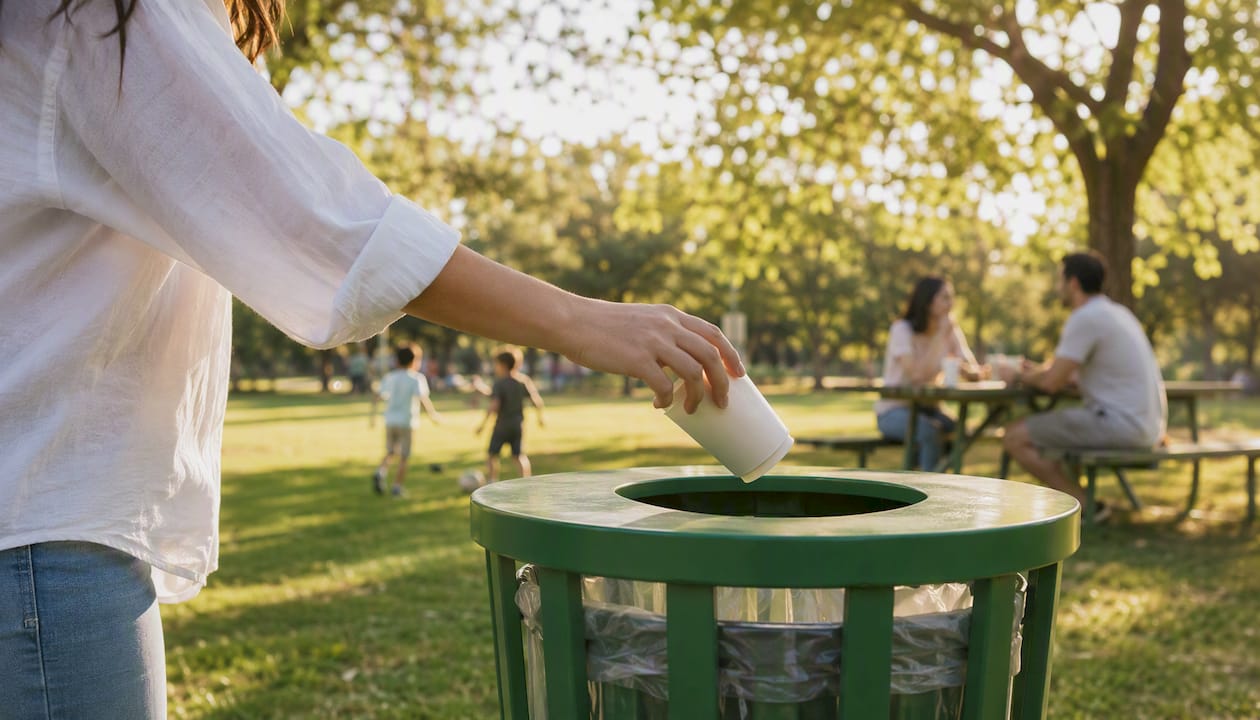
- Reuse incentive programs. A discount for BYO cups is the highest-impact, lowest-cost option. No infrastructure change required. Train staff to apply it consistently and display the discount clearly on your menu board.
- Cup-return and loan schemes. Reusable cup libraries (where customers borrow a cup and return it) are gaining traction in Australian cities. These require a small deposit system and a washing protocol but eliminate single-use cups entirely for dine-in and nearby takeaway.
- Verified recyclable cups with a confirmed local end-market. If a supplier can provide written confirmation that a named Australian MRF or mill accepts their cup format, this is a viable option. Without that confirmation, “recyclable” is a marketing claim, not a recovery guarantee.
- Certified compostable cups, only where industrial composting is accessible. If your business has a contracted commercial composting collection, certified compostable cups can divert waste. Without that collection, they go to landfill. Review commercial composting options in Australia before committing to this route.
Sample 30–90 day pilot checklist for a reuse incentive program:
- Week 1–2: Set discount amount, update POS system, brief all staff.
- Week 3–4: Add signage at the counter and on your menu board.
- Month 2: Track BYO cup rate weekly; set a baseline.
- Month 3: Review uptake, adjust discount if needed, and communicate results to your team.
Pro Tip: Pair your reuse discount with a short customer message: “Bring your cup, save $0.50, skip the landfill.” Customers respond better to a concrete saving and a concrete outcome than to abstract sustainability language.
How do you verify “recyclable” and “compostable” claims from suppliers?
The Australasian Recycling Label (ARL) is the most reliable on-pack signal in Australia. It tells consumers and businesses how to dispose of each component of a package based on actual local recovery infrastructure. APCO administers the ARL program and provides guidance procurement teams can use to cross-check supplier claims.
When a supplier presents a cup as “recyclable” or “compostable,” ask these questions before you buy:
- Which Australian MRF or mill accepts this cup format? Get the facility name in writing.
- Is there a current, active end-market buyer for the recovered fiber? Mill acceptance without a buyer means the material still goes to landfill.
- What certification backs the compostable claim? Look for AS 4736 (industrial compostable) or AS 5810 (home compostable) certification. Confirm your local collection service accepts that standard.
- Does the cup carry the Australasian Recycling Label? If so, what does the label instruct for your state?
- Can the supplier provide repulpability test reports? The Paper Cup Alliance recovery toolkit outlines what evidence mills and MRFs need to pilot cup acceptance.
Businesses should align packaging choices with proven local recovery pathways rather than assuming a label claim results in diversion from landfill. That principle applies to every cup format, including those marketed as next-generation or bio-based.
A procurement checklist for switching cups or launching a reuse program
Use this as a working document for your operations or sustainability lead.
- Define your goal. Reuse program, verified recyclable cups, or certified compostable cups? Each has a different supplier and infrastructure requirement.
- Request samples. Order samples from at least two suppliers before committing to a minimum order quantity (MOQ).
- Verify end-market evidence. Ask for written confirmation of local mill or MRF acceptance, or a named composting facility that accepts the format.
- Check certification documentation. Request ARL approval, AS 4736/AS 5810 certificates, or APCO compliance records as applicable.
- Confirm MOQ and lead times. Express digital printing options (available through suppliers like Coffeebagsdirect) can reduce lead times for custom-printed cups significantly.
- Plan staff training and signage. Budget one to two hours for a team briefing and allow two weeks for signage production.
- Set a pilot timeline. Run a 30–60 day pilot before a full rollout. Track waste diversion, customer feedback, and cost per cup.
Key supplier questions to negotiate:
- What is the minimum order for custom-printed cups?
- What is the return or credit policy if certification lapses?
- Can you provide updated ARL or APCO compliance documentation on request?
- What are the lead times for reorders during peak season?
For roasters thinking about their full packaging footprint beyond takeaway cups, the ground coffee bags guide covers procurement considerations for flexible packaging with similar rigor.
Key Takeaways
Standard single-use hot paper cups are not kerbside-recyclable in Australia, and the most reliable business response is to prioritize reuse incentives and verify any supplier recycling claim against a named local end-market.
| Point | Details |
|---|---|
| Kerbside recycling verdict | Standard poly-lined hot cups are not accepted in Australian kerbside recycling bins. |
| Scale of the issue | Australia uses approximately 1.5 billion single-use hot cups per year, most going to landfill. |
| Best immediate action | Introduce a BYO cup discount; it is the highest-impact, lowest-cost option available to cafes now. |
| Verify before you buy | Always request written end-market evidence before paying a premium for a “recyclable” cup claim. |
| Coffeebagsdirect support | Coffeebagsdirect offers custom-printed cups, APCO-aligned packaging guidance, and sample orders to help you switch. |
Why businesses need to lead on cup stewardship, not wait for infrastructure
The honest reality is that Australian recycling infrastructure for poly-lined cups has not caught up to the marketing language on the cups themselves. Cafes and roasters are caught in the middle: customers see “recyclable” on a cup and assume the bin does the work, while the cup ends up in landfill regardless. That gap is not going to close through consumer behavior alone.
Businesses that act now, by building reuse incentives into their pricing, verifying supplier claims through APCO guidance and the Australasian Recycling Label, and choosing packaging backed by real local recovery pathways, are the ones that will be ahead when regulatory requirements tighten. Australia’s packaging policy environment is moving toward extended producer responsibility, and the businesses with documented, verified sustainability practices will be better positioned than those relying on unverified label claims.
Coffeebagsdirect’s partnership with APCO is part of that commitment. The company’s sustainability resources for Australian roasters are built around the same principle: help businesses make decisions grounded in what actually works in the Australian market, not what sounds good on a supplier spec sheet. If you want to understand the difference between a recyclable claim that holds up and one that does not, that is the right place to start.
Coffeebagsdirect can help you make the switch
Switching from standard single-use cups to a verified, sustainable alternative is a procurement decision, not just a values statement. Coffeebagsdirect makes that decision easier with custom-printed cups, compostable and recyclable packaging options, and direct advisory support on certifications and local compliance.
Whether you need a small sample run to test a new cup format, custom branding with express digital printing, or guidance on which coffee packaging materials carry genuine APCO-aligned credentials, the team at Coffeebagsdirect can walk you through the options. You get material selection support, clear lead times, and packaging that reflects your brand and your sustainability commitments accurately. Request your samples or get a quote directly at coffeebagsdirect.com.au.
Useful sources and further reading
- Sustainability Victoria: Disposable coffee cups — Australian data on cup volumes, kerbside guidance, drop-off locator, and reuse recommendations.
- APCO and Australasian Recycling Label — Guidance on interpreting on-pack claims and verifying supplier compliance in the Australian context; Coffeebagsdirect’s APCO partnership page.
- Paper Cup Alliance / FPI Recovery Toolkit — Industry toolkit covering how MRFs and mills can pilot cup acceptance; useful for supplier conversations.
- Closed Loop Partners: Paper cup recycling milestone — North American mill acceptance data; context for understanding why Australian recovery lags.
- Recyclable vs. compostable packaging guide — Coffeebagsdirect’s explainer on how to interpret and verify packaging claims in Australia.
- Recyclable coffee packaging guide — External industry perspective on materials verification and what “recyclable” means in practice for coffee businesses.
- Sustainability in food services: operator guide — Practical operator guidance on reuse programs and behavior-change strategies for food service businesses.