
Home Compostable Certification for Australian Manufacturers

AS 5810 home compostable certification confirms that a finished product will disintegrate and biodegrade in a typical Australian home composting environment, verified through independent testing. To begin compliance, arrange testing through a NATA/ISO 17025-accredited laboratory and apply to the Australasian Bioplastics Association (ABA) for the Home Compostable Verification Programme and licence to use the official logo.
What this means for manufacturers in practice:
- Your finished product, including all inks, adhesives, and labels, must pass testing, not just the base material or resin.
- Certification grants a licence to display the ABA Home Compostable logo on packaging.
- Local council acceptance of certified items in kerbside organics bins is a separate question from certification itself.
- State-level labelling rules (notably in South Australia) affect whether your certified product qualifies for regulatory exemptions.
Pro Tip: Start by confirming whether your material supplier already holds an ABA verification. If they do, you may qualify for sublicensing rather than full independent testing, which can significantly reduce your time and cost to market.
Key Takeaways
AS 5810 home compostable certification requires independent testing of the finished product through a NATA/ISO 17025-accredited lab and ABA verification before any Home Compostable logo or claim can be used in Australia.
| Point | Details |
|---|---|
| Test the finished product | Inks, adhesives, and coatings must be included in testing, not just the base resin or film. |
| AS 5810 vs AS 4736 | AS 5810 covers home composting; AS 4736 covers industrial composting. They are not interchangeable. |
| Disintegration and biodegradation targets | AS 5810 requires disintegration within 180 days and substantial biodegradation within 12 months. |
| State labelling deadlines | South Australia requires clear labelling for certified barrier bags (from September 2024) and food containers (from March 2026) to qualify for exemptions. |
| Coffeebagsdirect | Supplies compostable packaging with certification-compatible materials and print methods for roasters and food brands pursuing AS 5810 verification. |
Table of Contents
- 1. What AS 5810 covers and how it differs from industrial composting (AS 4736)
- 2. How the ABA Home Compostable Verification Programme works
- 3. AS 5810 testing criteria and lab accreditation requirements
- 4. Step-by-step application process, timeline, and indicative costs
- 5. Practical preparation to improve your chances of passing AS 5810
- 6. Label use, trademark terms, and recent regulatory requirements
- 7. Where certified home-compostable products actually belong at end-of-life
- 8. Common mistakes, greenwashing risks, and red flags certifiers watch for
- 9. Why AS 5810 verification is worth prioritizing now
- Coffeebagsdirect supports test-ready, certified packaging for roasters and food brands
- Sources
1. What AS 5810 covers and how it differs from industrial composting (AS 4736)
AS 5810-2010 is the Standards Australia publication that sets out test procedures and performance requirements for plastics intended to biodegrade under home composting conditions. Home composting operates at ambient temperatures, typically between 20°C and 30°C, with variable moisture and aeration depending on how well the bin is managed. That is a fundamentally different environment from industrial composting, which runs at sustained thermophilic temperatures above 55°C.
AS 4736 is the industrial or commercial compostability standard. Products certified to AS 4736 carry the ABA Seedling Logo and are designed for commercial composting facilities, not home bins. A product that passes AS 4736 testing cannot automatically claim home compostability, because the lower temperatures in a home bin may not drive the same breakdown rate.
The key performance endpoints under AS 5810 include:
- Disintegration: the material must physically fragment within a few months under home composting test conditions.
- Biodegradation: substantial biodegradation must be achieved within about one year.
- Ecotoxicity: the resulting compost must show no toxic effects on plants or earthworms.
- Restricted substances: heavy metals and other hazardous substances must fall within defined limits.
- Organic fraction: where applicable, the material must meet a minimum organic content threshold.
Meeting an international equivalent such as EN 13432 or ASTM D6400 alone is not sufficient for Australian claims. Without ABA verification against AS 5810, you cannot legally use the Home Compostable logo or make compliant home compostability claims in Australia.
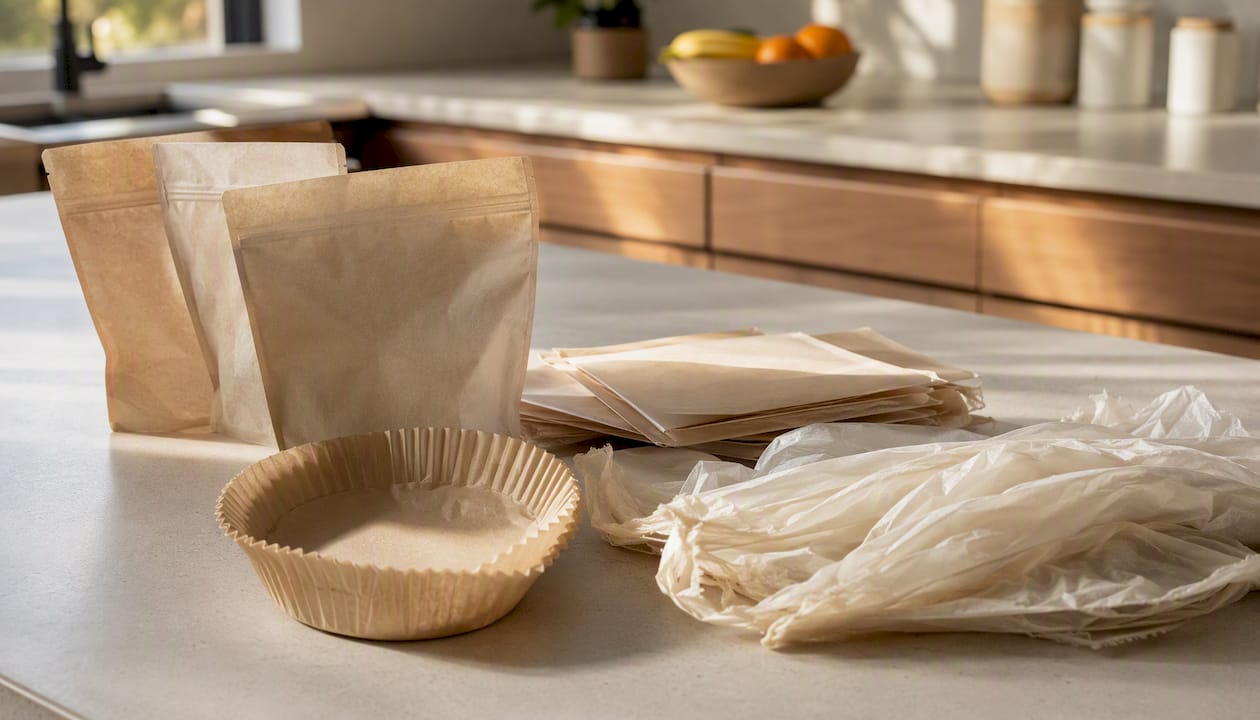
Typical product categories that pursue AS 5810 certification include compostable bin liners, foodservice packaging (cups, lids, trays), coffee capsules, produce bags, and flexible pouches intended for home compost disposal.
2. How the ABA Home Compostable Verification Programme works
The ABA manages the Home Compostable Verification Programme as a third-party confirmation that a finished product meets AS 5810. A successful applicant receives a licence to display the official Home Compostable logo, which is a recognized mark in Australia and New Zealand. The ABA also manages the Commercial Compostable Verification Programme under AS 4736, so the two programmes run in parallel but serve different end-of-life pathways.
The licence is a formal trademark and licence agreement. Only products that have completed verification and hold a current licence may display the logo. Displaying the logo without a valid licence is a trademark violation and exposes your business to regulatory and legal risk.
Sublicensing is available when a material supplier already holds ABA verification for the base material or product format. In that case, a downstream manufacturer can apply for a sublicence rather than commissioning entirely new testing, provided the finished product is sufficiently equivalent to the verified item. The ABA also checks for non-intentionally added PFAS and restricted substances as part of the verification process.
The process flow at a glance:
- Check first: confirm whether your material supplier holds an existing ABA verification or sublicence that covers your finished product format.
- Commission testing: if no sublicence applies, arrange testing through a NATA/ISO 17025-accredited laboratory.
- Submit application: compile lab reports, product specifications, and the ABA application form with applicable fees.
- Licence issuance: once the ABA reviews and approves the submission, a licence and logo use rights are granted.
3. AS 5810 testing criteria and lab accreditation requirements
The test programme under AS 5810 covers four principal areas, each with defined thresholds that a product must meet before the ABA will issue a licence.
| Test Area | What Is Measured | Typical Threshold / Timeframe |
|---|---|---|
| Disintegration | Physical fragmentation of the material | Within 180 days under home composting conditions |
| Biodegradation | Carbon conversion to CO₂ relative to reference material | Substantial biodegradation within about one year |
| Ecotoxicity | Effect of resulting compost on plant germination and earthworm survival | No significant toxic effect compared to control |
| Restricted substances | Heavy metals, PFAS, and hazardous chemical limits | Must not exceed AS 5810 / regulatory thresholds |
Disintegration and biodegradation figures above are sourced from Compostable Alternatives’ 2025 update on Australian certifications.
Beyond these four areas, finished-product testing must include all components: inks, adhesives, coatings, labels, and any barrier layers. Testing only the raw resin or base film is not adequate for ABA verification. The ABA’s programme requirements are explicit on this point, and it is one of the most common reasons applications stall.
Labs must hold NATA accreditation or demonstrate ISO 17025 capability. NATA accreditation is Australia’s national standard for laboratory competence and is directly recognized by the ABA. Providers such as Intertek operate ISO 17025-accredited testing programmes for compostable materials and can produce the structured test reports the ABA requires.
Why lab accreditation matters: An ISO 17025/NATA-accredited report carries independent assurance that the test methods, equipment calibration, and result interpretation meet a defined quality standard. Customers, retailers, and regulators can verify the report’s credibility in a way they simply cannot with an in-house or non-accredited test.
4. Step-by-step application process, timeline, and indicative costs
Getting from product concept to a licensed Home Compostable claim involves several sequential stages. Skipping or rushing any one of them typically results in delays or a failed application.
- Define your product scope. Identify every SKU, format, and component (including inks, adhesives, and labels) that will carry the Home Compostable claim.
- Check for existing verification. Contact your material supplier and the ABA to confirm whether a sublicence pathway is available.
- Prepare finished samples. Produce samples that are representative of commercial production, fully printed and assembled, with documented batch traceability.
- Select a NATA/ISO 17025-accredited lab. Obtain quotes from accredited providers and confirm their specific experience with AS 5810 testing.
- Run the full test programme. Submit samples for disintegration, biodegradation, ecotoxicity, and chemical contaminant screening.
- Collect and review lab reports. Confirm all endpoints are met before proceeding to the ABA application.
- Submit the ABA application. Complete the ABA application form, attach lab reports and product documentation, and pay the applicable fees.
- Receive licence and logo use rights. Once the ABA approves the submission, you receive a formal licence and can begin using the logo under the trademark agreement.
Timelines: Laboratory testing for AS 5810 is inherently time-intensive. Biodegradation testing alone runs for months under controlled conditions. Providers like Intertek note that testing and reporting typically takes several months, with certification issuance following receipt of final results. Budget a realistic total timeline of six to twelve months from sample submission to licence, depending on lab queue times and whether any retesting is required.
Indicative costs: Testing costs vary by lab, product complexity, and the number of components requiring individual assessment. ABA application and licence fees are separate from lab fees. Treat all cost estimates as indicative and obtain direct quotes from your chosen lab and from the ABA before committing to a project timeline.
For sublicensing, you will need written confirmation from the material supplier of their existing ABA verification, a declaration of material equivalence, and documentation showing your finished product does not introduce any new components that fall outside the verified scope.
5. Practical preparation to improve your chances of passing AS 5810
The single most common reason an AS 5810 application fails or stalls is testing the base material rather than the finished, assembled product. Inks, adhesives, barrier coatings, and labels all contribute to the compostability profile of the final item. A film that passes on its own may fail once a solvent-based adhesive or a fluorinated barrier coating is included.
Before you send samples to a lab, work through this pre-test checklist:
- Composition statement: document every material, coating, ink, and adhesive by weight percentage and supplier.
- Supplier declarations: obtain written PFAS-free and restricted-substance declarations from every component supplier.
- Processing conditions: record extrusion temperatures, lamination methods, and any post-processing treatments that could affect material structure.
- Sample preparation: produce samples under commercial production conditions, not lab-scale prototypes, to reflect real-world performance.
- Batch traceability: label and document every sample batch so results can be tied back to a specific production run.
Common failure causes include fluorinated barrier layers (PFAS), multi-material laminates where one layer does not biodegrade at the required rate, incompatible adhesives, and UV-cured inks with high heavy-metal content. Identifying and resolving these before testing saves both time and retesting costs.
Pro Tip: If your product uses a material that a supplier has already verified under AS 5810, request their test data and ask the ABA whether material equivalence applies to your specific construction. This can reduce the scope of testing you need to commission independently.
Maintaining clear documentation throughout development also positions you well for sublicensing if you later supply the material to other manufacturers.
6. Label use, trademark terms, and recent regulatory requirements
Using the ABA Home Compostable logo requires a current licence and compliance with the ABA’s trademark agreement. The logo must appear on the product or its primary packaging, be legible at the size printed, and must not be altered or combined with other marks in a way that misrepresents its meaning. Where a product has both a base and a lid, both components typically require labelling.
State-level regulation is now actively shaping which certified products qualify for exemptions from single-use plastic bans. South Australia’s labelling requirements for certified compostable items set two key deadlines:
- From 1 September 2024, barrier bags and shopping bags certified to AS 5810 or AS 4736 must be clearly labelled to qualify for exemptions.
- From 1 March 2026, certain food and beverage containers and their lids must be clearly labelled to qualify for exemptions.
If your product is sold in South Australia and relies on certification to be exempt from the state’s single-use plastics rules, labelling is not optional. Missing the label means losing the exemption, regardless of whether the product is genuinely certified.
A practical labelling checklist:
- Place the ABA Home Compostable logo on the primary packaging surface, not only on outer cartons.
- Confirm the logo meets minimum size and legibility requirements specified in the ABA licence agreement.
- Label both bases and lids separately where the product is a two-part item.
- Include a brief disposal instruction (e.g., “suitable for home composting”) alongside the logo.
- Review your label artwork against the ABA’s current logo use guidelines before going to print.
The ACCC advises businesses to ensure compostability claims are independently verified and clearly communicated to consumers. Vague or unverified claims such as “eco-friendly” or “biodegradable” without certification evidence are likely to be treated as misleading under Australian Consumer Law. The ACCC’s guide on environmental claims is the primary reference for structuring compliant claim language.
7. Where certified home-compostable products actually belong at end-of-life
AS 5810 certification confirms suitability for home composting under controlled test conditions. In practice, real home compost bins vary widely in temperature, moisture, and aeration, and a poorly managed bin may not achieve the same breakdown rate as a laboratory test. The City of Greater Geelong’s guidance on compostable labelling recommends that consumers test a small piece of a certified product in their own bin if the system is not well managed.
For manufacturers, this means consumer instructions matter as much as the certification itself. Disposal pathways to communicate clearly:
- Home compost bin: the primary intended pathway for AS 5810-certified items. Suitable for well-managed bins with adequate moisture, aeration, and organic material.
- FOGO/green-lidded kerbside organics bin: many councils accept AS 5810-certified items in their food organics and garden organics (FOGO) collection, but acceptance is not universal. EPA NSW research on FOGO confirms that organics collection systems differ significantly by region.
- Commercial composting: AS 5810-certified products will generally also meet AS 4736 conditions, but confirm with the facility operator before directing consumers to this pathway.
- General waste: the fallback if no composting pathway is available locally, though this defeats the environmental purpose of certification.
Always confirm kerbside acceptance with the relevant local council or processor before printing disposal instructions on packaging. What is accepted in one council area may be rejected in another, and incorrect instructions create contamination problems for processors. For a broader view of how compostable packaging interacts with Australian collection systems, the guide to recyclable and compostable packaging covers the key distinctions.
8. Common mistakes, greenwashing risks, and red flags certifiers watch for
The most damaging mistake a manufacturer can make is printing “home compostable” on packaging without a current ABA licence. Under Australian Consumer Law, an unverified compostability claim is a misleading representation, and the ACCC has signalled that environmental claims are a priority enforcement area. Independent verification through the ABA is the primary defense against a greenwashing challenge.
Common pitfalls to avoid:
- Claiming compostability without ABA verification. Even if your material supplier holds a certificate, that does not automatically extend to your finished product.
- Testing only raw resin or film. The finished item, including all inks, adhesives, and coatings, must be tested.
- Hidden PFAS or fluorinated chemistries. These are increasingly screened for and will cause a failed application. Obtain supplier declarations before testing.
- Incompatible multi-material laminates. A structure that combines a compostable film with a non-compostable barrier layer will not pass AS 5810 as a whole.
- Unclear or missing labelling. Certification without compliant label placement does not satisfy state regulatory requirements.
Red flags that certifiers and auditors look for:
- Missing or incomplete supplier declarations for restricted substances.
- No finished-product test data, only raw material certificates.
- Inconsistent batch records that make it impossible to confirm the tested product matches what is being sold.
- Logo use on products not covered by the current licence scope.
If your application is rejected or testing reveals a failure, the remediation path is straightforward: identify the failing component, reformulate or substitute it, and retest the revised finished product. Attempting to resubmit without addressing the root cause wastes both time and testing budget.
9. Why AS 5810 verification is worth prioritizing now
The business case for pursuing AS 5810 verification has strengthened considerably as state-level regulation tightens and retail procurement standards evolve. South Australia’s labelling deadlines are already in effect for barrier bags, and the March 2026 deadline for food containers is approaching. Businesses that hold current ABA verification and compliant labelling are positioned to retain shelf placement and procurement eligibility that unverified competitors will lose.
From a market trust perspective, the ABA Home Compostable logo is the only mark that Australian councils, retailers, and consumers can verify against a local standard. International marks like TÜV AUSTRIA’s OK compost HOME exist, but businesses selling in Australia should rely on ABA verification to meet local regulator and council expectations. A logo that a procurement officer or council waste manager cannot verify against an Australian standard carries less weight in a tender or listing decision.
The ACCC’s active focus on greenwashing enforcement means the cost of an unverified claim is no longer just reputational. Businesses that invest in AS 5810 verification and compliant labelling reduce their exposure to enforcement action, consumer complaints, and the cost of relabelling or product withdrawal.
For packaging designers and brand owners, verification also simplifies consumer communication. A certified product with a recognized logo and a clear disposal instruction requires no further explanation. That clarity reduces contamination in organics streams and builds the kind of consumer trust that supports repeat purchase.
Coffeebagsdirect supports test-ready, certified packaging for roasters and food brands
Getting your packaging to the point where it can pass AS 5810 testing requires more than the right material. The inks, adhesives, and print methods you choose directly affect whether your finished product meets the standard, and sourcing those components from a supplier who understands the requirements saves significant time.
Coffeebagsdirect supplies compostable flexible packaging for coffee roasters and food brands, with material options and print methods selected to support certification pathways. From custom printed coffee bags produced with certification-compatible inks to label-ready artwork that meets ABA logo placement and legibility requirements, the team can help you produce test-ready samples and commercially compliant packaging in one place. Request samples or get a quote at Coffeebagsdirect to start with materials that are already aligned to your certification goals.
Sources
These are the authoritative sources you will need to execute the AS 5810 verification process:
- Guide to labelling requirements for certified compostable items
- Commercial Compostable Verification Programme
- Making environmental claims — a guide for business (ACCC)
Recommended
- Recyclable and Compostable Packaging: Australia Guide – Coffee Bags Direct
- Commercial Composting in Australia: A Business Guide – Coffee Bags Direct
- Eco-Friendly Packaging Alternatives for Australian Businesses – Coffee Bags Direct
- Sustainability in Coffee Packaging: An Australian Guide – Coffee Bags Direct