
Sustainability in Coffee Packaging: An Australian Guide

What sustainability in coffee packaging actually means for your business
Sustainability in coffee starts with one practical decision: what wraps your product and where that material ends up. For Australian roasters and cafés, this means choosing packaging certified against real standards, not just labeled with a leaf-icon.
Two Australian Standards define genuine compostability. AS 4736 covers industrial composting, requiring biodegradation within about six months at industrial composting temperatures around 55–60°C. AS 5810 covers home composting at ambient temperatures of 20–30°C over the same period. Both are verified by the Australasian Bioplastics Association (ABA), whose Seedling Logo and Home Compostable logo are the trusted marks to look for on packaging.
Beyond materials, the Global Coffee Platform’s RegenCoffee framework pushes further, emphasizing soil restoration, water conservation, and biodiversity as active outcomes rather than baseline compliance. It’s a useful lens for roasters thinking past the bag itself.
Practical steps to get started:
- Partner with verified local suppliers offering ABA-certified compostable or recyclable options
- Match your packaging standard (AS 4736 vs. AS 5810) to your actual local waste infrastructure
- Display certification logos clearly on every bag or cup
- Train staff to explain disposal pathways to customers
- Audit your current packaging against APCO guidelines annually
Australian standards, certifications, and what packaging materials actually do
Certification is the floor, not the ceiling. A product carrying the ABA Seedling Logo meets AS 4736, meaning it composts in a commercial facility. One carrying the Home Compostable logo meets AS 5810 and can break down in a backyard bin or FOGO stream. The distinction matters because AS 4736-certified cups fail at home composting temperatures, and most Australian councils do not accept bioplastic packaging in their FOGO bins regardless of certification.
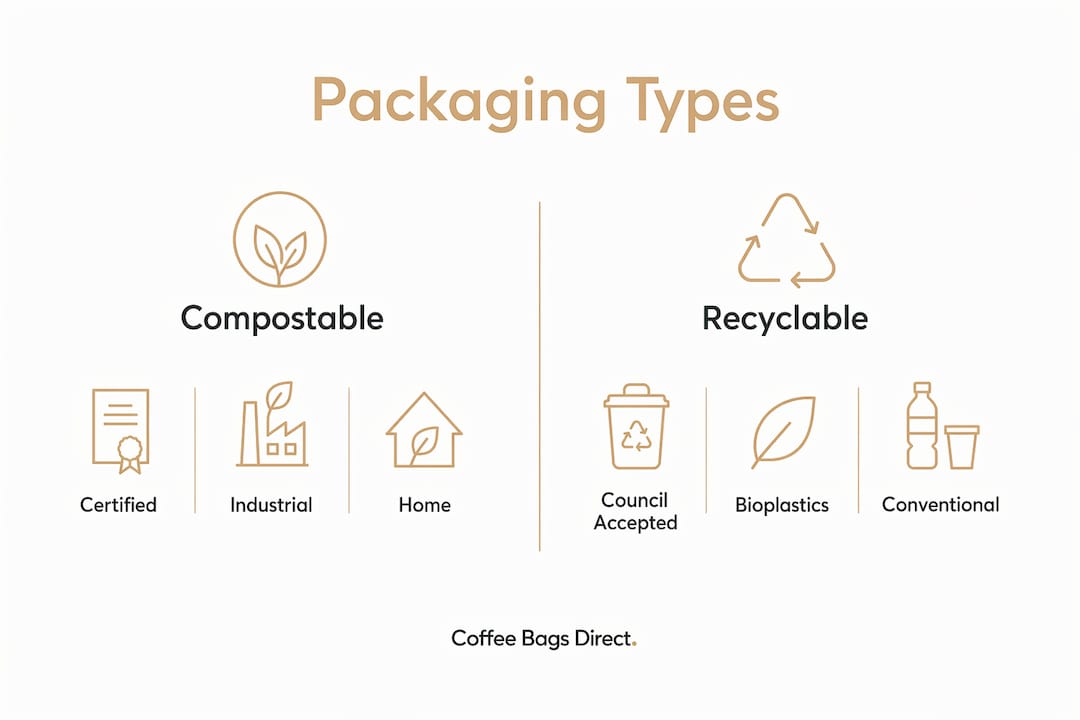
South Australia’s regulations, effective March 1, 2026, require individual food and beverage containers to be clearly labeled as certified compostable to qualify for exemption from prohibited plastic product status. Generic “compostable” claims without referencing AS 4736 or AS 5810 are non-compliant.
| Material | Compostable | Recyclable | Required infrastructure |
|---|---|---|---|
| PLA-lined paper cups | AS 4736 (industrial) | No | Commercial FOGO facility |
| Kraft paper bags | No | Yes (most councils) | Yellow recycling bin |
| Compostable bioplastic bags | AS 4736 or AS 5810 | No | FOGO or home compost |
| Foil/metallic bags | No | No (mixed materials) | General waste |
| Aqueous-coated cups | No | Yes (ARL labeled) | Yellow recycling bin |
Credible certifications and best practices:
- ABA Seedling Logo (AS 4736) for commercial composting claims
- ABA Home Compostable Logo (AS 5810) for home or FOGO disposal
- Australasian Recycling Label (ARL) for recyclable materials
- APCO membership as a signal of ongoing compliance commitment
- Clear on-pack disposal instructions, not just logos
For a deeper breakdown of compostable vs. recyclable options specific to Australian roasters, Coffeebagsdirect covers the certification gaps worth knowing before you order.
How The Sustainable Coffee Company approaches packaging in practice
The Sustainable Coffee Company, based in Australia, offers a working example of certified sustainable packaging applied at the product level. Their compostable pod capsules and coffee bags position sustainability as a core brand promise, not an afterthought. Compostable pod capsules are priced at $11.95 for 10 capsules, with 1kg coffee bean bags ranging from $54 to $59, reflecting the real cost of sourcing and packaging responsibly.
What sets this model apart is specificity. Rather than vague environmental claims, the business commits to compostable materials across its product range, giving cafes and roasters a concrete benchmark for what genuine commitment looks like at the retail level.
How to select eco-friendly packaging that works in your area
The most common mistake is choosing packaging based on its label rather than your local waste stream. Roasters and cafes should prioritize packaging compatible with local recycling infrastructure over compostable materials that will realistically end up in landfill due to collection gaps.
Start by checking whether your council accepts bioplastics in its FOGO program. If not, aqueous-coated recyclable cups with ARL marking are a lower-risk, more honest choice for most venues. Reserve AS 4736 compostable options for product lines where your customers have a realistic composting pathway. For ethical coffee sourcing decisions that extend beyond packaging, the same principle applies: specificity beats aspiration every time.
Pro Tip: Ask every packaging supplier for the actual ABA certificate number, not just a logo. A supplier who can’t produce documentation is selling a claim, not a verified product.
Verified Australian suppliers for eco-friendly coffee packaging
Coffeebagsdirect is an APCO-partnered supplier offering compostable, recyclable, kraft, metallic, and foil coffee packaging options with custom printing via digital and rotogravure methods. Their express digital printing suits roasters needing fast turnaround on small runs, while bulk orders scale for established cafe groups. Certification guidance and material selection support are part of the service, which matters when you’re navigating AS 4736 vs. AS 5810 decisions for the first time.
The Sustainable Coffee Company demonstrates that compostable packaging at the consumer product level is commercially viable in Australia, providing a useful reference point when briefing your own supplier.
How packaging choices affect your carbon footprint
Foil and mixed-material bags offer excellent barrier properties for coffee freshness but generate no end-of-life benefit. They go to landfill. Kraft paper bags are recyclable in most Australian yellow bins but offer lower moisture and oxygen barriers without additional lining. Compostable bioplastics, when they reach a commercial FOGO facility, convert to organic matter rather than persisting as microplastics.
The carbon calculation isn’t just about disposal. Production energy, transport distance, and material weight all factor in. Lighter packaging generally means lower transport emissions per unit. Choosing a local Australian supplier over an offshore one reduces freight-related carbon, and it keeps your supply chain traceable, which matters for coffee supply chain sustainability reporting.
How to communicate your packaging choices without greenwashing
Vague claims create legal and reputational risk. The Australian Competition and Consumer Commission (ACCC) treats unsupported environmental claims as potential greenwashing, and “our packaging is eco-friendly” without specifics is exactly the kind of statement that draws scrutiny.
Specific language works better and builds more trust. “Our bags are AS 5810 home compostable, certified by the ABA” tells a customer exactly what to do with the bag. Pair that with a reusable cup discount, which is the single highest-impact action most cafes can take, and your sustainability story becomes verifiable rather than aspirational. Staff training on disposal pathways turns your packaging choice into a genuine customer education moment.
Coffeebagsdirect works with Australian roasters and cafes to match certified packaging to your actual operational reality. Whether you need custom printed bags with ABA-certified compostable materials or recyclable kraft options with ARL labeling, the team can guide your selection based on your local waste infrastructure.
Key Takeaways
Certified packaging that matches your local waste infrastructure is the single most effective sustainability decision an Australian coffee business can make.
| Point | Details |
|---|---|
| Match standard to infrastructure | AS 4736 suits venues with FOGO access; AS 5810 works for home compost or general FOGO claims. |
| ABA certification is the benchmark | Only ABA-verified logos confirm genuine compostability under Australian standards. |
| South Australia’s 2026 mandate | From March 1, 2026, individual food and beverage containers must be clearly labeled as certified compostable to be exempt from prohibited plastic status. |
| Recyclable often outperforms compostable | Aqueous-coated cups with ARL labeling reach more end-of-life infrastructure than AS 4736 bags in most Australian states. |
| Specificity prevents greenwashing | Named certifications, disposal instructions, and ABA certificate numbers protect your brand from ACCC scrutiny. |