
Commercial Composting in Australia: A Business Guide

What is commercial composting, and who provides it in Australia?
Commercial composting is the large-scale, controlled process of converting organic waste into nutrient-rich compost through accelerated biological decomposition. Unlike backyard composting, it handles high volumes of food scraps, garden organics, and compostable materials under precisely managed conditions of temperature, moisture, and aeration. The output is a consistent, saleable product used in agriculture, horticulture, and landscaping.
For Australian businesses, engaging with industrial composting means partnering with specialized facilities or deploying on-site systems that meet Australian standards and divert organic waste from landfill. Here are the main verified providers serving Australian organizations:
- Direct Compost Solutions — eco-friendly, Australian-made compost bins and starter kits for household and small-scale use, with products offered at a range of prices
- REMONDIS Lake Macquarie Organics Resource Recovery Facility — full-service waste management and organics recycling for commercial, council, and industrial clients
- Compost Community — council-subsidized compost systems with strong educational programs for community groups and businesses
- Compost Master — localized commercial composting services focused on dependable organic waste management
- Western Composting Technology — specialists in in-vessel, windrow, and aerated static pile composting for local government and commercial contracts
- Biobowser Technologies Pty Ltd — automated on-site composting systems using microbial technology for institutions including schools, hospitals, and restaurants
Australian businesses are also guided by the Australian Packaging Covenant Organisation (APCO) and comply with standards like AS4454 when producing or using commercial compost.
How do commercial composting methods work at industrial scale?
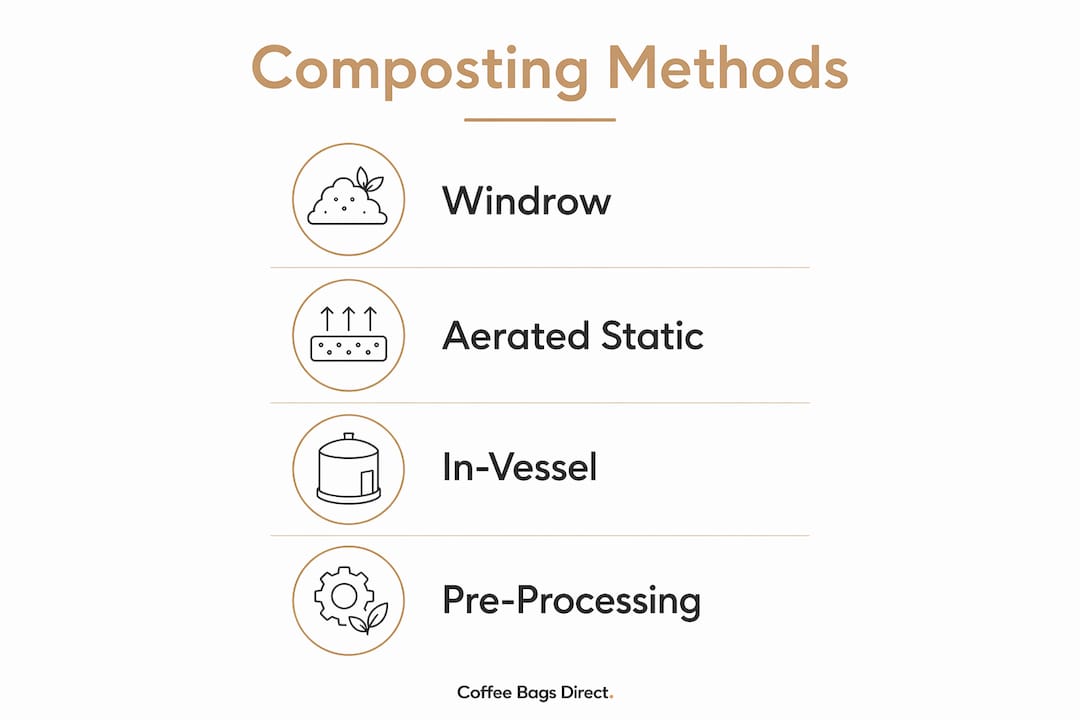
Three primary methods drive large-scale composting in Australia, each suited to different volumes, site constraints, and output requirements.
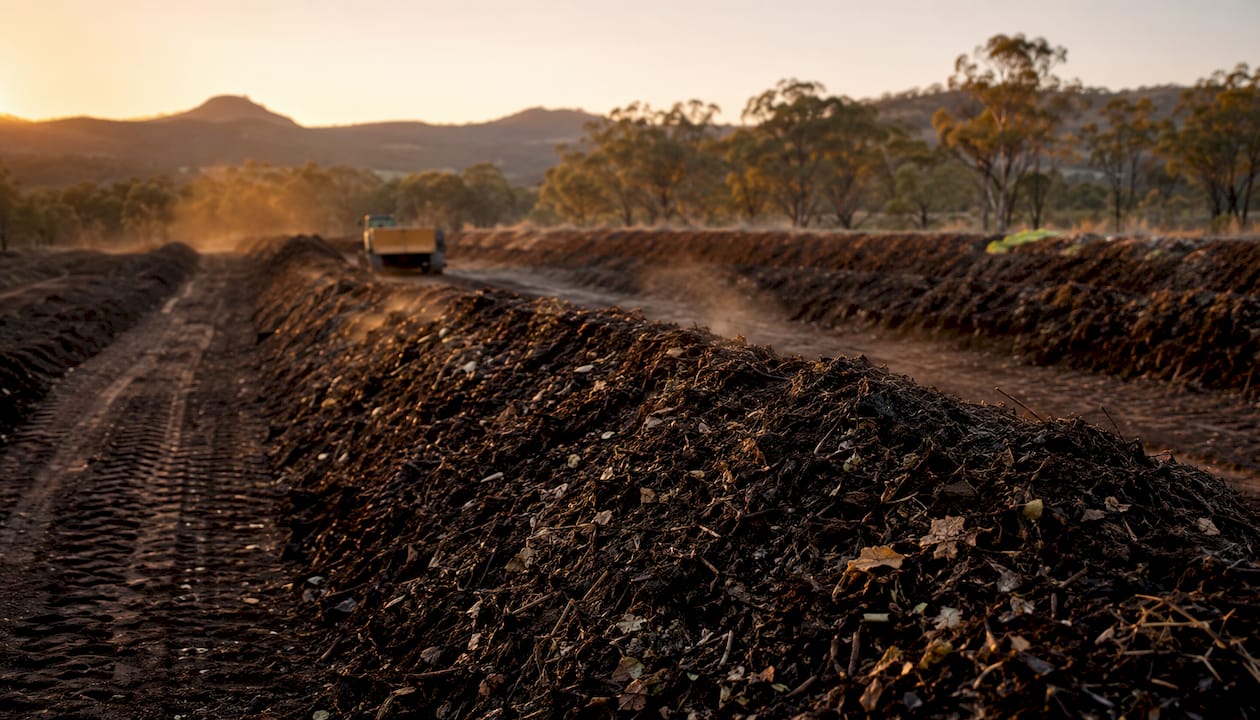
Windrow composting arranges organic material in long rows that are turned regularly to introduce oxygen, manage moisture, and redistribute heat. It suits high-volume operations with outdoor space and is widely used by local councils and organics processors.
Aerated static pile (ASP) uses perforated piping beneath the pile to push or pull air through the material without turning. ASP systems generally achieve faster decomposition than traditional windrows and are better suited to sites with odor-control requirements.
In-vessel composting (IVC) encloses the process in a drum, tunnel, or container, giving operators precise control over temperature, airflow, and moisture. Western Composting Technology and Biobowser Technologies both deploy controlled-environment systems of this type, making IVC the preferred choice for urban facilities and institutions where space and emissions are tightly managed.
All three methods depend on the same biological levers:
- Carbon-to-nitrogen (C:N) ratio — the correct balance between carbon-rich materials (wood chips, cardboard) and nitrogen-rich organics (food scraps, grass) drives microbial activity. An imbalanced C:N ratio causes odor problems and slows decomposition regardless of equipment quality.
- Temperature — commercial processes reach temperatures high enough to eliminate weed seeds and pathogens, a threshold home composting rarely achieves
- Moisture and aeration — microbes need an optimal moisture level and consistent oxygen to sustain rapid breakdown
- Feedstock preparation — shredding organic inputs accelerates decomposition by increasing surface area
Commercial facilities also pre-process materials using grinders, pulpers, or dehydrators before composting begins, reducing volume and improving feedstock consistency.
What environmental benefits does commercial composting deliver?
Organic waste sent to landfill decomposes anaerobically, producing methane, a greenhouse gas approximately 28 times more potent than CO2. Diverting that waste into commercial composting systems cuts those emissions directly. Australia sent 2.96 million tonnes of packaging to landfill in 2020–21 alone, a figure that underscores how much organic and compostable material still bypasses recovery.
Beyond emission reductions, finished compost improves soil structure, increases water retention, and reduces the need for synthetic fertilizers. That cycle, from food waste back to productive soil, is the practical expression of circular economy principles that Australian councils and businesses are increasingly required to demonstrate.
Statistic callout: Methane from landfilled organic waste is approximately 28 times more potent as a greenhouse gas than CO2. Commercial composting eliminates that emission pathway entirely by keeping organic material in an aerobic process.
Commercial composting also transforms waste management from a cost center into a brand-value opportunity. Businesses that divert organic waste visibly signal sustainability commitments, which resonates with the growing segment of consumers and procurement teams that factor environmental performance into purchasing decisions.
What certification and standards apply to commercial composting in Australia?
Australian Standard AS4454-2003 is the primary benchmark governing commercial compost quality and safety. It specifies the testing and process controls a facility must meet before its compost can be sold or applied to land. Sophisticated facilities use automated monitoring systems to record temperature-time profiles and demonstrate compliance with pathogen-kill requirements during the active composting phase.
Key testing and certification requirements under AS4454 and related guidelines include:
- Pathogen elimination — temperature-time records must confirm sustained heat sufficient to kill human pathogens and weed seeds
- Heavy metal and contaminant limits — finished compost is tested against maximum allowable concentrations for metals including lead, cadmium, and mercury
- Stability and maturity testing — compost must reach biological stability before sale to prevent nitrogen drawdown in soils
- Compostable packaging verification — businesses using certified compostable packaging must confirm that their chosen facility accepts it, since compatibility varies by technology. Windrow facilities and IVC systems process materials at different rates, and acceptance policies differ between operators
For compostable plastics and packaging, the relevant international frameworks include EN 13432 and EN 14995, which define biodegradability, disintegration, and ecotoxicity thresholds. Australian businesses using certified compostable bags or food service ware should verify that their composting partner accepts those materials before committing to a packaging format.
Pro Tip: Ask your composting provider for their current accepted materials list before purchasing compostable packaging. A bag certified to EN 13432 may still be rejected by a windrow facility that screens out plastics at intake.
How do Australia’s main commercial composting providers compare?
Six verified providers cover the range of needs Australian businesses are likely to encounter, from household-scale bins to fully automated institutional systems.
| Provider | Services offered | Specialization | Target clients | Location | Rating |
|---|---|---|---|---|---|
| Direct Compost Solutions | Compost bins, starter kits, garden supplements | Household and small-scale composting systems | Households, small businesses | Australia-wide | 5★ (12 reviews) |
| REMONDIS Lake Macquarie Organics Resource Recovery Facility | Organics recycling, bulk bins, skips, waste collection | Full-service waste and organics recovery | Commercial, council, industrial clients | Lake Macquarie, NSW | 4.4★ (12 reviews) |
| Compost Community | Council-subsidized systems, worm farming tutorials, community resources | Community composting and education | Community groups, local businesses | Australia-wide | 4★ (4 reviews) |
| Compost Master | Commercial composting services | Localized organic waste management | Businesses needing reliable composting | Australia | 5★ (2 reviews) |
| Western Composting Technology | In-vessel, windrow, ASP composting, anaerobic digestion | Controlled-environment composting for government contracts | Local governments, commercial operators | Western Australia | 5★ (1 review) |
| Biobowser Technologies Pty Ltd | Automated on-site composting systems, microbial decomposition | Rapid on-site composting with minimal staffing | Governments, schools, hospitals, restaurants, farms | Australia-wide | 5★ (1 review) |
REMONDIS Lake Macquarie is the strongest option for commercial and council clients that need a single provider handling the full waste stream, from general collection through to organics recovery. Its bulk bin and skip rental services make it practical for high-volume generators like food manufacturers or large hospitality venues.
Western Composting Technology stands out for local governments and commercial operators that need high-quality compost output from controlled processes. Its work in anaerobic digestion alongside windrow and IVC composting gives it a technical depth that few Australian providers match.
Biobowser Technologies addresses a specific gap: institutions that generate organic waste on-site but lack the space or staff for conventional composting. Its automated microbial systems process all organic waste types rapidly, with minimal operator involvement, making it well suited to schools, hospitals, and aged-care facilities.
Direct Compost Solutions occupies the small-scale end of the spectrum. Its Australian-made bins (A$72–A$158) and starter kits suit businesses with modest organic waste volumes or those looking to complement a broader waste program with on-site bin composting.
Compost Community is the right fit when council subsidies are available and education is a priority. Its discounted systems and tutorials help businesses and community groups build composting habits without significant upfront cost.
Compost Master offers localized commercial composting services for businesses that need a dependable, straightforward provider without the complexity of a full waste-management contract.
How can your business engage with commercial composting services?
Getting started with a composting program is straightforward when you follow a clear sequence. The steps below apply whether you are contracting with an external facility or deploying an on-site system.
- Audit your organic waste — quantify the volume and types of organic material your business generates weekly. Food scraps, coffee grounds, compostable packaging, and garden waste all have different acceptance profiles at composting facilities.
- Segregate at the source — set up clearly labeled, color-coded bins at waste generation points. Contamination is the most common reason composting programs fail; clean separation at the kitchen or prep station prevents it.
- Match your waste to a provider — cross-reference your materials list against each provider’s accepted feedstocks. A food entrepreneur’s guide to waste management recommends confirming acceptance of compostable packaging specifically, since policies vary by technology.
- Request a service quote — REMONDIS, Western Composting Technology, and Biobowser all operate on contract or quotation-based pricing. Get at least two quotes and compare collection frequency, bin sizes, and reporting options.
- Review the contract terms — check for minimum volumes, contamination penalties, and what happens to rejected loads. Ask whether employee training is included; most commercial providers offer it as part of onboarding.
- Train your team — post visual guides at every bin station showing accepted and rejected materials. Regular refreshers reduce contamination rates over time.
- Explore financial incentives — some Australian state governments and councils offer rebates or subsidized systems for businesses that divert organic waste. Compost Community’s council-subsidized pricing is one example; check with your local council for current programs.
Pro Tip: Request monthly diversion reports from your composting provider. Tracking tonnes diverted from landfill gives you concrete data for sustainability reporting and can support applications for green procurement certifications.
Coffeebagsdirect offers compostable packaging that works with these systems
The providers compared above handle the composting process itself. If your business also needs packaging that is compatible with those systems, that is where Coffeebagsdirect fits in.
Coffeebagsdirect supplies compostable coffee packaging certified for use with commercial composting facilities, including bags, pouches, and custom-printed options for roasters and cafes. As an APCO member, Coffeebagsdirect aligns its materials with Australian packaging standards, so the bags you put in your green bin are genuinely accepted by the facilities processing them. For businesses that want to close the loop from roast to compost, pairing certified compostable packaging with a verified composting provider is the most direct path. Explore the full range of sustainable packaging options to find the format that fits your waste program and your brand.
Key Takeaways
Commercial composting is the most effective way for Australian businesses to divert organic waste from landfill, reduce methane emissions, and produce a usable soil product that supports circular economy goals.
| Point | Details |
|---|---|
| Methane reduction | Landfill organic waste produces methane approximately 28 times more potent than CO2; composting eliminates that pathway. |
| Three core methods | Windrow, aerated static pile, and in-vessel composting each suit different volumes, sites, and output requirements. |
| AS4454 compliance | Australian Standard AS4454-2003 governs compost quality; facilities must test for pathogens, contaminants, and stability. |
| Provider fit | REMONDIS suits high-volume commercial clients; Biobowser suits institutions needing on-site automation; Western Composting Technology suits government contracts. |
| Coffeebagsdirect | Supplies APCO-aligned compostable coffee packaging designed to be accepted by Australian commercial composting facilities. |