
Recyclable Coffee Bags for Roasters: What Actually Works

Mono-material LDPE (also called mono-PE or film #4) is the most practical recyclable coffee bag choice for U.S. roasters right now. Bags built from a single polymer family are compatible with soft-plastic collection streams at major retailers and, in select municipalities, curbside programs. Where those streams aren’t available, a TerraCycle Zero Waste Box mail-back program accepts a broader range of flexible formats. Here’s what that means in practice:
- Mono-PE / LDPE pouches that carry a How2Recycle store drop-off label are the fastest path to a credible recyclability claim in most U.S. markets.
- TerraCycle-style mail-back programs work where local infrastructure is limited, but they cost more per unit and require consumer effort.
Two immediate next steps for your team:
- Ask your converter for the material code (look for “mono-PE” or “film #4”) and any Cyclos-HTP or How2Recycle test results that confirm recyclability in flexible-film streams.
- Check store drop-off availability and municipal curbside rules for your top three sales geographies before printing any on-pack recycling claims.
Table of Contents
- Which recyclable coffee bag materials actually work in practice?
- How U.S. recycling infrastructure determines what actually gets recycled
- Take-back and mail-back programs: what they accept and when they make sense
- Design choices that make your bags recyclable in practice
- How to label bags so customers actually recycle them
- What roasters should expect on cost and lead time
- Key Takeaways
- The part most roasters get wrong about recyclable packaging
- Coffeebagsdirect supports your switch to recyclable packaging
- Useful sources and further reading
Which recyclable coffee bag materials actually work in practice?
Not every bag marketed as “recyclable” can be recycled in a real-world U.S. stream. The distinction comes down to structure.
Mono-material options that work
Mono-PE constructions — bags where every layer, including the barrier, valve, and zipper, belongs to the polyethylene family — are compatible with flexible-film recycling programs when designed correctly. The two most common structures are PE/PE (a straightforward two-layer laminate) and PE/EVOH/PE, where a thin ethylene vinyl alcohol layer adds oxygen barrier without leaving the mono-material family. Mono-PP (polypropylene) is a second option where PP collection streams exist, though those are less common in the U.S. than PE streams.
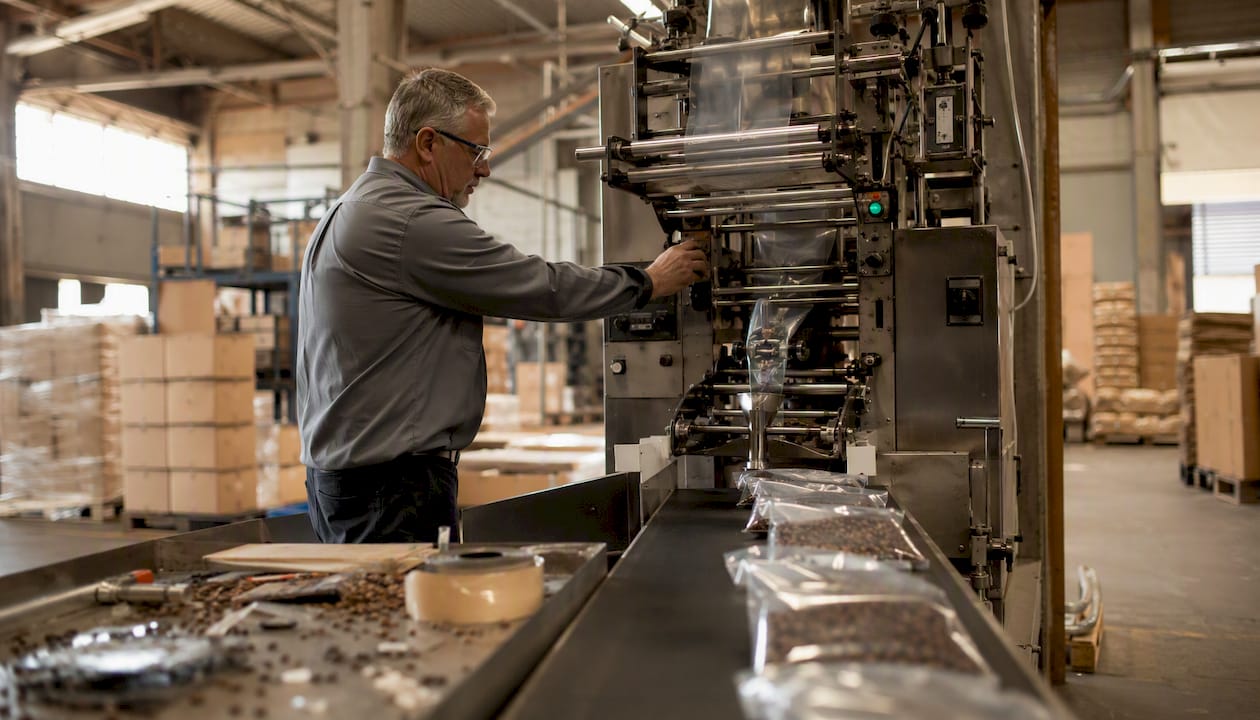
PE/EVOH/PE is the right call when you need extended shelf life — up to 18 months for whole-bean or ground coffee with low turnover or long distribution chains. PE/PE suits faster-moving products where the simpler structure is sufficient. According to PackagingBest, mono-material solutions can preserve up to 18 months of shelf life, making the barrier trade-off manageable for most roasters.
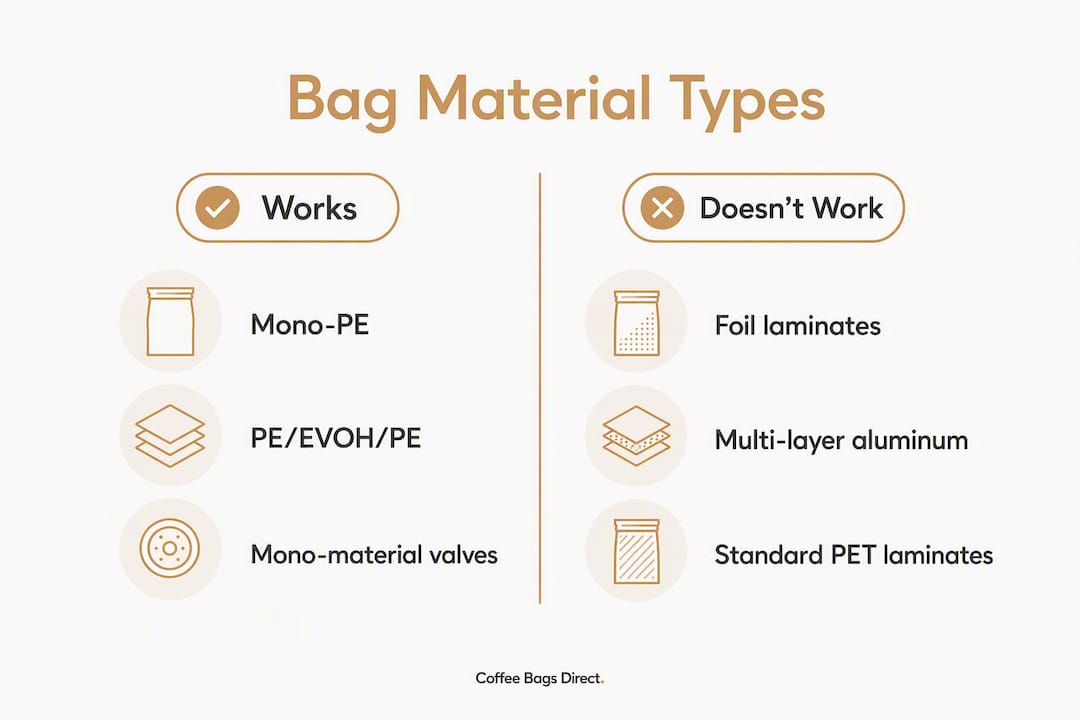
What doesn’t work in flexible-film streams
Foil laminates (PET/AL/PE), multi-layer aluminum structures, and most standard PET-based laminates are not accepted in curbside or store drop-off soft-plastic streams. The aluminum layer makes separation at a materials recovery facility (MRF) impractical. Kraft paper bags with inner PE linings are similarly problematic: the paper stream rejects them because of the plastic liner, and the plastic stream rejects them because of the paper. They are not recyclable in either stream without separation.
Bag features that affect recyclability
| Feature | Recyclable option | Non-recyclable option |
|---|---|---|
| Degassing valve | Mono-PE valve (same polymer family) | PET or mixed-material valve |
| Resealable zipper | PE zipper strip | Nylon or mixed-material zipper |
| Window | PE film window | PET or cellophane window |
| Ink system | Water-based or low-solvent inks | Heavy-solvent inks that contaminate film |
| Barrier layer | PE/EVOH/PE (thin EVOH layer) | Aluminum foil laminate |
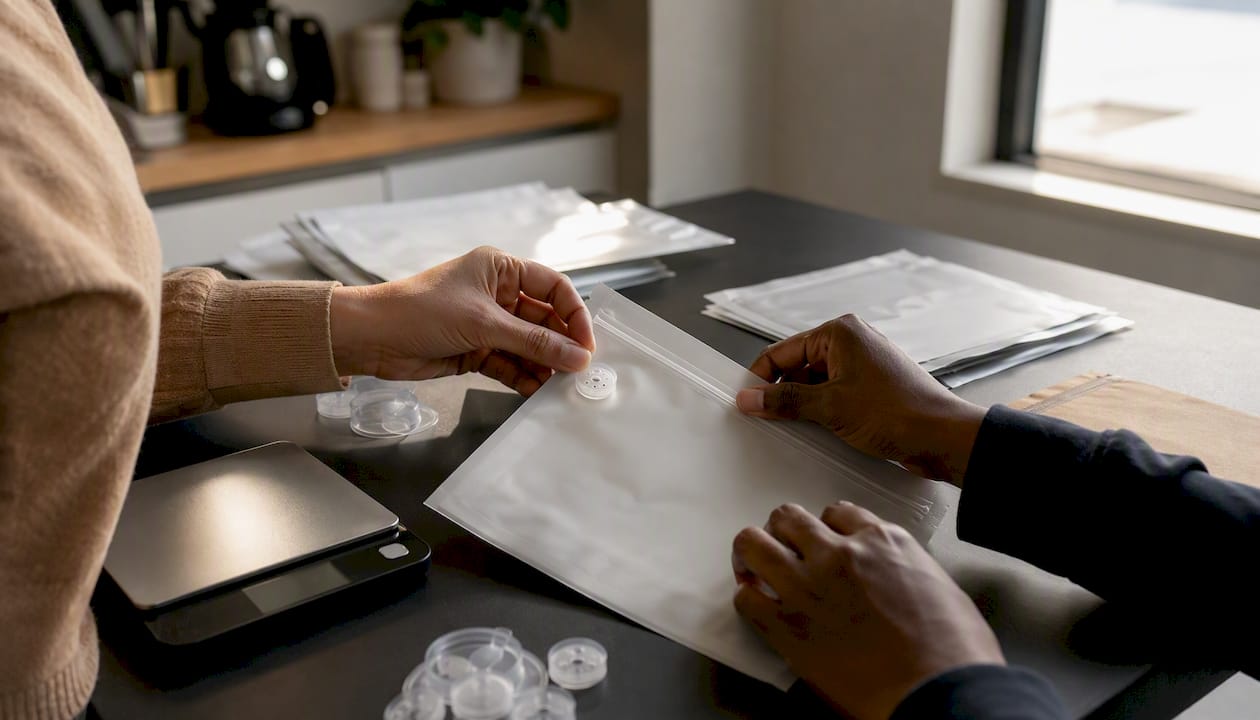
Manufacturers now offer mono-material valves and resealable zippers built from the same PE family as the bag body, so you don’t have to sacrifice freshness protection to stay mono-material.
Pro Tip: When requesting samples from a converter, ask specifically: “Is this bag mono-material by weight? What percentage of the total package weight is PE?” Mono-material design typically means more than 90% of package weight sits in one polymer family — that’s the threshold most flexible-film recycling programs use to confirm compatibility.
How U.S. recycling infrastructure determines what actually gets recycled
A bag being technically recyclable and a customer being able to recycle it locally are two different things. Infrastructure is the gap between them.
Most U.S. municipal recycling programs (MRFs) do not accept flexible film in curbside bins. Film wraps around sorting equipment and causes costly jams, so the majority of curbside programs explicitly exclude it. Curbside acceptance of soft plastics exists in some cities, but it remains the exception rather than the rule, and rules vary by county and even by hauler contract.
The more reliable path for LDPE film in the U.S. is store drop-off. Major retailers operate soft-plastic collection bins that accept clean, dry flexible film labeled #4 (LDPE). These bins consolidate film for processing outside the MRF system. For your customers, this means dropping bags at a participating store rather than tossing them in the bin at home.
Here’s how to map your sales geography to disposal options:
- Identify your top three to five sales markets by zip code or metro area.
- Search Earth911 (earth911.com) for “plastic film” or “LDPE” in each market to find local drop-off locations and any municipal programs that accept soft plastics curbside.
- Check major retailer participation in your markets. Retailers with in-store film collection bins are common in suburban and urban areas; rural markets may have fewer options.
- Document what you find. If store drop-off is available in 80% of your markets, a store drop-off How2Recycle label is accurate. If coverage is patchy, a mail-back option or a more conservative label claim is the honest choice.
- Revisit annually. Soft-plastic infrastructure is expanding in the U.S., and what’s unavailable in a market today may be available within 12 months.
One important distinction: compostable bags (typically PLA-based) do not belong in flexible-film drop-off bins. Compostable films require industrial composting infrastructure and can contaminate plastic recycling streams if mixed in. If you sell both recyclable and compostable formats, your on-pack labeling needs to make that difference unmistakably clear.
Take-back and mail-back programs: what they accept and when they make sense
When local soft-plastic infrastructure doesn’t cover your customer base, mail-back programs fill the gap. The trade-offs are real, but so is the coverage.
How a TerraCycle-style program works
A brand-operated or third-party mail-back program follows a predictable flow: the consumer collects used bags at home, ships them in a prepaid mailer or drops them at a designated collection point, and the operator consolidates the material for processing. TerraCycle’s Zero Waste Box is the most widely recognized example in the U.S. market. Brands can either partner with TerraCycle directly or build their own take-back program using a similar logistics model.
What these programs typically accept and exclude
Typical accept list: flexible coffee pouches (foil and non-foil), multi-layer laminates, mixed-material bags, and film packaging generally.
Typical exclusions: bags with food residue or contamination, rigid components that haven’t been separated, and materials outside the program’s defined scope. Cleanliness is a consistent requirement across programs.
Curbside/store drop-off vs. mail-back: a practical comparison
| Dimension | Curbside / store drop-off | Mail-back program |
|---|---|---|
| Formats accepted | Mono-material LDPE / film #4 only | Broader: foil, mixed laminates, and multi-layer |
| Consumer effort | Low (drop at store or bin) | Higher (collect, ship, or find drop point) |
| Cost to brand | Low (label compliance cost only) | Higher (program fees, prepaid mailers) |
| Geographic coverage | Depends on retailer/MRF presence | Nationwide via mail |
| Scalability | High once infrastructure exists | Limited by logistics cost at volume |
| Best for | Mono-PE bags in markets with store drop-off | Foil/laminate bags or underserved markets |
For most roasters, the practical answer is a two-track approach: switch new bag formats to mono-PE for store drop-off eligibility, and offer a mail-back option for existing foil-laminate SKUs while the transition is underway.
Design choices that make your bags recyclable in practice
Recyclability is built in at the specification stage, not added afterward. Here’s what to confirm with your converter before any production run.
Supplier specification checklist
- Film structure: Specify mono-PE (all layers PE or PE-compatible). Ask for the material data sheet confirming polymer family for every layer.
- Barrier layer: Request PE/EVOH/PE for extended shelf life; confirm EVOH layer thickness is within flexible-film recycling guidelines (thin EVOH layers are generally acceptable in mono-material streams).
- Degassing valve: Specify a mono-PE one-way valve. Confirm the valve body and membrane are both PE-family materials.
- Resealable zipper: Specify a PE zipper strip. Nylon zippers disqualify a bag from mono-material status.
- Window panels: If a window is required, use a PE film window bonded with a compatible adhesive, not PET or cellophane.
- Inks: Request water-based or low-solvent inks. Heavy-solvent ink systems can leave residues that affect film recyclability.
- Adhesives: Confirm lamination adhesives are compatible with flexible-film recycling. Solvent-based adhesives that don’t fully cure can contaminate the stream.
- Certifications: Ask for Cyclos-HTP assessment results or a How2Recycle evaluation confirming store drop-off eligibility.
Printing method and recyclability
Digital printing is the better choice for pilots and smaller runs. It avoids the plate-making step, allows you to test mono-material runnability on press before committing to gravure minimums, and lets you update label copy (including recycling instructions) without reprinting plates. Rotogravure delivers superior print quality and lower per-unit cost at high volumes, but the plate cost and minimum order quantities make it a poor fit for initial recyclability pilots.
Varnishes and surface coatings deserve attention too. Matte or gloss aqueous coatings are generally compatible with flexible-film recycling. UV-cured coatings and heavy metallized finishes can interfere with recyclability, so confirm compatibility with your converter before specifying them.
Pro Tip: Run a small digital-printed pilot of 500–1,000 units on your target mono-PE film before committing to a gravure run. Use that pilot to validate press runnability, seal integrity, and shelf-life performance — and to get your How2Recycle or Cyclos assessment done on the actual production film, not a generic substrate.
How to label bags so customers actually recycle them
The best recyclable bag in the world ends up in landfill if the customer doesn’t know what to do with it. Clear, accurate on-pack instructions close that gap.
On-pack copy examples
For a store drop-off eligible mono-PE bag: “Please recycle this bag at a store drop-off bin. Do not place in curbside recycling.”
For a mail-back program participant: “Return this bag for recycling. Visit [yourwebsite.com/recycle] for drop-off locations and mail-back instructions.”
Keep it to one or two lines. Customers won’t read a paragraph on a coffee bag.
QR code landing page
A QR code on the bag should link to a page that contains: a plain-language explanation of how to recycle the bag, a local recycling lookup (linking to Earth911 or your own drop-off locator), the nearest retailer collection points, and a mail-back option if you offer one. That page should load fast on mobile and require no account creation.
Certification marks and claim accuracy
How2Recycle labels and store-collection certification marks are the most recognized signals for U.S. consumers. Use the specific How2Recycle label that matches your bag’s actual end-of-life path: “Store Drop-Off” for film #4 bags, not the curbside label. Mismatched claims create consumer confusion and expose your brand to greenwashing scrutiny.
One important note on terminology: “recyclable” and “compostable” are not interchangeable. Recyclable means the material can re-enter a manufacturing stream. Compostable (governed by standards like ASTM D6400 in the U.S.) means the material breaks down under industrial composting conditions. Putting a compostable bag in a film drop-off bin contaminates the load. Your labeling should make the distinction explicit, especially if you carry both formats.
For sustainable coffee packaging guidance specific to your brand’s claims, review the relevant U.S. FTC Green Guides before finalizing any environmental marketing language.
What roasters should expect on cost and lead time
Switching to recyclable mono-PE constructions doesn’t require a complete overhaul of your packaging budget, but it does require realistic planning.
Primary cost factors:
- Material: Mono-PE film with EVOH barrier typically costs more per kilogram than standard foil laminates. Post-consumer recycled (PCR) content, if specified, adds a further premium but delivers a stronger environmental story.
- Printing method: Digital printing for pilots carries a higher per-unit cost but no plate fees. Gravure becomes cost-effective at higher volumes, typically above 10,000 units per SKU.
- Custom features: Mono-PE valves and PE zippers are available but may carry a small premium over standard mixed-material components.
- Certification and testing: A Cyclos-HTP or How2Recycle assessment involves a one-time fee per bag construction. Budget for this in your pilot phase, not after a full production run.
- Logistics for take-back: If you run a mail-back program, prepaid mailer costs and consolidation fees add ongoing operational cost per unit returned.
Lead-time drivers: Sample approval for a new mono-PE construction typically takes two to four weeks. If you’re moving to gravure, add four to six weeks for plate production. Recyclability testing and certification can run concurrently with sample approval if you submit the film specification early.
Pilot recommendation: A production pilot of 500–2,000 units on digital print is the right starting point. It validates press runnability on the mono-PE film, confirms seal integrity and shelf-life performance under real storage conditions, and gives you the actual production film needed for a How2Recycle or Cyclos assessment. Plan for a 10–14 week total timeline from specification sign-off to certified pilot bags in hand.
Key Takeaways
Mono-material LDPE (film #4) bags designed for store drop-off are the most practical recyclable coffee bag option for U.S. roasters, with mail-back programs covering markets where soft-plastic infrastructure is limited.
| Point | Details |
|---|---|
| Specify mono-material film | Ask your converter for mono-PE with a material data sheet confirming every layer is PE-family. |
| Match label to actual end-of-life | Use the How2Recycle “Store Drop-Off” mark only if film #4 drop-off is available in your key markets. |
| Map infrastructure before printing | Search Earth911 for your top sales markets to confirm soft-plastic drop-off coverage before finalizing claims. |
| Pilot before full production | Run 500–2,000 units on digital print to validate runnability, shelf life, and recyclability certification on the actual film. |
| Coffeebagsdirect for recyclable bags | Coffeebagsdirect offers custom-printed mono-PE coffee bags with express digital printing for pilots and advisory on recyclability labeling. |
The part most roasters get wrong about recyclable packaging
The most common mistake isn’t choosing the wrong film. It’s assuming the bag’s recyclability claim does the work for you.
A How2Recycle label is only as useful as the infrastructure behind it. If your primary markets are rural or suburban areas without major retailer soft-plastic bins, that label creates a promise your customer can’t keep. The bag goes in the trash anyway, and your brand carries the claim. That’s worse than no claim at all.
The second mistake is treating compostable and recyclable as interchangeable sustainability upgrades. They aren’t. Compostable PLA films deliver shorter shelf life (typically 6–12 months versus up to 18 months for high-barrier recyclable films) and require industrial composting infrastructure that most U.S. consumers don’t have access to. Switching to compostable packaging without a clear composting pathway for your customers doesn’t reduce landfill contribution. It just changes the label.
The high-return move is simpler than most roasters expect: switch to mono-PE, confirm your converter’s material specs in writing, map your markets to actual drop-off locations, and put plain-language disposal instructions on the bag. That combination, done correctly, creates a recyclable bag your customers can actually act on.
Coffeebagsdirect supports your switch to recyclable packaging
Switching film constructions and updating label claims is a real project, and the details matter. Coffeebagsdirect works directly with coffee roasters on custom-printed recyclable coffee bags built from mono-PE constructions, with express digital printing for pilots and full rotogravure capability for production runs. You get material specification guidance, sample kits, and advisory on How2Recycle labeling and take-back options, all from a single supplier.
To get started, prepare two things: your target bag format (stand-up pouch, flat bottom, side gusset) and your required shelf life. Then request a sample kit through the coffee packaging page. The team will match you to the right mono-PE construction, confirm valve and zipper compatibility, and walk you through the certification path before you commit to a production run.
Useful sources and further reading
| Source | What it covers |
|---|---|
| Eco-Friendly Coffee Bag Solutions — PackagingBest | Materials primer: mono-material shelf life, format trade-offs, and resealable packaging waste reduction |
| Recyclable vs. Compostable Coffee Bags — coffeeteabag.com | Technical comparison of compostable vs recyclable films, shelf-life ranges, and infrastructure requirements |
| Mono-Material Coffee Bags — biopacktech.com | Supplier spec page for mono-PE and mono-PP constructions with barrier and format details |
| Coffee Bag Material Options — bsflexpack.com | Overview of PE/EVOH/PE and other structures with barrier performance guidance |
| Recyclable Coffee Bags with Valve — bowepack.com | Supplier detail on mono-material valves, zippers, and PE constructions for multiple bag styles |
| Recyclable Coffee Bags — qiyupack.com | How2Recycle and CEFLEX compatibility claims; store drop-off eligibility for mono-PE bags |
| Earth911 local recycling search | Find LDPE / film #4 drop-off locations by zip code for your key sales markets |