
Compostable Coffee Packaging for Roasters: 2026 Guide

Compostable coffee packaging is a practical, shelf-stable option for U.S. roasters when you specify the right materials and verify that every component, including the valve, zipper, and adhesive, carries a finished-product certificate from BPI or TÜV AUSTRIA OK Compost. The critical distinction is industrial versus home compostability: most certified compostable pouches require a commercial composting facility to reach the sustained temperatures needed for breakdown, not a backyard bin. Barrier performance has improved significantly with engineered bioplastic blends and kraft-PLA laminates, and switching to some bio-based materials can generate 68% fewer greenhouse gases and use 65% less energy during production compared with conventional plastics. If you are ready to start, request samples and a pilot test run before committing to a full production order.
Pro Tip: Always ask for the finished-product certificate, not just the material certificate. A bag made from certified PLA film can still fail compost facility acceptance if the valve or zipper is conventional polyethylene.
“Compostable” implies a verified, test-based timeframe for breakdown into safe components. “Biodegradable” is often a vaguer marketing term with no guaranteed timeframe or third-party verification behind it. For U.S. distribution, only certified compostable claims hold up under FTC Green Guides scrutiny.
Table of Contents
- What bag formats are available in compostable coffee packaging?
- What materials are used in compostable coffee bags and how do they perform?
- Which certifications and standards should you verify?
- How do compostable materials affect coffee freshness?
- What should you know about printing, MOQ, and pricing?
- What should you ask suppliers and test before a bulk order?
- How do the main compostable materials compare side by side?
- What is the verdict for roasters ready to switch?
- Key Takeaways
- Why documentation is the real differentiator in compostable packaging
- Coffeebagsdirect’s compostable packaging for your next order
- Authoritative sources to read next
What bag formats are available in compostable coffee packaging?
Roasters have more format options than most buyers realize. The most common formats in compostable materials are:
- Stand-up pouches (SUPs): The dominant retail format, available in 2 oz, 4 oz, 8 oz, 12 oz, and 1 lb sizes. Works well for whole bean and ground coffee at retail and subscription.
- Side-gusset bags: A clean, classic silhouette suited to wholesale and foodservice. Easier to fill on high-speed lines.
- Quad-seal / flat-bottom bags: Shelf presence is strong; the flat base lets the bag stand without a display rack. Popular for specialty retail and gift sets.
- Kraft paper bags with PLA lining: A natural, tactile finish that reads as artisan. Common in 4 oz and 8 oz sizes for single-origin and small-batch roasters.
- Clear cellulose-style bags: Made from NatureFlex or similar cellulose films, these offer product visibility. Best for loose-leaf or whole-bean presentation where color sells.
- Valve bags: Any of the above formats fitted with a certified compostable degassing valve. Non-negotiable for freshly roasted ground coffee.
- Zippered resealable pouches: Compostable zippers are available and certified; confirm component scope with your supplier before ordering.
- Single-serve compostable capsules: Home-compostable capsule formats now exist with end-to-end OK Compost HOME certification. Blue Circle reports home composting within approximately 26 weeks under typical home conditions for their certified capsules.
For small-batch roasters piloting compostable packaging, kraft paper bags with PLA lining and digital-printed stand-up pouches typically carry the lowest minimum order quantities (MOQs) and the shortest lead times. That makes them the lowest-risk entry point before scaling to rotogravure runs.
Pro Tip: Match your bag format to your filling method. Ground coffee needs a degassing valve regardless of material. Whole-bean bags can often skip the valve if you allow a 12–24 hour off-gas period before sealing, though a valve is still best practice for freshness.
What materials are used in compostable coffee bags and how do they perform?
The material choice determines barrier performance, printability, compostability environment, and cost. Here are the primary options:
- PLA (Polylactic Acid): Derived from corn starch or sugarcane. Stiff, glossy, and printable, but relatively low moisture and oxygen barrier on its own. Requires industrial composting.
- PBAT blends (PLA + PBAT): Adding polybutylene adipate terephthalate improves flexibility and toughness. Better heat-seal performance than pure PLA. Still industrial compostable.
- PHA (Polyhydroxyalkanoate): Produced by microbial fermentation. Better barrier than PLA and can be home compostable depending on formulation and certification. Higher cost per kilogram.
- Cellulose films (e.g., NatureFlex by Futamura): Transparent, high-clarity films derived from wood pulp. Good moisture barrier, compostable in both industrial and some home conditions when certified. Excellent for clear compostable coffee bags.
- Kraft + PLA laminates: A kraft paper outer layer bonded to a PLA inner liner. Strong tactile appeal, good printability on the kraft surface, and adequate barrier for 6–12 month shelf life with proper gas flushing. The most accessible format for roasters new to compostable packaging.
- Aqueous and solventless coatings: Applied to paper or film substrates to improve barrier without adding a separate plastic layer. Compostability depends on coating chemistry; request TDS and certification confirmation.
Using renewable materials like PLA can generate 68% fewer greenhouse gases and use 65% less energy during production compared with conventional plastics, making the lifecycle case for switching compelling even before end-of-life benefits are counted.
| Material | Barrier Performance | Printability | Compostability | Relative Cost |
|---|---|---|---|---|
| PLA | Low to moderate | Excellent gloss | Industrial only | Low to moderate |
| PLA + PBAT blend | Moderate | Good | Industrial only | Moderate |
| PHA | Moderate to good | Good | Industrial or home (certified) | High |
| Cellulose (NatureFlex) | Good moisture barrier | Excellent clarity | Industrial or home (certified) | Moderate to high |
| Kraft + PLA laminate | Moderate | Good (kraft surface) | Industrial only | Low to moderate |

Pro Tip: Choose a kraft PLA-lined paper bag when your brand positioning is artisan or natural and your shelf-life target is under 9 months with nitrogen flushing. Move to a multi-layer bioplastic pouch (PLA+PBAT or PHA) when you need longer shelf life, a glossy finish, or a clear window.
Which certifications and standards should you verify?
Certification is where most compostable packaging claims either hold up or fall apart. The standards that matter for U.S. distribution are:
- ASTM D6400: The U.S. standard for compostability of plastics in municipal or industrial composting facilities. The primary benchmark for finished pouches and films.
- ASTM D6868: Covers compostable coatings and adhesives on paper or other substrates. Relevant when your bag uses an aqueous barrier coating.
- EN 13432: The European equivalent, widely accepted by certifiers globally. Many U.S.-sold products carry EN 13432 alongside ASTM D6400.
- BPI (Biodegradable Products Institute): The leading U.S. third-party certifier. BPI certification is based on ASTM D6400/D6868 and includes a registration number you can verify on the BPI website.
- TÜV AUSTRIA OK Compost Industrial: European certifier, widely recognized. Certificate numbers are searchable in the TÜV AUSTRIA database.
- TÜV AUSTRIA OK Compost HOME: A stricter standard requiring breakdown at lower temperatures over a longer period, up to 12 months at approximately 25°C. This is the certification to request if your customers have access to home composting.
Industrial composting typically requires sustained temperatures above 130°F (~55°C) and controlled conditions. A bag certified only to industrial standards will not reliably break down in a backyard compost pile.
Supplier documents to request
- Finished-product certificate with registration number (BPI or TÜV AUSTRIA) — not just a material data sheet.
- Component certificates for the valve, zipper, and adhesive, each individually certified.
- Technical Data Sheet (TDS) and Safety Data Sheet (SDS) for each material layer.
- Certificate of Analysis (COA) for barrier performance (OTR and WVTR test results).
- Third-party barrier test reports confirming real-world oxygen and moisture transmission rates.
How to verify a certificate
- Note the certificate registration number from the supplier’s document.
- Visit the certifier’s public database: BPI at bpiworld.org or TÜV AUSTRIA’s OK Compost portal.
- Search by registration number and confirm the scope covers the finished pouch, not just the base film.
- Check that the certificate is current and has not expired.
- Confirm the scope statement explicitly lists valves, zippers, and adhesives if your bag includes them.
A finished pouch can be rejected by industrial compost facilities if the valve or zipper contains conventional polyethylene, even when the film itself is certified. Finished-product certification that explicitly lists component scope is the only document that closes that gap.
How do compostable materials affect coffee freshness?
Barrier performance is the honest trade-off in compostable packaging. Engineered bioplastic blends and kraft-PLA laminates have closed much of the gap with conventional foil laminates, but they generally still show higher oxygen transmission rates (OTR) and water vapor transmission rates (WVTR) than multi-layer foil structures. For roasters targeting a 12-month shelf life at retail, that gap matters.
Practical mitigations that work well in compostable pouches:
- Certified compostable degassing valve: Releases CO₂ from freshly roasted coffee without allowing oxygen ingress. Confirm the valve carries its own compostability certificate.
- Nitrogen gas flushing: Displacing oxygen inside the sealed bag before closure is the single most effective freshness extension tool, regardless of material. Pair it with a tight heat seal.
- Inner cellulose or PHA liner: Adding a high-barrier inner layer to a kraft outer bag improves OTR without compromising compostability, provided the liner is also certified.
- Secondary carton or outer sleeve: For retail shelf life beyond 9 months, an outer carton reduces light and humidity exposure and adds a print surface without affecting the bag’s compostability claim.
- Storage recommendations on-pack: Advise consumers to store away from direct sunlight and heat. Simple, but it extends perceived freshness.
Pro Tip: Run an accelerated shelf-life test (ASLT) before your first production run. Store sealed samples at elevated temperature and humidity (typically 40°C / 75% RH) for 4–8 weeks and test aroma retention and headspace oxygen. This predicts real-world shelf life far faster than waiting out a 12-month ambient test. Understanding how packaging preserves coffee freshness at the material level will help you interpret those results.
What should you know about printing, MOQ, and pricing?
Custom compostable pouches involve a few more cost variables than conventional packaging, but the gap has narrowed as demand has grown.
- Digital printing: — Low MOQs (often 250–500 units per SKU), fast turnaround (typically 5–10 business days), and no plate costs. The right choice for pilot runs, seasonal SKUs, and subscription boxes. Print adhesion on bioplastic films requires surface treatment; confirm your supplier pre-treats the substrate.
For roasters comparing digital versus rotogravure printing options, the break-even point where rotogravure becomes more cost-effective per unit is generally around 3,000–5,000 units per SKU, though that threshold shifts with material and finish complexity.
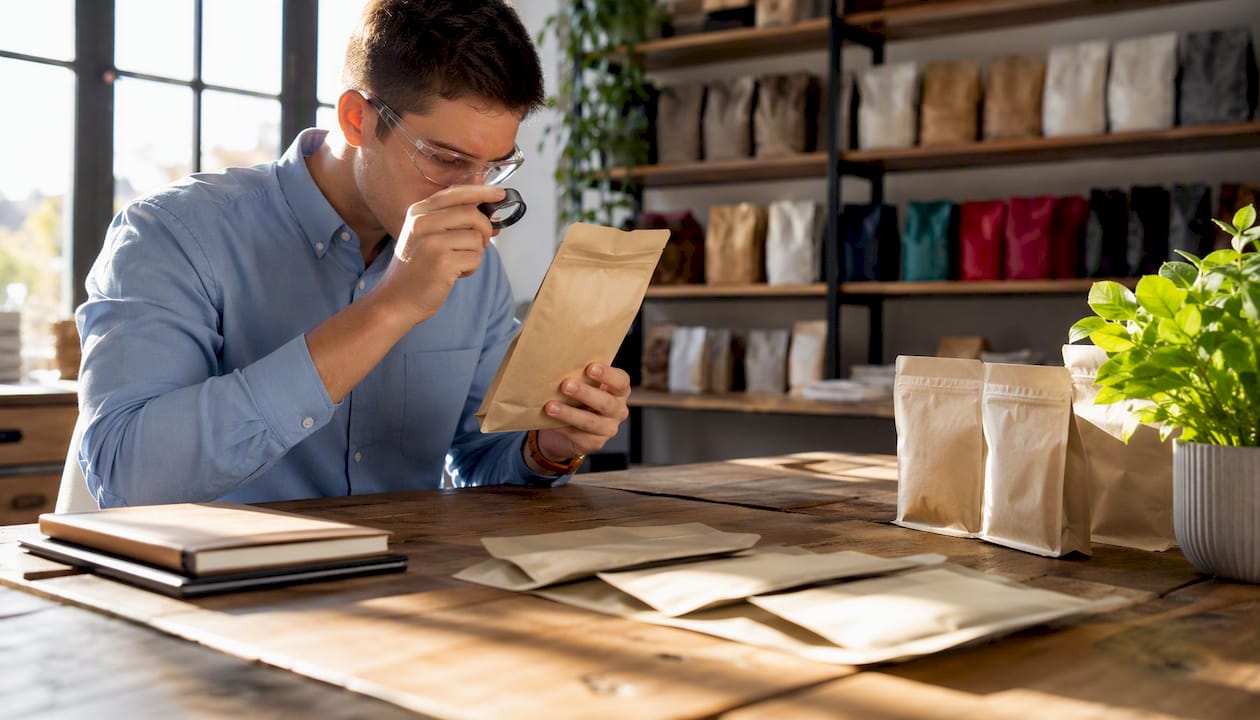
Pro Tip: Order a printed sample run of 50–100 bags before approving a full production order. Check ink adhesion by rubbing the printed surface firmly with a damp cloth. Delamination or ink transfer at this stage signals a surface treatment or ink compatibility issue that will only get worse in transit.
What should you ask suppliers and test before a bulk order?
A structured pre-order process protects you from receiving non-compliant packaging that fails at the compost facility or on the shelf.
Supplier document checklist
- Finished-product compostability certificate (BPI or TÜV AUSTRIA) with registration number
- Individual component certificates for valve, zipper, and adhesive
- TDS and SDS for each material layer
- COA with OTR and WVTR test results
- Sample photos showing valve placement and zipper construction
- Statement confirming inks are water-based or soy-based and within certification scope
Sample test plan
- Seal strength test: Heat-seal a sample batch and pull-test seams to confirm bond integrity.
- Degassing valve function: Fill bags with freshly roasted coffee, seal, and check valve one-way flow after 24 and 48 hours.
- Aroma retention: Store sealed samples at ambient conditions for 4 and 8 weeks; open and assess aroma against a control bag.
- Visual print quality: Inspect color consistency, registration, and ink adhesion across 10 random samples.
- Disintegration test (optional but recommended): Submit 3–5 bags to a certified industrial composting facility or a third-party lab for a disintegration check under ASTM D6400 conditions.
Retain all sample evidence, including photos, test results, and the supplier’s certificate copies, before placing a bulk order. Request third-party test reports directly from the certifier or an accredited lab rather than relying solely on supplier-provided documents.
Timeline: Allow 2–3 weeks for sample receipt and testing before approving production. For rotogravure runs, add 4–6 weeks for plate production. Build this into your launch calendar.
Pro Tip: Ask your supplier to provide the certificate number in writing on their quotation, not just on a separate document. That creates a paper trail linking the specific product specification to its certification, which matters if a compost facility ever questions compliance.
How do the main compostable materials compare side by side?
| Material | Compostability | Barrier (OTR/WVTR) | Printability | Component Compostability | Cost / MOQ Shape | Best Use Case | Shelf Life |
|---|---|---|---|---|---|---|---|
| PLA | Industrial only | Low to moderate | Excellent gloss | Valves/zippers available certified | Low cost, moderate MOQ | Specialty retail, short shelf life | Up to 6 months with N₂ flush |
| PLA + PBAT blend | Industrial only | Moderate | Good | Certified options available | Moderate cost, moderate MOQ | Retail and subscription | 6–9 months with N₂ flush |
| PHA | Industrial or home (certified) | Moderate to good | Good | Certified options available | High cost, higher MOQ | Premium specialty, home-compost claims | 9–12 months with N₂ flush |
| Cellulose (NatureFlex) | Industrial or home (certified) | Good moisture barrier | Excellent clarity | Confirm per supplier | Moderate to high cost | Clear compostable bags, whole bean display | 6–9 months |
| Kraft + PLA laminate | Industrial only | Moderate | Good (kraft surface) | Certified options available | Low cost, low MOQ | Artisan/small-batch retail | 6–9 months with N₂ flush |
Certified industrially compostable packaging is tested to achieve 90% biodegradation within a specified period, commonly 3–6 months under industrial conditions per EN 13432 and ASTM D6400 guidance. Home-compostable standards require breakdown at lower temperatures over a longer period, up to 12 months at approximately 25°C, which is why the certification pathway and the on-pack disposal instructions must match.
For small-batch specialty roasters, kraft + PLA laminates and PLA+PBAT stand-up pouches offer the best entry point on cost and MOQ. Grocery channel buyers who need longer shelf life and home-compostable claims should specify PHA or certified cellulose films and confirm that the finished-product certificate covers the home-compostable pathway explicitly.
What is the verdict for roasters ready to switch?
Compostable coffee packaging is ready for production use in the U.S. market when you specify the right material, verify finished-product certification, and confirm every component is within scope.
- Choose industrial compostable (PLA, PLA+PBAT, kraft+PLA) when your customers have access to municipal composting programs and your shelf-life target is under 9 months with nitrogen flushing.
- Choose home compostable (certified PHA or cellulose) when your brand promise includes end-of-life convenience for consumers without access to commercial composting.
- Verify component certification for the valve, zipper, and adhesive before every new supplier relationship. One non-certified component invalidates the finished-product claim at the compost facility.
Three prioritized next steps
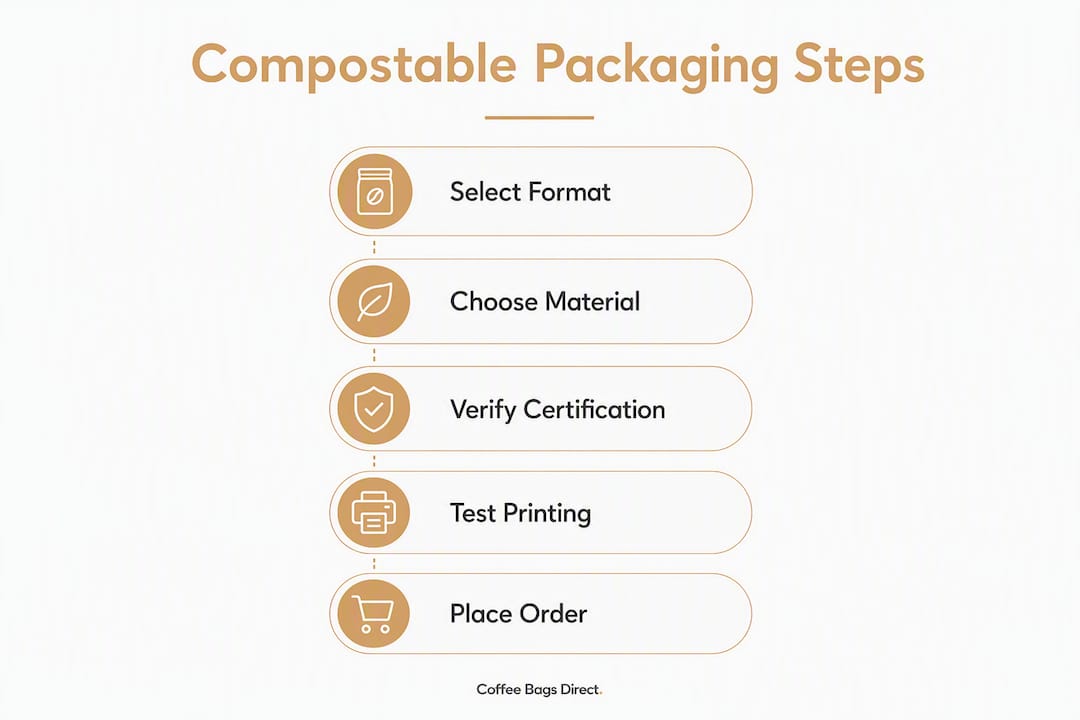
- Request samples and certificates. Ask for a physical sample pack and the finished-product certificate with registration number before placing any order.
- Run a small pilot with shelf-life testing. Order a short digital-print run, fill with your coffee, and run a 4–8 week aroma and seal-integrity test before committing to full production.
- Update labeling and consumer disposal instructions. Your packaging must clearly state “industrially compostable” or “home compostable” per FTC Green Guides guidance to avoid misleading claims. Include the certifier logo and a brief disposal instruction on-pack.
Coffeebagsdirect offers sample packs, component-certified compostable pouches, and express digital printing for pilot runs. Contact the team to request samples or start a custom quote.
Key Takeaways
Compostable coffee packaging is procurement-ready for U.S. roasters when finished-product certification covers every component and barrier performance is matched to your shelf-life target.
| Point | Details |
|---|---|
| Certification scope is everything | Request finished-product certificates (BPI or TÜV AUSTRIA) that explicitly list valves, zippers, and adhesives within scope. |
| Industrial vs. home compostable | Most certified compostable pouches require industrial composting above 130°F; only PHA and certified cellulose films qualify for home-compostable claims. |
| Barrier trade-offs are manageable | Nitrogen gas flushing and certified degassing valves extend shelf life to 6–12 months depending on material blend. |
| Pilot before full production | A 4–8 week accelerated shelf-life test on a small digital-print run validates performance before you commit to a large order. |
| Coffeebagsdirect for compostable pouches | Coffeebagsdirect supplies custom compostable coffee bags with certified components, express digital printing, and sample support for U.S. roasters. |
Why documentation is the real differentiator in compostable packaging
The market for compostable coffee packaging has matured quickly, but the documentation behind the claims has not always kept pace. The most common problem Coffeebagsdirect sees is a roaster receiving a bag with a “compostable” label on the outer carton, only to discover that the valve is conventional polyethylene and the adhesive has no certification at all. That is not a minor oversight. A single non-certified component means the finished pouch will be rejected by most industrial compost facilities, and the “compostable” claim on the bag becomes a liability under FTC Green Guides.
The fix is straightforward but requires discipline: treat every component as a separate certification question, not an assumption. Ask for the valve certificate. Ask for the zipper certificate. Ask for the adhesive TDS. If a supplier cannot provide those documents within a reasonable timeframe, that tells you something important about their supply chain visibility.
There is also a labeling gap that causes real consumer frustration. When a bag says “compostable” without specifying industrial or home, consumers put it in their backyard bin, it does not break down, and the brand takes the blame. Clear, specific disposal instructions are not just good practice. They are what separates a credible sustainability claim from a greenwashing risk.
Coffeebagsdirect’s approach is to make that documentation process as straightforward as possible: providing certificate copies with orders, flagging component scope proactively, and supporting roasters through the sample and testing phase before full production. Retaining third-party test reports and COAs as part of your supplier file is a trust signal that holds up to scrutiny from retailers, certifiers, and increasingly, consumers.
Coffeebagsdirect’s compostable packaging for your next order
Coffeebagsdirect gives roasters a direct path from specification to certified, shelf-ready compostable pouches, without the back-and-forth of sourcing materials, certifications, and printing separately. The range covers stand-up pouches, side-gusset bags, and flat-bottom formats in compostable materials, all with certified valve and zipper options available. Express digital printing means you can run a pilot of 250–500 units with your full artwork in under two weeks, which is the fastest way to validate print quality and barrier performance before scaling.
Every order comes with documentation support: finished-product certificate copies, component certification confirmation, and material TDS on request. For roasters who also need compliant on-pack labeling, custom printed labels are available to match your compostable pouch specification. Browse the full range of custom compostable coffee bags or contact the team to request a sample pack and a quote tailored to your SKU count and volume.
Authoritative sources to read next
- BPI (Biodegradable Products Institute): The U.S. certifier for ASTM D6400/D6868 compliance. Use the BPI product database to verify certificate registration numbers for any supplier claiming BPI certification.
- FTC Green Guides: The FTC’s guidance on environmental marketing claims, including compostable and biodegradable. Required reading before finalizing on-pack claims for U.S. distribution.
- European Bioplastics — EN 13432 lifecycle note: Covers the EN 13432 standard and lifecycle data for bio-based materials. Use it to support GHG and energy reduction claims in your brand communications.
- U.S. EPA — Approaches to Composting: Explains the temperature and condition requirements for industrial composting. Useful for understanding why industrial-certified bags do not break down in home bins.
- What is recyclable coffee packaging?: A useful comparison resource for roasters weighing compostable versus recyclable options as part of a broader sustainability strategy.
Save certificate numbers and COAs from every supplier in a dedicated compliance file. If a compost facility or retailer ever questions your packaging’s credentials, that file is your first line of defense.