
Variable Data Printing: Personalized Packaging and Marketing Guide

Variable data printing (VDP) is a digital printing method that outputs a unique version of each piece in a single press run, swapping text, images, barcodes, or QR codes from one item to the next without stopping the press. No plates, no re-setup, no batch restarts.
Three reasons brands choose it:
- Personalization at scale. Every recipient or package gets content specific to them, from a first name on a mailer to a unique batch code on a coffee bag.
- Operational traceability. Serialized codes, expiry dates, and QR links give you a direct line from production to the end consumer.
- No plate costs. Unlike offset lithography, VDP runs entirely digitally, so short and variable runs are economically viable.
Common applications include direct-mail postcards, bank and utility statements, serialized product labels, loyalty QR codes, event tickets, and food packaging with batch or traceability data. For coffee roasters and food brands, Coffeebagsdirect offers express digital printing that puts VDP directly on flexible packaging substrates.
Table of Contents
- How does variable data printing actually work?
- Which press technologies support variable data printing?
- Where does VDP deliver the most value?
- How do you prepare files and data for a VDP job?
- What does VDP cost, and when does it make financial sense?
- What privacy and data-quality rules apply to personalized print campaigns?
- How do you connect VDP outputs to campaign measurement?
- How does VDP support sustainable packaging for coffee and food brands?
- Key Takeaways
- Why most brands underestimate what VDP can actually do for packaging
- Custom VDP-ready packaging from Coffeebagsdirect
How does variable data printing actually work?
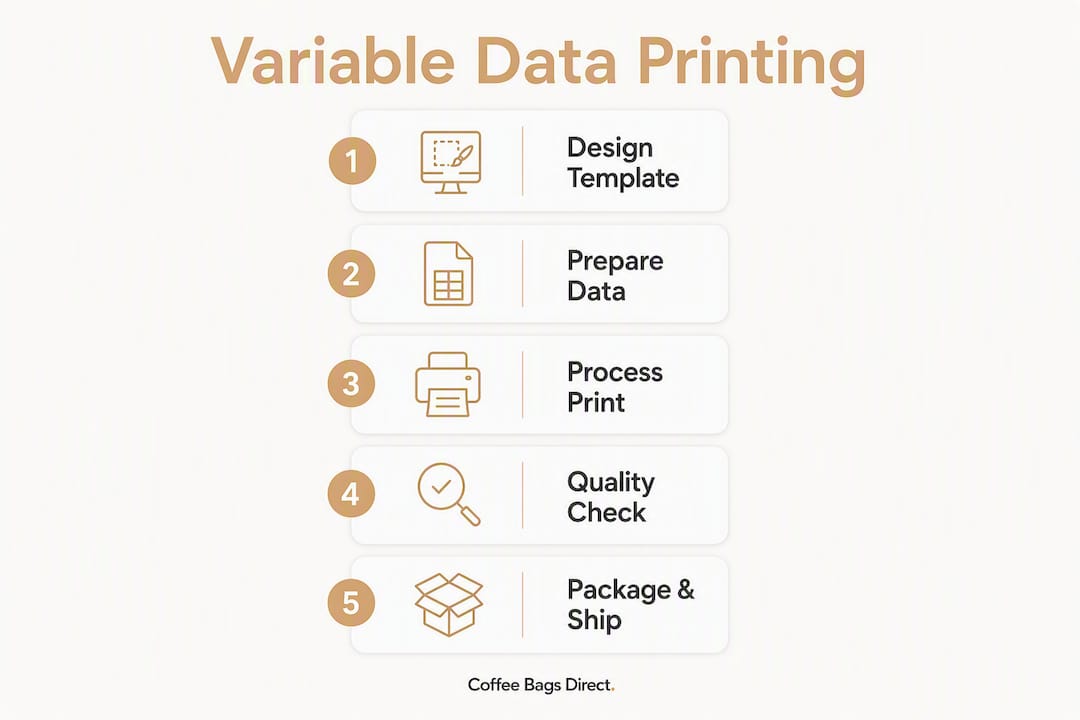
The workflow has three core components: a master template (the static design), a variable data source (a CSV, Excel file, or live API feed), and a digital front end (DFE) connected to a digital press. These three elements combine to produce every unique piece.
Here is the end-to-end sequence:
- Prepare the data source — Structure your CSV or Excel file so each column maps to exactly one variable field in the design (name, address, QR payload, batch code, etc.).
- Compose and output. The VDP composition engine merges template and data, producing an optimized output file (ideally PDF/VT or a similar format that references static assets once).
Think of it like a mail-merge on a spreadsheet, except the output is a print-ready file where every row becomes a physically printed, unique piece.
Pro Tip: Design your template so static backgrounds are defined as XObjects or equivalent reusable assets. When the DFE can reference a static element once instead of re-rasterizing it for every piece, press throughput stays high and job costs stay predictable. Files that force re-processing of static assets can drastically reduce throughput and push up per-piece costs.
Which press technologies support variable data printing?
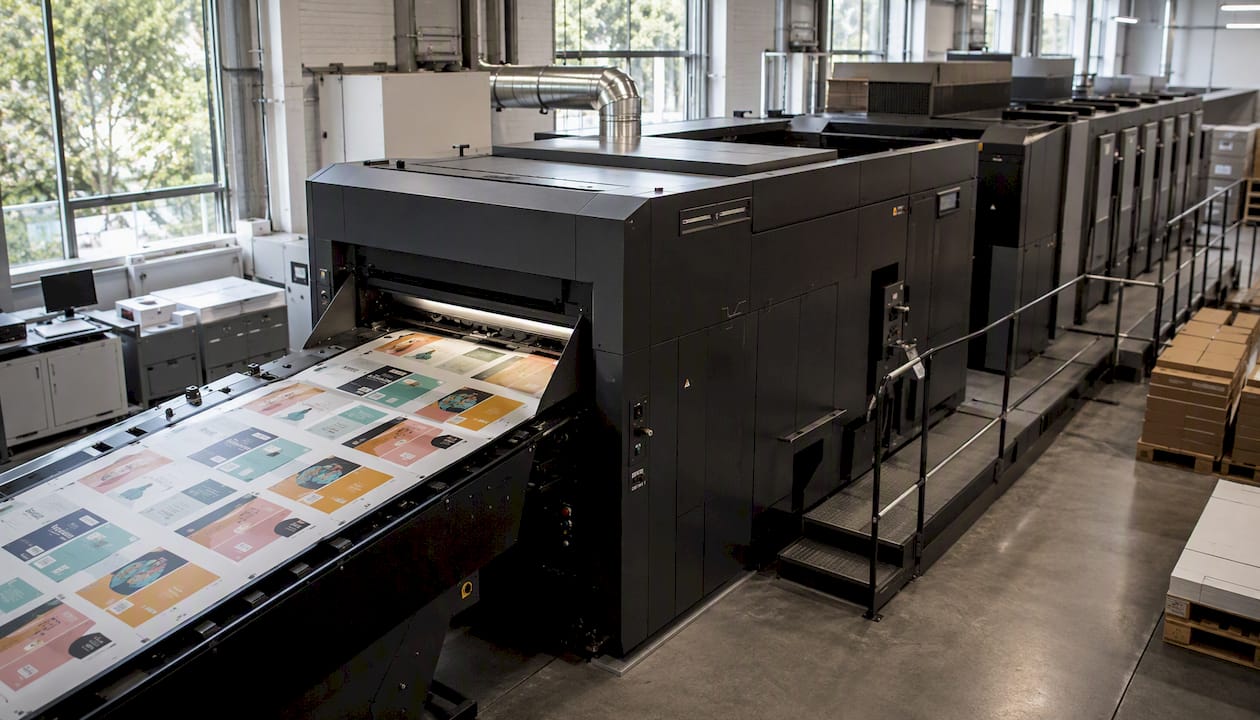
Not every digital press handles VDP the same way. The three main families each have a different profile for speed, quality, and substrate compatibility.
| Press type | Typical speed | Color quality | Substrate range | Best fit |
|---|---|---|---|---|
| Digital toner / laser | Moderate | Good for text-heavy, sharp edges | Coated and uncoated paper, some films | Transactional docs, direct mail |
| Continuous-feed inkjet | Very high | Excellent for photo and gradient | Wide range including flexible films | High-volume direct mail, labels |
| Sheet-fed electrophotographic (Indigo-style) | Moderate-high | Premium, near-offset quality | Papers, films, foil, flexible packaging | Short-run packaging, premium labels |
Before committing to a print provider, ask these questions:
- What is the engine speed at full VDP (i.e., with every piece unique, not just versioned)?
- How does the DFE handle reused static assets? Does it support PDF/VT or PPML to avoid re-processing?
- What inline verification options are available, and what is the reject-handling process for unreadable codes?
The answers will tell you whether the provider’s press is genuinely optimized for VDP or simply capable of it in a slower, less efficient mode.
Where does VDP deliver the most value?
VDP’s strongest use cases fall into a few clear categories. Knowing which one matches your project helps you scope the job correctly from the start.
- Personalized direct-mail postcards. Name, address, and a tailored offer on each piece. Response rates consistently outperform generic mass-print versions because the content is relevant to the recipient.
- Transactional documents. Utility bills, bank statements, and insurance documents where account numbers, balances, and personal details must be unique and accurate on every page.
- Serialized labels for traceability. Unique QR codes, DataMatrix codes, batch numbers, and expiry dates printed and verified inline to ISO standards. High-volume runs can generate millions of unique codes, each scanned and confirmed before leaving the press.
- Unique QR promotions and coupons. Single-use discount codes or loyalty QR codes that link to personalized landing pages, trackable per recipient.
- Event tickets with unique IDs. Serialized barcodes prevent duplication and enable gate scanning.
For coffee roasters and food brands, the packaging use case is particularly practical. A single bag design can carry a unique QR code linking to a loyalty program, a batch number for traceability, and an expiry date, all printed in one pass on the same flexible substrate. This is the difference between versioning (swapping one of three regional designs) and full variability (every single bag carries a unique code). Choose versioning when your content changes by group; choose full variability when every piece needs a distinct identifier.
How do you prepare files and data for a VDP job?
Clean data and well-structured artwork are what separate a smooth VDP run from a costly reprint. Work through this checklist before submitting anything to press.
- Audit your data file — Open your CSV or Excel file and check for trailing spaces, inconsistent capitalization, and blank rows. Minor formatting errors like misaligned headers or trailing spaces can break automated print jobs entirely.
Common pitfalls worth knowing: a field named “First_Name” in your data file will not populate a placeholder named “FirstName” in your design. A missing image file for even one record can halt the entire job. Truncated fields, where a long address gets cut off because the text box is too small, are often only visible in a physical proof.
What software do you use to build VDP jobs?
The right tool depends on your volume and complexity.
Desktop mail-merge (InDesign Data Merge) suits low-volume jobs with simple text and image swaps. It is accessible, requires no specialist training, and outputs print-ready PDFs. The limitation is speed and optimization: InDesign does not produce PDF/VT natively, so the DFE may re-process static assets on every record.
Plugin and composition tools such as FusionPro and XMPie sit between desktop and enterprise. They handle variable images, conditional logic (show this offer if the recipient is in ZIP code X), and produce optimized outputs that DFEs process efficiently. These are the right choice when your job involves more than simple text swaps or when you are printing thousands of pieces.
Enterprise composition and RIP solutions with native PDF/VT or PPML support are built for high-volume, high-complexity jobs. The DFE references static assets once and processes only the variable delta per record, keeping the press at full engine speed. If your provider uses this class of workflow, your file-prep requirements are stricter but your per-piece cost at volume is lower.
The vendor-agnostic question to ask about any tool: does it produce PDF/VT or an equivalent optimized output that the DFE can process without re-rasterizing static elements?
What does VDP cost, and when does it make financial sense?
VDP pricing has several moving parts. Understanding each one lets you build a realistic budget and compare it honestly against a conventional print run.
- Per-piece variable-data fee — A small charge per printed piece on top of the base print cost, reflecting the additional processing and verification overhead.
For turnaround, a straightforward VDP direct-mail job with clean data typically runs in a few business days from proof approval. Add time for data clean-up if the file needs work, large unique-image libraries (rendering time scales with image count), and substrate proofing for packaging jobs.
The break-even calculation is simple: add setup fees plus (per-piece VDP cost × quantity) and compare that total to a conventional print run at the same quantity. VDP becomes cost-effective when the personalization benefit justifies the per-piece premium, or when the run is short enough that offset plate costs would dominate. For digital versus rotogravure decisions on flexible packaging, the crossover point depends on run length and design complexity.
What privacy and data-quality rules apply to personalized print campaigns?
Personalized printing campaigns in the U.S. involve consumer data, and that carries both legal and operational responsibilities.
On the legal side, campaigns that combine printed pieces with PURLs or email follow-ups fall under CAN-SPAM requirements for the digital touchpoints. For regulated datasets (healthcare, financial, children’s data), additional federal and state frameworks apply. Consult qualified legal counsel before running personalized campaigns with sensitive consumer data.
Practically, a short data-security checklist covers the main risks:
- Transfer data files over encrypted channels (SFTP or equivalent), never plain email
Data quality is equally important. Deduplicate your list before sending it to press. Validate addresses against USPS address standards if you are mailing. Run a sample verification of 50–100 records to catch encoding errors, especially if your data includes special characters or accented names. A clean data file is the single biggest factor in a smooth VDP run.
This article provides general information, not legal advice. Confirm current requirements with a qualified attorney or the relevant primary source for your specific dataset and campaign type.
How do you connect VDP outputs to campaign measurement?
The printed piece is the start of the tracking loop, not the end. VDP makes it straightforward to close the measurement gap between print and digital.
- PURLs (personalized URLs). Each recipient gets a unique URL (e.g., yourbrand.com/jane-smith) that routes to a personalized landing page. Every visit is attributed to that specific printed piece.
- Unique QR codes. Link each QR to a UTM-tagged URL or a unique redirect. Scan events feed directly into Google Analytics or your CRM.
- Unique coupon codes. Single-use codes that redeem only once prevent fraud and give you exact redemption attribution per recipient.
- Encoded IDs for CRM matching. A short alphanumeric code on the piece lets your CRM match a response back to the original record without exposing personal data on the printed surface.
For A/B testing in print, split your data file into two groups before the job goes to press: one receives creative A, the other creative B. Keep all other variables constant. Sample size guidance from direct-mail practice suggests a reasonable number of pieces per cell for statistically meaningful results, though the right number depends on your expected response rate. After the campaign, pull response data from your CRM or analytics platform, match it back to the print records by unique ID, and calculate response rate per cell. That closes the loop between the physical piece and your digital measurement stack.
How does VDP support sustainable packaging for coffee and food brands?
For packaging projects, VDP adds a layer of complexity that flat-paper print jobs do not have. Scannability on curved or laminated surfaces, ink adhesion on flexible substrates, and post-print finishing durability all require proofing on the actual bag material, not just a flat paper proof.

VDP also supports sustainability goals in a direct way. On-demand, shorter print runs mean you produce only what you need, reducing overstock and obsolete inventory. Targeted regional printing, where only the relevant regional SKU is printed for each market, cuts the waste that comes from printing a full national run and discarding unsold regional variants. Fewer physical SKUs in your warehouse means less material waste overall.
For coffee roasters, a practical VDP packaging workflow looks like this: a single base bag design carries a unique QR code per batch (linking to origin story or loyalty program), a printed batch number, and an expiry date, all variable across the run. Coffeebagsdirect’s express digital printing for coffee bags supports this kind of on-demand, short-run VDP work on flexible packaging substrates, with substrate proofing available to confirm scannability and ink legibility before full production.
When evaluating any packaging vendor for VDP work, request:
- A substrate proof on your chosen bag material (not a paper proof).
- A camera-verified sample confirming QR and barcode scannability on the curved or laminated surface.
- Confirmation of inline verification options and the reject-handling process.
- Minimums and lead times for express digital runs.
Coffeebagsdirect’s sustainability partnerships, including its alignment with the Australian Packaging Covenant Organisation (APCO), provide an additional trust signal for brands that need to document their packaging supply chain’s environmental credentials.
Key Takeaways
Variable data printing is most cost-effective when personalization, traceability, or short-run flexibility matters more than the lowest possible per-piece price on a long identical run.
| Point | Details |
|---|---|
| VDP definition | A digital method that prints unique content on each piece from one run, with no plates required. |
| File-prep priority | Clean, mapped CSV/Excel data and embedded fonts prevent the most common production delays. |
| Press speed matters | Choose a provider whose DFE supports PDF/VT or equivalent to keep engine speed high on variable jobs. |
| Packaging needs substrate proofs | Always request a proof on the actual bag material to confirm scannability on curved or laminated surfaces. |
| Coffeebagsdirect for packaging VDP | Offers express digital printing, substrate proofing, and custom labels suited to short-run VDP coffee packaging projects. |
Why most brands underestimate what VDP can actually do for packaging
Most conversations about variable data printing stop at name personalization on a direct-mail postcard. That is the entry-level application, and it undersells what the technology can do for physical product packaging.
For coffee roasters and food brands, the more interesting opportunity is using VDP to build a direct data connection between the bag and the consumer. A unique QR code per batch is not just a marketing tool; it is a traceability asset, a loyalty mechanism, and a quality-control record all at once. When that code is printed inline and camera-verified, you have documented proof that every bag leaving your facility carries a legible, unique identifier.
The sustainability angle is equally underappreciated. Brands often default to long conventional print runs because the per-unit cost looks lower on paper. But when you factor in the cost of obsolete inventory, regional variants that never sell through, and the environmental impact of overproduction, on-demand VDP runs frequently come out ahead. The math changes when you count waste, not just print cost.
The practical advice: before your next packaging run, prepare a sample data file with 50–200 records covering your variable fields (batch codes, QR payloads, expiry dates), and request a substrate proof from your print provider. That single step will tell you more about whether VDP fits your workflow than any amount of research.
Custom VDP-ready packaging from Coffeebagsdirect
Custom-branded coffee packaging with unique batch codes, loyalty QR codes, and serialized labels is exactly what Coffeebagsdirect’s express digital printing is built for. Where long conventional runs lock you into a fixed design and a warehouse full of identical bags, express digital printing lets you run short, targeted batches with variable data on every piece, on the flexible substrates your coffee bags actually use.
Coffeebagsdirect offers substrate proofing on your chosen bag material, so you can confirm QR scannability and ink legibility before committing to a full run. Custom labels with variable barcodes and serialized codes are also available for brands that need traceability without a full bag redesign.
To get started, prepare your artwork seed file and a sample data CSV with your variable fields (batch number, QR payload, expiry date), and note your target volume. Then request a custom print quote to receive a substrate proof and a timeline for your express digital VDP run. For label-specific projects, the custom printed labels page covers material options and minimum order details.
Recommended
- How Digital Printing Transforms Flexible Food Packaging – Coffee Bags Direct
- Custom Printed Labels Australia | Coffee & Product Labels – Coffee Bags Direct
- Packaging ROI Insights | Boost Brand Value & Sales – Coffee Bags Direct
- Custom Printed Coffee Bags | Digital & Rotogravure Printing AU – Coffee Bags Direct