
Compostable Cup Lids: How to Choose the Right One

Choose certified CPLA lids for hot beverages when your business has access to commercial composting, and plant-fiber or bagasse lids when home composting is the realistic end-of-life route. That single decision, made before you place a bulk order, determines whether your eco-friendly lid actually gets composted or ends up in a landfill.
The criteria that drive that verdict:
- Certification: Look for BPI, CMA, or TUV OK Industrial on the product page, not just a green leaf icon.
- Composting route: CPLA/PLA requires industrial composting; bagasse and molded fiber can go in a home compost bin.
- Temperature tolerance: CPLA handles hot beverages and is rated for typical hot beverage temperatures; standard PLA warps with hot liquids.
- PFAS-free claims: Fiber lids from reputable suppliers carry explicit no-added-PFAS declarations.
- Cup compatibility: Confirm rim diameter and lip profile before ordering, not after.
The bottom line: A certified compostable lid that ends up in a landfill because no local facility accepts it delivers no environmental benefit. Match your material to your actual waste infrastructure first, then choose the lid style.
Table of Contents
- What are compostable cup lids actually made from?
- Which certifications actually matter for U.S. buyers?
- How do you match lid style to your cup and beverage?
- Do compostable lids actually break down, or is that a myth?
- What should businesses check before placing a bulk order?
- Common myths about compostable lids, corrected
- Which lid should you choose for your situation?
- Key Takeaways
- Why infrastructure-first thinking changes everything
- Coffeebagsdirect can help you source and print the right packaging
- Useful sources for verifying compostable lid claims
What are compostable cup lids actually made from?
Compostable cup lids are manufactured from two broad material families, each with distinct performance profiles.
CPLA and standard PLA
CPLA (crystallized polylactic acid) is the workhorse material for hot-drink lids. The crystallization process raises the heat deflection point significantly compared to standard PLA, making CPLA lids rated for typical hot beverage temperatures, which covers espresso-based drinks and drip coffee. CPLA lids are opaque, rigid, and feel similar to conventional plastic lids in the hand.
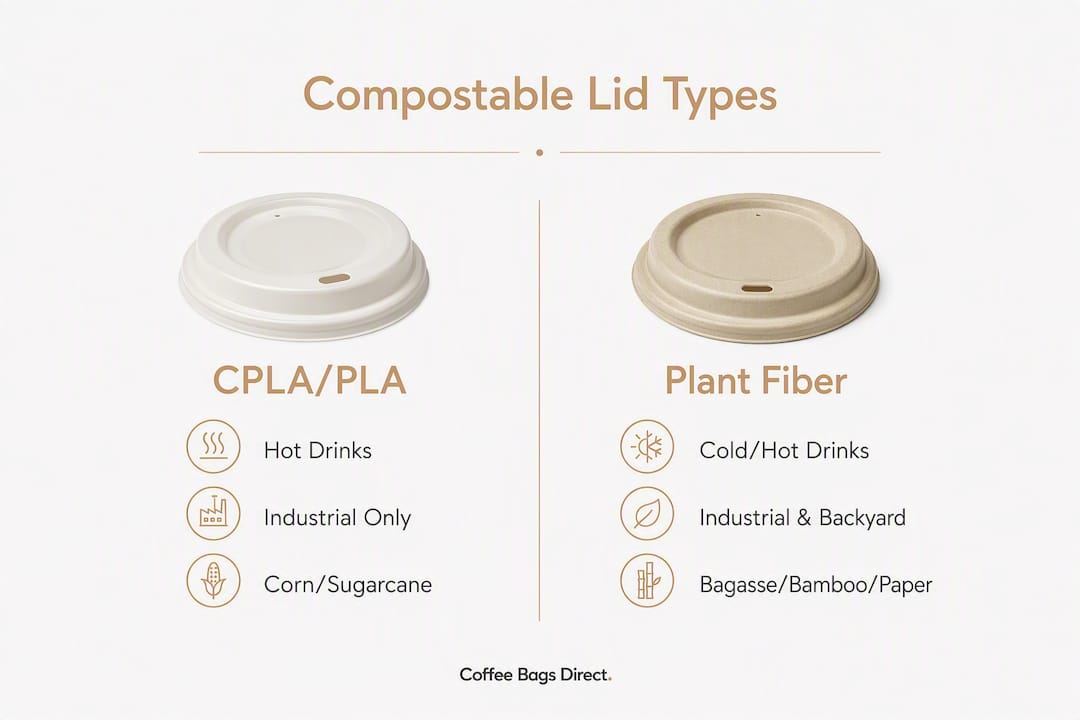
Standard PLA is a different story. It is derived from corn starch or sugarcane and performs well for cold or refrigerated drinks, but it softens and can deform when filled with hot liquids. PLA cold sip lids are certified compostable for commercial composting and are suitable for iced coffee, cold brew, and chilled beverages. They can be refrigerated or frozen but should not be microwaved or used with hot drinks.
Both CPLA and standard PLA require industrial composting conditions to break down. Neither is suitable for backyard compost piles.
Molded plant-fiber lids (bagasse, bamboo, paper fiber)
Bagasse lids are pressed from sugarcane pulp, a byproduct of sugar production. They are typically home-compostable, plastic-free, and increasingly available with explicit no-added-PFAS declarations from suppliers. The drinking experience differs from bioplastic: fiber lids have a slightly textured rim and a more natural feel. Sip-through designs in fiber are improving, but clarity is not possible with this material since it is always opaque.
Key performance notes across all material types:
- Temperature range: CPLA is suitable for hot beverages, standard PLA is suited for cold use only, and bagasse/fiber are generally suitable for hot and cold, check supplier specs.
- Rigidity: CPLA is firm and snaps onto cups cleanly. Fiber lids can vary in rigidity depending on thickness and pressing method.
- Clarity: PLA can be produced in clear or translucent form for cold cups. CPLA and fiber lids are opaque.
- Common failure modes: Standard PLA warps with hot liquids. Fiber lids can soften if submerged in liquid for extended periods. CPLA lids may crack in very cold temperatures if the formulation is not optimized.
Pro Tip: Before placing any bulk order, request a physical sample and test it with your actual cups filled with your actual beverages at serving temperature. A lid that fits perfectly on an empty cup can leak or pop off under the weight and heat of a full drink.
Which certifications actually matter for U.S. buyers?
The certification landscape is where most purchasing mistakes happen. A green label and the word “compostable” on a product page are not enough.
| Certification | What it means | Composting route | U.S. applicability |
|---|---|---|---|
| BPI (Biodegradable Products Institute) | Third-party verified to ASTM D6400 or D6868 | Industrial only | Widely recognized by U.S. facilities |
| CMA (Compost Manufacturing Alliance) | Tested in real commercial composting conditions | Industrial only | Accepted by many U.S. compost facilities |
| ASTM D6400 / D6868 | Standard for compostable plastics/coatings | Industrial only | The underlying U.S. standard |
| TUV OK Industrial | European third-party industrial compostability | Industrial only | Recognized by some U.S. facilities |
| USDA BioPreferred | Biobased content, not compostability | N/A | Confirms plant-based origin, not end-of-life |
BPI certification and ASTM D6400/D6868 are the primary markers U.S. buyers should require from suppliers. CMA certification carries additional weight because it tests products in actual commercial composting facilities rather than laboratory conditions alone. USDA BioPreferred confirms that a product is made from renewable plant-based materials, but it says nothing about whether the lid will actually break down in a compost pile.
State-level rules add another layer. Colorado has explicit standards requiring clarity on compostable claims and may mandate specific on-product labeling or disclosures. Washington state has similar requirements. Some suppliers note directly on product pages that items are not intended for sale in Washington or Colorado unless specific labeling is applied. If you operate in either state, confirm labeling compliance with your supplier before ordering. For a broader view of regulatory certifications for food-contact packaging, cross-referencing federal and state requirements is worth the time.
Watch for these misleading phrases on product pages:
- “Eco-friendly” or “green” with no certification mark
- “Biodegradable” without a composting standard cited (biodegradable ≠ compostable)
- “Plant-based” without BPI, CMA, or ASTM documentation
- “Compostable” with no specification of industrial vs. home
How do you match lid style to your cup and beverage?
Lid style affects spill resistance, drinking experience, and sustainability profile. The right choice depends on what you are serving and how customers consume it.
Common lid styles and their best applications:
- Flat sip lids (hot): Standard for hot coffee and tea. CPLA flat lids with a small sip opening are the most common format for hot takeaway cups.
- Dome lids: Used for cold drinks with whipped cream or blended beverages. Available in PLA for compostable cold service.
- Strawless sip lids: A raised sip spout replaces the straw slot. Reduces material complexity, eliminates the need for a separate straw, and suits iced coffee and cold brew. Strawless sip lids certified for commercial composting are available in PLA for cold use.
- Straw-slot lids: Accommodate a straw but the slot can compromise the seal if not designed tightly. Pair with compostable paper straws to maintain a fully compostable service set.
- Sip-through fiber lids: Molded bagasse or paper fiber with a drinking rim. Best for hot drinks when home composting is the end-of-life plan.
Confirming cup-to-lid fit
Lid compatibility is not universal. A lid rated for “12–20 oz cups” from one manufacturer may not fit cups from another, even at the same nominal size. Use this checklist before bulk ordering:
- Measure the cup’s top inner diameter to the nearest millimeter.
- Check the lid’s listed rim diameter and fit tolerance in the supplier’s spec sheet.
- Confirm the lip profile: rolled-rim cups require a different lid than straight-wall cups.
- Test the lid on a filled cup at serving temperature, not just an empty one.
- If you serve multiple cup sizes, ask whether the supplier offers a one-size-fits-multiple lid or whether you need separate SKUs.
Straw slots improve convenience but create a weak point in the seal. Strawless sip lids address this and reduce the total number of compostable items per order, which simplifies your waste stream.

Do compostable lids actually break down, or is that a myth?
The honest answer: it depends entirely on where the lid ends up after use.
CPLA and PLA lids are engineered for industrial composting. They require the sustained high temperatures, moisture levels, and microbial activity found in commercial composting facilities to break down within a reasonable timeframe. A CPLA lid placed in a backyard compost bin will not fully decompose. It may sit there for years, looking intact. This is not a defect in the product; it is a material property that buyers need to understand before choosing it.
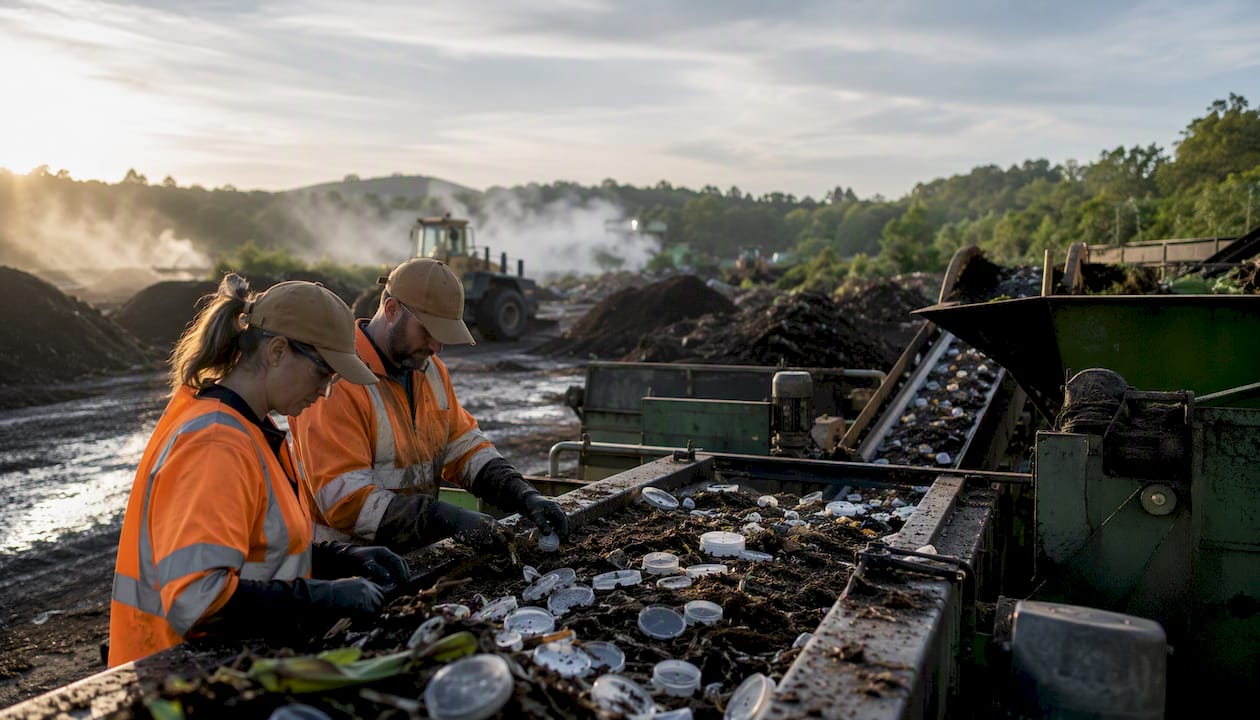
Bagasse and molded plant-fiber lids behave differently. Because they are made from actual plant material rather than bioplastic, many are certified for home composting and will break down in a well-managed backyard pile. Suppliers increasingly market these as plastic-free options with no-added-PFAS, which addresses a separate but growing concern about chemical coatings in food-contact packaging.
The infrastructure gap is the real issue. Certified compostability is facility-dependent: a lid can carry a BPI mark and still end up in a landfill if no local commercial facility accepts that waste stream. Before committing to CPLA lids, verify that a commercial composting facility in your area accepts food-service compostables. Resources like CompostNow and the US Composting Council’s facility directory can help you locate services by zip code.
Pro Tip: If you run a café, label your waste bins with the specific lid type and composting route. “Compostable — commercial facility only” prevents customers from tossing CPLA lids into home compost bins or, worse, the recycling stream.
According to the EPA, compostable plastics like PLA are not suitable for recycling and can contaminate recycling streams if sorted incorrectly — a risk that increases when products are not clearly labeled at the point of disposal.
What should businesses check before placing a bulk order?
Procurement mistakes with compostable lids tend to fall into three categories: wrong material for the composting infrastructure, wrong fit for the cup, or missing certification documentation when an auditor or regulator asks. A structured buying process prevents all three.
Vendor checklist — request these before ordering:
- Material spec sheet (CPLA, PLA, bagasse, or fiber blend)
- Certification documents: BPI, CMA, TUV, or ASTM D6400/D6868 PDFs
- Temperature range and hot/cold use designation
- PFAS declaration (no-added-PFAS or PFAS-free statement)
- State-specific labeling compliance (especially WA and CO)
- Rim diameter and cup compatibility data
Suppliers commonly provide CMA, TUV, or BPI certificates on product pages or on request. If a supplier cannot produce a certification PDF, treat that as a red flag regardless of how the product is marketed.
Step-by-step first bulk order process:
- Request a sample pack covering the lid styles and sizes you need.
- Run a fit test with your actual cups at serving temperature and fill level.
- Confirm your local composting infrastructure accepts the material type.
- Place a small pilot order (typically one to two cases) and run a two-week operational trial.
- Audit your waste stream: are lids actually reaching the compost bin, or are they being discarded in general waste?
- Place the full bulk order once fit, composting route, and staff handling are confirmed.
For sustainable coffee service packaging, lead times on certified compostable lids can run two to four weeks for standard stock and longer for custom-printed or specialty items. Build that into your inventory planning.
Common myths about compostable lids, corrected
Myth vs. fact:
- “Compostable lids can go in the recycling bin.” False. PLA and CPLA are not recyclable through standard curbside programs and actively contaminate recycling streams. The EPA confirms that compostable plastics should not be placed in recycling bins.
- “All compostable lids will break down at home.” Only fiber/bagasse lids with a home-composting certification will. CPLA and PLA require industrial composting conditions.
- “Biodegradable means the same as compostable.” It does not. Biodegradable has no regulated timeframe or end-product standard in the U.S. Compostable has specific standards (ASTM D6400/D6868).
- “A green leaf logo means it’s certified.” Not necessarily. Verify the specific certification body (BPI, CMA, TUV) and request the certificate number.
Lifecycle tradeoffs are real too. CPLA and PLA lids require agricultural inputs, processing energy, and transport. If the lid ends up in a landfill because no local facility accepts it, the environmental benefit over conventional plastic is minimal. Fiber lids carry lower carbon intensity when home composting is the end-of-life plan, and they avoid the bioplastic processing chain entirely. When your business has no access to commercial composting, a certified home-compostable bagasse lid is the more defensible choice, even if it feels less “high-tech.”
Consumers frequently misread recycling symbols and assume lids with numbers or plastic icons are recyclable. Clear on-lid labeling and brief staff training at the point of service reduce contamination rates significantly.
Which lid should you choose for your situation?
| Scenario | Recommended material | Composting route | Temperature | Key verification step |
|---|---|---|---|---|
| Café with commercial compost hauler | CPLA (hot) / PLA (cold) | Industrial facility | CPLA suitable for hot beverage temperatures | Confirm hauler accepts food-service compostables |
| Business without composting access | Bagasse / molded fiber | Home compostable | Hot and cold (check specs) | Request home-compost certification PDF |
| Cold-drink-only service | PLA strawless sip lid | Industrial facility | Cold/refrigerated only | Verify BPI or CMA mark on product page |
| Mixed hot and cold menu | CPLA (hot) + bagasse (cold) | Industrial + home | Per material | Test fit across all cup sizes before bulk order |
Before you order in bulk: Request the certification PDF, confirm your local composting facility accepts the material, and run a physical fit test with your actual cups at serving temperature. These three steps prevent the most common and costly ordering mistakes.
Key Takeaways
Certified compostable cup lids only deliver their environmental benefit when the material matches the composting infrastructure available at your location.
| Point | Details |
|---|---|
| Match material to infrastructure | CPLA/PLA requires industrial composting; bagasse suits home composting or low-infrastructure areas. |
| Verify certification before ordering | Require BPI, CMA, or ASTM D6400/D6868 PDFs from suppliers, not just a green logo. |
| Test fit before bulk purchase | Confirm rim diameter, lip profile, and performance at serving temperature with your actual cups. |
| Label disposal clearly | Mark bins with the specific composting route to prevent recycling contamination. |
| Coffeebagsdirect for procurement support | Coffeebagsdirect offers material selection guidance, sample requests, and custom printing for cafes and food brands. |
Why infrastructure-first thinking changes everything
The packaging industry has spent years marketing compostable products as a straightforward swap for conventional plastic. The reality is more nuanced, and buyers who understand that nuance make better decisions.
The most common mistake we see is businesses choosing CPLA lids because they carry a BPI mark, without first confirming that their city or hauler actually accepts them. The certification is real. The composting infrastructure often is not. That gap is where good intentions become landfill.
The infrastructure-first approach flips the decision sequence: start with your waste stream, then choose your material. If commercial composting is available and your hauler accepts food-service compostables, CPLA is a strong, well-tested choice for hot drinks. If it is not, a certified home-compostable bagasse lid is more honest about its end-of-life outcome, even if it feels less familiar.
Coffeebagsdirect’s partnership with APCO and our focus on recyclable and compostable packaging standards reflects this same thinking: certification matters, but so does the practical path from cup to compost. We work with cafes and food brands to match packaging choices to real operational conditions, not just marketing claims.
Coffeebagsdirect can help you source and print the right packaging
Choosing the right compostable lid is only part of the picture. Your cups, bags, and labels need to work together as a cohesive, compliant packaging system, and that is where Coffeebagsdirect adds real value for cafes and food brands.
Coffeebagsdirect offers material selection guidance, sample requests, and custom printed coffee packaging with express digital printing for fast turnaround. Whether you need help confirming cup-to-lid compatibility, sourcing certified compostable materials, or printing compliant labeling for states like Washington or Colorado, the team can walk you through your options. Small pilot orders are welcome, and the advisory support means you are not navigating certification documents alone.
Get in touch with Coffeebagsdirect to request samples, ask for compliance documentation, or get a quote on custom-printed cups and packaging that align with your sustainability goals.
Useful sources for verifying compostable lid claims
- U.S. EPA — Frequently Asked Questions About Plastic Recycling and Composting: Primary federal guidance on compostable plastics, recycling contamination, and disposal routes.
- BPI (Biodegradable Products Institute): Explains BPI certification requirements and what the mark means for U.S. buyers.
- US Composting Council — Facility Directory: Locate commercial composting facilities that accept certified compostable products.
- CompostNow — Compost Services Locator: Find compost haulers and drop-off services by zip code.
- Colorado Department of Public Health & Environment — Standards for Compostable Products: State-level labeling requirements for compostable products sold or used in Colorado.
- ASTM D6400 / D6868: The underlying U.S. standards for compostable plastics and coatings; request that suppliers cite the specific standard on their certification documents.
Keep certification PDFs on file from every supplier and run at least one pilot composting audit before scaling to full volume. Knowing your material is certified is the first step; confirming it actually reaches a composting facility closes the loop.
Recommended
- Are Paper Cups Recyclable in Australia? A Cafe Guide – Coffee Bags Direct
- Top 6 Compostable Coffee Cup Alternatives 2026 – Coffee Bags Direct
- Recyclable and Compostable Packaging: Australia Guide – Coffee Bags Direct
- Compostable vs Recyclable Coffee Bags: What Aus Roasters Need to Know – Coffee Bags Direct