
Mono Material Packaging: A Practical Brand Guide

Mono-material packaging is packaging built from a single resin family, such as polyethylene (PE), polypropylene (PP), or paper, so the entire structure can enter one recycling stream without mechanical separation. The business case is straightforward: when your pouch, valve, zipper, and film are all the same polymer, a materials recovery facility (MRF) or store drop-off program can process the unit as a clean, single-resin bale. For coffee roasters and food brands evaluating flexible pouches, stand-up bags, or tubes, the practical first step is a short feasibility pilot with your converter, covering sealing trials, accelerated shelf-life testing, and a disposal label check against How2Recycle guidance before committing to a full rollout.
- Mono-material means one dominant resin or material family across the entire pack, including closures and valves.
- The primary business case: simpler sorting, higher-quality recyclate, and a credible on-pack recyclability claim.
- Immediate next step: brief your converter, run a pilot SKU, and confirm your local film-collection or curbside acceptance pathway.
Table of Contents
- What “mono-material” actually means for your packaging
- Why mono-material packaging improves recyclability in the U.S.
- Common mono-material choices and barrier strategies that actually work
- Practical pros and cons for brand owners
- Your design-for-recycling checklist before switching
- How to plan your switch: timeline, costs, and pilot structure
- How mono-material packaging is actually recycled in the United States
- Key Takeaways
- The gap most brands miss when switching to mono-material
- Coffeebagsdirect’s mono-material coffee pouch service
- Sources and further reading
What “mono-material” actually means for your packaging
The term gets used loosely, so a working definition matters. A mono-material structure is one where a single resin or material family makes up at least 90–95% of the pack by weight, a threshold widely cited in industry analysis as the practical benchmark for recyclability claims. That means the film, zipper, degassing valve, and closure must all be the same polymer family — the entire pack must be at least 90–95% by weight of that single material, including all functional components.
What counts as mono-material and what does not:
Counts:
- A PE stand-up pouch with a PE zipper, PE valve, and PE-based ink system, where all components add up to ≥90–95% PE by weight
- A PP flexible tube where the body, cap, and shoulder are all polypropylene and total PP content meets the 90–95% threshold
- A mono-PET bottle with a tethered PET cap (cap stays attached, so it enters the same stream and the PET content is ≥90–95%)
- A kraft paper pouch with a paper-based liner and paper zipper strip, with total paper content ≥90–95%
Does not count:
- Any pack where incompatible components (foil, nylon, EVOH, or another resin family) exceed 5–10% by weight, regardless of dominant layer thickness
- Any pack where the closure (cap, valve, zipper) is a different resin family and pushes total content below the 90–95% threshold
- A paper bag with a foil inner liner, where foil content is more than 5–10% by weight
Common single material packaging formats you will encounter in practice include mono-PE coffee pouches, BOPP/CPP flexible snack bags, mono-polymer squeeze tubes, and single-resin bottles with tethered caps. For coffee specifically, a PE film pouch with a PE zipper and a PE-bodied degassing valve is the most widely adopted mono-material design in the specialty roasting segment.
Why mono-material packaging improves recyclability in the U.S.
Single-resin designs reduce the need for component separation and increase the chance that material re-enters circular streams. That is the core claim, and it holds up in practice because sorting economics drive recycling outcomes in the United States.
At a typical U.S. MRF, optical sorters identify resin types by near-infrared (NIR) spectroscopy. A multilayer laminate combining PE, nylon, and aluminum confuses the sorter or, more often, gets rejected entirely and sent to landfill. A mono-PE pouch reads as PE, routes to the PE film bale, and exits as a cleaner feedstock for reprocessing. Shell Polymers notes that single-resin systems allow the entire unit, including bag, valve, and closure, to be processed as one, reducing energy and cost during sorting.
The U.S. flexible film gap: Most curbside programs in the United States still do not accept flexible films, regardless of resin type. For mono-material flexible pouches, store drop-off programs, such as the How2Recycle Store Drop-Off label pathway, are currently the more reliable recovery route. Confirming acceptance with your local film-collection program before printing a recyclability claim is not optional.
The circularity argument extends beyond sorting. Research on packaging design and food-loss reduction shows that packaging which protects product integrity while remaining recoverable at end of life delivers a double sustainability benefit: less food waste and less packaging waste. Mono-material designs, when properly specified, can achieve both.
Industry analysis also frames mono-material adoption as central to meeting the EU’s goal of making 100% of packaging recyclable or reusable by 2030. While U.S. federal regulation has not set an equivalent mandate, Extended Producer Responsibility (EPR) legislation is advancing in states including California, Colorado, Oregon, and Maine, and mono-material designs are consistently better positioned under recyclability scoring frameworks those programs use.
Common mono-material choices and barrier strategies that actually work
The short answer: PE (LDPE, HDPE, and MDO-PE), PP (BOPP and CPP), mono-PET for certain rigid formats, and paper for dry goods are the four primary material families for single material packaging. The harder question is how to maintain oxygen and moisture barrier performance without reverting to a multilayer laminate.
Peer-reviewed polymer research documents several viable strategies for improving barrier performance in mono-polyolefin films through surface treatments and film orientation, without adding incompatible layers. The practical toolkit includes:
- Machine-direction orientation (MDO-PE): Stretching PE film in the machine direction improves stiffness and barrier properties, making it a viable base for coffee and food pouches that previously required nylon or foil layers.
- Metallization on mono-PE or mono-PP: Thin aluminum metallization applied to a PE or PP substrate can remain within the recyclability threshold if the metal layer stays below the 5–10% weight limit. Confirm with your recycler.
- Polymer-based barrier coatings: Aqueous coatings (PVOH, acrylic) and PLA-based coatings are both used as barrier layers on mono-material substrates. Aqueous coatings are generally more compatible with film recycling streams because they de-ink more cleanly; PLA coatings can interfere with PE recycling if they are not removed during reprocessing. When evaluating aqueous vs. PLA liner options, the key question is whether your film recycler accepts the coated structure.
- High-barrier mono-polyolefin films: Advanced materials research describes coating and nanomaterial approaches that deliver high barrier performance in mono-material formats, including nanocomposite coatings applied to PE or PP substrates.
- De-inking-friendly ink systems: Printing directly on mono-PE or mono-PP requires inks that release cleanly during the wash step in film recycling. Solvent-based inks with strong adhesion to the substrate can contaminate the recyclate; water-based or UV-curable inks designed for de-inking compatibility are preferred.
| Material | Typical barrier strength | Common uses | U.S. recyclability stream |
|---|---|---|---|
| MDO-PE | Moderate (improved vs. standard LDPE) | Coffee pouches, food bags | Store drop-off (film) |
| BOPP/CPP | Moderate to good | Snack bags, dry food | Store drop-off (film) |
| Mono-PET | Good | Bottles, trays | Curbside (rigid) |
| Kraft paper (>90% paper) | Low to moderate | Dry goods, coffee | Paper/cardboard curbside |
| Metallized mono-PE | Good (if within weight threshold) | Coffee, barrier pouches | Store drop-off (verify) |
Peer-reviewed studies on polymer composition and recyclability confirm that additives, colorants, and coating chemistry all affect recyclate quality, which is why material selection needs to be validated with your specific recycler, not just against a generic resin code.
Pro Tip: Before specifying a barrier coating, request a de-inking compatibility test from your film recycler or converter. A coating that looks recyclable on paper can still contaminate a bale if it does not release cleanly at the wash temperature used by your local reprocessor.

Practical pros and cons for brand owners
Mono-materials improve recyclability and your sustainability story, but they require honest trade-offs in barrier performance and up-front capital. Here is what that looks like in practice.
Advantages:
- Higher recyclability and a cleaner on-pack claim (store drop-off or curbside, depending on format)
- Simpler material declarations for EPR reporting and retailer sustainability scorecards
- Potential production savings from eliminating lamination steps in some formats
- Stronger brand story for sustainability-focused retail buyers and consumers
- Easier color matching across a single-resin substrate
Challenges worth planning for:
Barrier performance is the most common sticking point. Standard mono-PE film does not match the oxygen transmission rate (OTR) of a PE/nylon/foil laminate, which matters for whole-bean coffee with a 12-month shelf-life target. Peer-reviewed evidence on recycling system impacts and material-performance trade-offs confirms that OTR and water vapor transmission rate (WVTR) trade-offs are real and measurable in mono-polymer films, and that engineering solutions (MDO, coatings, metallization) close the gap but rarely eliminate it entirely.
Sealing windows also shift. Mono-PE films seal at different temperatures and dwell times than multilayer laminates, and your existing sealing bars may need recalibration or replacement. This is an operational cost that brands frequently underestimate in the initial business case.
Supply chain and cost: mono-material films, particularly MDO-PE and high-barrier coated variants, often carry a price premium over commodity multilayer laminates at lower volumes. That premium typically narrows as order volumes grow and as converter experience with the material increases.
Your design-for-recycling checklist before switching
Start with this sentence: confirm your target recyclability pathway before you specify a single material. Everything else follows from that.
- Define your recyclability target. Curbside rigid (PET bottle), store drop-off flexible film (PE pouch), or paper curbside? Each pathway sets different material constraints.
- Select the resin family. Choose PE, PP, PET, or paper based on your format, fill, and shelf-life requirements. Confirm food-contact approval for the U.S. market (FDA 21 CFR compliance).
- Specify barrier strategy. Choose MDO orientation, aqueous coating, metallization, or high-barrier mono-polyolefin film. Document the weight percentage of each layer.
- Verify the 90–95% threshold. Calculate total pack weight by material. If any incompatible component (foil, nylon, EVOH) exceeds 5–10% by weight, the structure is not mono-material.
- Select closures and valves. Zipper, degassing valve, and cap must be the same resin family as the film. Request resin certification from your closure supplier.
- Choose ink and adhesive systems. Specify de-inking-compatible inks and adhesives. Ask your converter for a wash-test result or recycler compatibility letter.
- Run accelerated shelf-life testing. Test at conditions relevant to your product (temperature, humidity, light exposure) for the target shelf life. Do not skip this step for coffee or food products.
- Conduct a sealing trial. Run production-scale sealing at your converter’s facility. Confirm seal strength, sealing window, and line speed before approving the spec.
- Verify MRF or program acceptance. Send a sample to your target film recycler or MRF. Confirm the structure is accepted before printing a recyclability claim.
- Update on-pack disposal messaging. Add a How2Recycle label or equivalent disposal instruction. Match the label to the verified collection pathway (store drop-off vs. curbside).
- Plan PCR content. Ask your converter about post-consumer recycled (PCR) content availability for your chosen resin. Even 30% PCR content strengthens your sustainability claim.
Supplier questions to ask your converter:
- What resin family and grade do you recommend for our fill and shelf-life requirements?
- What is the sealing window (temperature range, dwell time, pressure) for this film?
- Which ink and adhesive systems are de-inking-compatible with this substrate?
- Can you provide a recycler compatibility letter or wash-test result?
- What is your minimum order quantity for this mono film, and what are lead times?
- Do you have experience with FDA 21 CFR food-contact approvals for this structure?
Pro Tip: Run a combined pilot: production-scale sealing trial plus a 4–8 week accelerated shelf-life test plus a physical sample submission to your target film recycler, all in the same 6–8 week window. Doing them sequentially adds months to your timeline.
How to plan your switch: timeline, costs, and pilot structure
A realistic pilot-to-launch timeline runs 6–12 weeks for a focused pilot SKU and 3–9 months for a phased commercial rollout, depending on the complexity of your format and the number of SKUs involved. The range is wide because shelf-life requirements, converter readiness, and regulatory approvals all vary.
Key cost drivers:
- Raw material premium: MDO-PE and high-barrier coated mono films typically cost more per kilogram than standard multilayer laminates at equivalent volumes. The gap narrows above certain volume thresholds.
- Tooling and sealing changes: Sealing bar replacement or recalibration, and potentially new forming tooling if your pouch geometry changes.
- R&D and shelf-life testing: Accelerated shelf-life testing for food and coffee products, plus any third-party lab fees for barrier property verification.
- Printing setup: If you switch ink systems for de-inking compatibility, expect a printing setup cost and potentially a color-matching trial.
- Labeling updates: New on-pack disposal messaging, How2Recycle label licensing, and artwork revisions.
Pilot plan:
Define three KPIs before you start: sealing yield (percentage of packs that pass seal integrity testing), shelf-life result (measured OTR/WVTR vs. target), and recycling acceptance (confirmed by your target MRF or film-collection program). Run a small-volume production batch, typically 500–2,000 units, at your converter’s facility. Submit samples to your target film recycler. Review results against KPIs before approving the commercial spec.
Supplier selection criteria for U.S. brands:
- In-house technical support and access to a testing lab for barrier and seal verification
- Experience printing on mono-PE or mono-PP substrates with de-inking-compatible inks
- FDA 21 CFR food-contact compliance documentation for the chosen resin and coating
- Demonstrated experience with How2Recycle label coordination or equivalent U.S. recyclability programs
- Ability to supply PCR content at your target volume
How mono-material packaging is actually recycled in the United States
Effectiveness depends entirely on format. Rigid mono-material bottles, such as mono-PET or mono-HDPE, are well-supported in most U.S. curbside programs and process cleanly through NIR-based optical sorters at MRFs. Flexible mono-material films are a different story.
At a U.S. MRF, flexible films of any resin type, including mono-PE pouches, are typically screened out early in the sorting process because they wrap around conveyor belts and jam equipment. Most curbside programs explicitly exclude flexible films. Industry guidance from Shell Polymers confirms that flexible mono films often rely on store drop-off for reliable recovery in the U.S., and that the mismatch between curbside streams and flexible film recovery is a known operational gap.
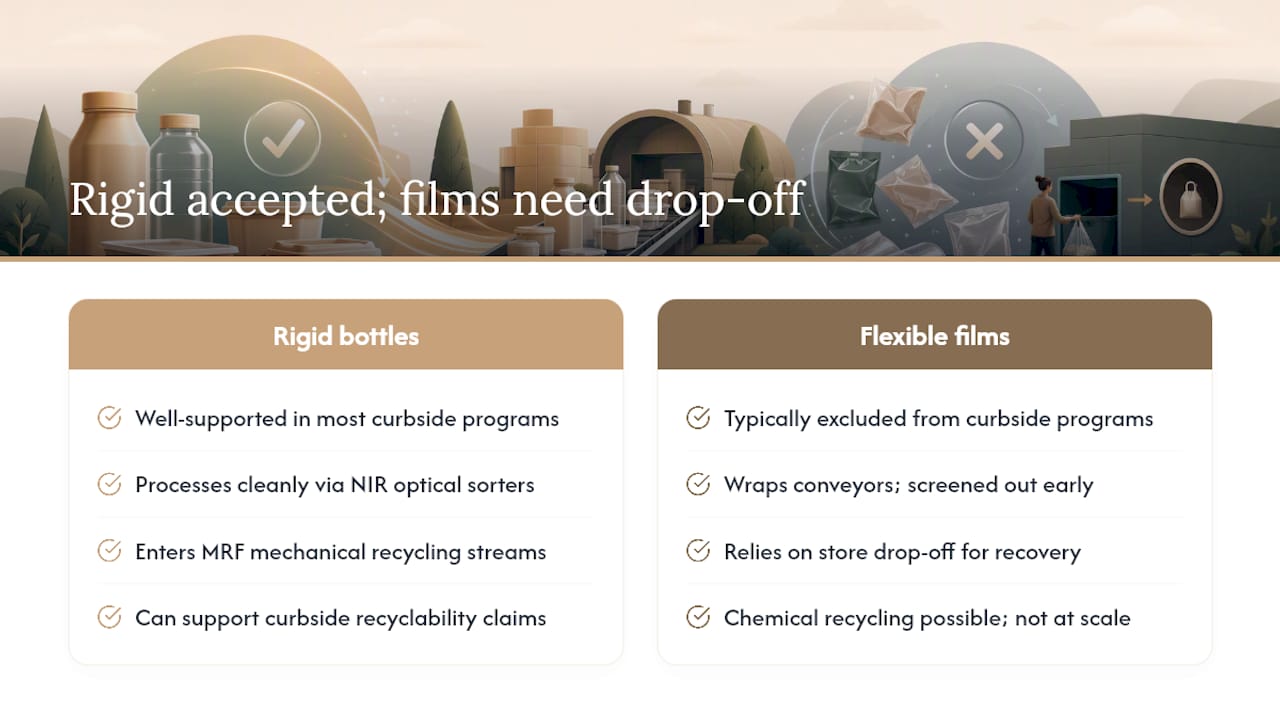
Store drop-off programs, such as those coordinated through How2Recycle’s Store Drop-Off label, accept clean, dry flexible films at participating retail locations. Acceptance criteria typically require that the film be a single resin (PE or PP), free of food residue, and not laminated to incompatible materials. Mono-PE pouches that meet these criteria can enter the store drop-off stream and be baled and sold to film reprocessors.
Advanced recycling (chemical or pyrolysis-based) is an emerging alternate end-of-life route for flexible films that do not qualify for mechanical recycling. Several U.S. facilities accept mixed flexible films for chemical recycling, though this pathway is not yet at scale and should not be the primary claim basis for a recyclability label.
Statistic context: The Association of Plastic Recyclers and industry data consistently show that flexible film recovery rates in the U.S. remain low relative to rigid plastics, underscoring why confirming your specific film’s acceptance in a real program, not just its resin type, is the only reliable basis for a recyclability claim.
Pro Tip: Before printing “Store Drop-Off Recyclable” on your pouch, physically submit a sample to a How2Recycle-participating film drop-off location and confirm acceptance in writing from the program coordinator. Resin type alone does not guarantee acceptance.
Key Takeaways
Mono-material packaging delivers its recyclability benefits only when the entire pack, including closures, valves, and coatings, stays within one resin family and is confirmed as accepted by a real U.S. collection program.
| Point | Details |
|---|---|
| Define recyclability pathway first | Confirm store drop-off or curbside acceptance before specifying any material or coating. |
| Apply the 90–95% threshold | All components, including zipper, valve, and closure, must be the same resin family and together constitute at least 90–95% of the total pack weight to meet the mono-material benchmark. |
| Barrier gaps are solvable | MDO-PE, aqueous coatings, and metallization close most OTR/WVTR gaps without adding incompatible layers. |
| Flexible films need store drop-off | U.S. curbside programs generally exclude flexible films; store drop-off via How2Recycle is the primary verified pathway. |
| Coffeebagsdirect supports the full switch | From material selection and pilot sample runs to custom printed mono-material coffee pouches and recycling program coordination. |
The gap most brands miss when switching to mono-material
The most common mistake brands make when switching to single material packaging is treating resin type as a proxy for recyclability. It is not. A mono-PE pouch that has never been submitted to a real film-collection program is not recyclable in any practical sense, regardless of what the resin code says.
Two non-obvious pitfalls come up repeatedly. The first is sealing window mismatch: MDO-PE and standard LDPE seal at different temperatures, and brands that skip a production-scale sealing trial end up with seal failures on the commercial line, which is an expensive lesson. The second is assuming that curbside acceptance equals actual acceptance. Most U.S. curbside programs do not accept flexible films at all, and even store drop-off programs have specific criteria around cleanliness, resin type, and coating compatibility that a generic “recyclable” claim does not satisfy.
The practical fixes are straightforward. Run a combined pilot that includes a production-scale sealing trial, an accelerated shelf-life test, and a physical sample submission to your target collection program, all within the same 6–8 week window. Measure three KPIs: sealing yield, shelf-life result against your OTR/WVTR target, and confirmed recycling acceptance in writing. Those three data points are the only honest basis for a recyclability claim, and they are what separates a credible sustainability story from a marketing claim that will not survive scrutiny.
Coffeebagsdirect’s mono-material coffee pouch service
Custom mono-material coffee pouches, built to your spec and printed with your brand, are exactly what Coffeebagsdirect delivers for roasters and food brands ready to make the switch. The practical advantage over sourcing materials and printing separately: you get material selection guidance, express digital printing on mono-PE and mono-PP substrates, pilot sample runs for feasibility testing, and coordination support for recycling program verification, all from one supplier who understands the full conversion path.
Services include:
- Custom mono-material stand-up pouches and side gusset bags in PE, PP, and kraft paper formats
- Express digital printing with de-inking-compatible ink systems
- Small-volume sample runs for pilot and shelf-life testing
- Custom printed labels for on-pack disposal messaging and How2Recycle compliance
- Material selection advisory covering barrier strategy, PCR content, and FDA 21 CFR food-contact compliance
For roasters who want to understand the full range of recyclable and compostable options before committing to a spec, Coffeebagsdirect’s guide to recyclable coffee packaging covers the key decision points in plain language. When you are ready to move from research to production, request a sample or get a quote for custom printed coffee bags to start your pilot.
Sources and further reading
The following sources informed the technical claims and practical guidance in this article. Each is recommended for engineering, procurement, and sustainability teams who need to go deeper on specific topics.
“Mono-material packaging removes the need to separate different polymers during recycling, simplifying sorting and improving recyclate quality. Single-resin systems allow entire units, including bag, valve, and closure, to be processed as one, reducing energy and cost during sorting.” — Shell Polymers, Boost Sustainability with Mono-Material Packaging
-
Shell Polymers, “Boost Sustainability with Mono-Material Packaging” — Boost sustainability with mono-material packaging. Covers reduced separation needs, MRF vs. store drop-off differences, sealing and shelf-life testing hurdles, and converter trial guidance. Primary reference for implementation and end-of-life sections.
-
SmartPackagingHub, “Monomaterial Packaging: Pros, Cons, and Perspectives” — Monomaterial Packaging: Pros, Cons, and Perspectives. Covers the 90–95% threshold, regulatory drivers including EU 2030 targets, and market trend analysis. Recommended for sustainability leads and policy context.
-
Peer-reviewed: Resources, Conservation and Recycling — doi.org/10.1016/j.resconrec.2021.106126. Quantifies recycling system impacts and OTR/WVTR trade-offs for mono-material films. Essential reading for packaging engineers evaluating barrier performance data.