
Coffee Bag Valve: A Roaster's Specification Guide

A one-way degassing valve is a small, self-sealing disc device applied to a coffee bag that lets carbon dioxide (CO2) escape while blocking oxygen from entering. If you’re sealing whole-bean or ground coffee shortly after roasting, packaging in bags larger than a small portion, or targeting retail shelf lives beyond a few weeks, a valve-equipped bag is the right call.
Three quick signals that you need a valve:
- Bag size: 8 oz or larger (smaller bags may degas fully before sealing)
- Roast-to-pack timeline: sealing within 72 hours of roast
- Shelf life target: two weeks or more at retail or in transit
Industry targets for oxygen levels inside a properly valved, high-barrier bag run 0.5%–3.0%. Hitting that range requires matching the right valve to the right film, fill weight, and sealing timeline — not just adding any valve to any bag.
Key Takeaways
A one-way degassing valve works only as well as the film, fill weight, and sealing timeline it’s matched to — spec all three together, not the valve in isolation.
| Point | Details |
|---|---|
| Target oxygen range | Aim for 0.5%–3.0% residual oxygen inside a sealed bag; above 3.0% signals a valve, film, or process issue. |
| Valve sizing by fill weight | Use an 8 mm valve for 8–12 oz bags, a 10 mm valve for 1–2 lb bags, and dual valves for bulk packs above 2 lb. |
| QA test protocol | Weigh sealed samples at packaging, then reweigh at 24, 48, and 72 hours; weight loss confirms CO2 venting and correct valve sizing. |
| Sustainability compliance | A compostable claim requires both a certified compostable film (ASTM D6400) and a certified compostable valve; the valve alone disqualifies the bag. |
| Coffeebagsdirect | Supplies valve-equipped bags in compostable and recyclable film options, with custom printing and sample services to validate specs before a full production run. |
Table of Contents
- How does a coffee bag valve actually work?
- What valves do well — and where they fall short
- What valve types and specs should you actually check?
- A procurement checklist for buying valve-equipped bags
- Common valve failures and how to catch them early
- What the research actually tells roasters about valve performance
- Regulatory and food safety standards for coffee bag valves in the US
- Why most roasters underestimate the valve-film system
- Coffeebagsdirect supplies valve-equipped bags with custom printing and sample services
- Recommended resources for further reading
How does a coffee bag valve actually work?
The mechanism is straightforward. A small elastomer disc sits over a set of perforations in the bag wall. When internal CO2 pressure builds past the valve’s opening threshold, the disc lifts slightly, gas escapes, and the disc reseats. Oxygen cannot push the disc open from the outside because atmospheric pressure is lower than the pressure required to lift the disc from that direction. The result is a genuinely one-way flow.
Two numbers on a manufacturer’s datasheet matter most: opening pressure and flow rate. Opening pressure (typically expressed in millibars or inches of water column) tells you how much CO2 buildup is needed before the valve vents. A lower opening pressure is better for high-volume degassers like dark roasts and ground coffee. Flow rate tells you how much gas the valve can pass per unit of time. A valve with too low a flow rate for a fast-degassing coffee will let pressure build until the bag seams stress or the valve adhesive peels.
Valve placement on the bag also affects performance. Most manufacturers recommend positioning the valve on the front panel, roughly one-third down from the top seal, away from the bottom gusset. That placement keeps the valve clear of pooled oils and away from the seam stress zones that occur during filling and sealing.
When reviewing a datasheet, look for: opening pressure, closing pressure, rated flow (in cc/min or similar), approved film types, operating temperature range, and any food-contact compliance certifications. A credible spec sheet lists all six. CO2 release peaks in the first 24–72 hours after roasting, so high-volume operations that seal quickly need valves rated for that initial surge, plus confirmation that the adhesive holds through temperature cycling in transit.
Pro Tip: On incoming valve samples, press the center of the valve disc firmly with a fingertip from the outside. You should feel clear resistance. Then press from the inside of the bag (before sealing) — the disc should lift with noticeably less force. If both directions feel identical, the valve is not functioning as a true one-way device.
What valves do well — and where they fall short
One-way valves solve a specific problem: they let roasters package freshly roasted beans immediately without waiting for bulk degassing, which can take days. That means faster order fulfillment, no bloated or burst bags, and coffee that arrives with its volatile aromatics intact rather than off-gassed into a warehouse.
Practical benefits for roasters, retailers, and consumers:
- Sealing can happen soon after roasting, not requiring days’ delay.
- Bag integrity is maintained through transit and on-shelf storage.
- Consumers can squeeze the bag lightly and sniff through the valve as a quick freshness check before purchase
- CO2 released inside the bag helps displace residual oxygen, especially in the first 48 hours
- Valved bags often outperform transfer to canisters for short-term storage because the bag’s own CO2 displaces oxygen when reopened
Limitations are real and worth stating plainly:
- A valve does not stop oxidation once the bag is opened; after first opening, the coffee is exposed to ambient air on every subsequent access
- Valve service life is finite; a bag stored for 12+ months may have a valve that no longer seals reliably
- A valve cannot compensate for a low-barrier film; if the laminate allows oxygen transmission, the valve’s contribution is marginal
- Valves add per-unit cost and a potential failure point that vacuum or nitrogen-flushed packaging avoids
When to prefer nitrogen flushing or vacuum packaging: if your roast-to-pack window is longer than 5–7 days, or if you’re targeting premium shelf lives beyond 12 months, nitrogen flushing combined with a high-barrier film typically delivers lower residual oxygen than a valve alone. Vacuum packaging suits whole-bean specialty lots where some degassing has already occurred. For most commercial roasters sealing within 72 hours, a valve-equipped bag remains the most practical and cost-effective solution.
What valve types and specs should you actually check?
Valves come in a few common form-factors, and the right choice depends on your fill weight and degassing rate.
| Form-factor | Typical diameter | Recommended fill weight | Opening pressure guidance |
|---|---|---|---|
| Mini / standard | 8 mm | 8–12 oz | Moderate; suits whole-bean light-to-medium roasts |
| Standard / large | 10 mm | 1–2 lb | Lower opening pressure preferred for faster degassers |
| Dual valve | Two 8–10 mm | 2–5 lb bulk bags | Needed when single-valve flow rate is insufficient |
| Pre-laminated zone | Varies | Any | Valve integrated into film at manufacture; no adhesive step |
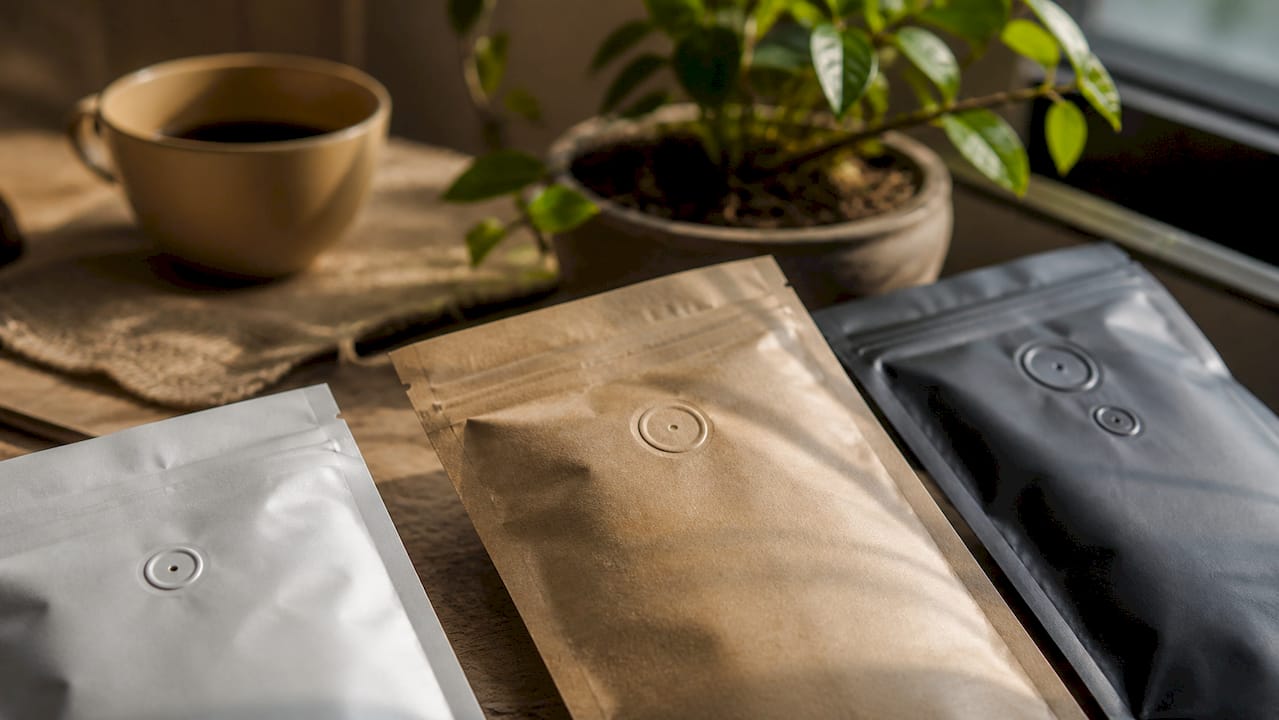
Valve sizing guidance comes from fill weight mapping: an 8 mm valve suits 8–12 oz bags, a 10 mm valve suits 1–2 lb bags, and larger or dual valves are needed for bulk packs. Undersized valves create back-pressure that stresses seams and can cause delamination.
The elastomer disc material matters for food safety. Request documentation confirming FDA food-contact compliance (21 CFR) or equivalent certification from your supplier. The disc and housing must also be compatible with your bag’s laminate; polypropylene-based films behave differently from foil laminates under heat-seal application.
Your spec checklist for every valve supplier:
- Opening pressure (mbar or inches H2O)
- Rated flow (cc/min at a stated differential pressure)
- Adhesive or attachment method (heat-seal vs. pressure-sensitive adhesive)
- Operating temperature range (storage, transit, and sealing conditions)
- Shelf life of the valve itself (before application and after)
- Compostable or biodegradable options and their certifications
Pro Tip: Convert your roast-to-pack timeline into valve requirements this way: if you seal within 6 hours of roast, you need a low opening pressure and a high flow rate to handle the CO2 surge. If you seal at 24–48 hours, a standard flow rate is usually sufficient. Ground coffee degasses roughly 50% faster than whole-bean, so always spec one flow-rate tier higher when packaging ground.
A procurement checklist for buying valve-equipped bags
Start every supplier conversation with these requests before placing any production order.
- Request a datasheet confirming opening pressure, rated flow, operating temperature range, and food-contact compliance certification.
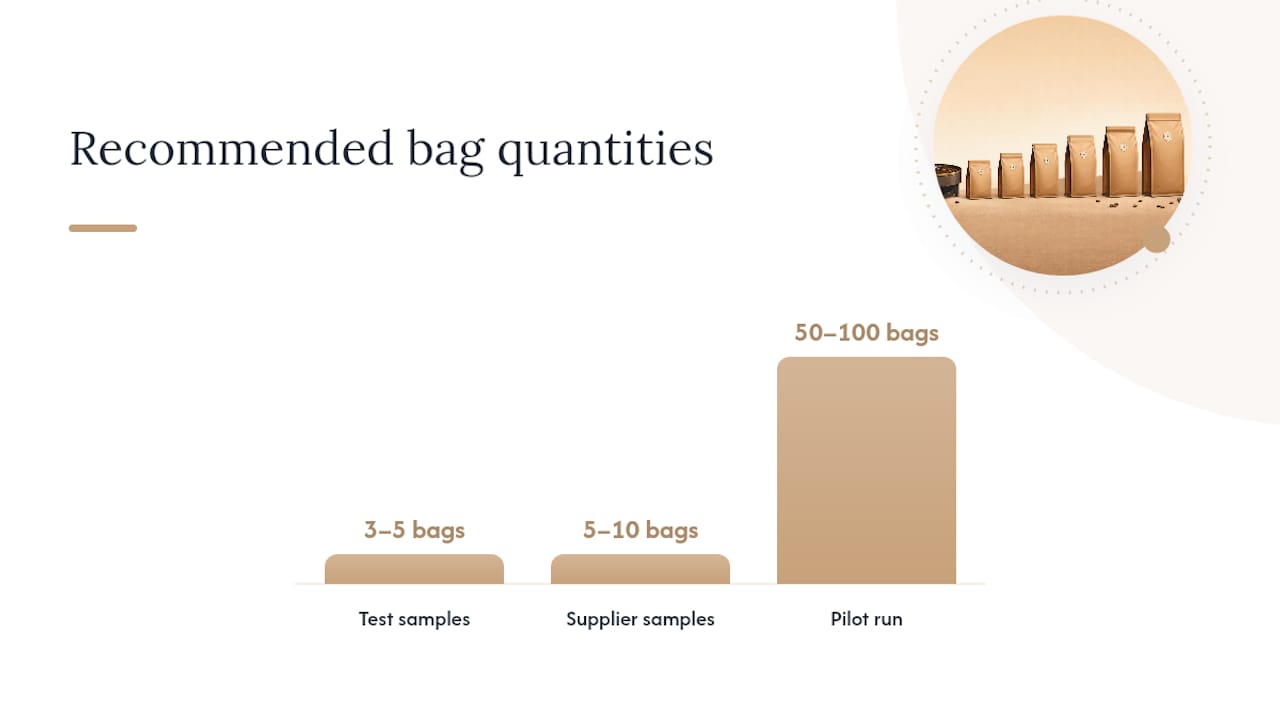
- Ask for 5–10 sample bags with the valve pre-applied to your chosen film and bag style.
- Confirm minimum order quantities (MOQs) for both valve bags and any custom-printed versions; MOQs vary significantly by print method (digital vs. rotogravure).
- Check lead times for both stock valve bags and custom-printed runs; factor in 2–4 weeks for custom printing plus any valve application lead time.
- Clarify printing constraints: valve placement must be accounted for in artwork; confirm the valve zone is excluded from the print area.
- Ask about failure rates and warranty: a credible supplier will state an acceptable defect rate (typically under 0.5%) and describe their replacement policy.
Sample test plan for 3–5 bags before a production run:
- Seal freshly roasted coffee into sample bags immediately after roasting.
- Weigh each bag on a calibrated scale and record the weight.
- Reweigh at 24, 48, and 72 hours. Weight loss indicates CO2 volume; this simple protocol reveals whether your valve’s flow rate matches your coffee’s actual degassing rate.
- Squeeze each bag firmly. The bag should vent through the valve, not through seams.
- Run a temperature cycle: 24 hours at 40°F, then 24 hours at 90°F. Recheck valve adhesion and seam integrity.
- Perform a sniff test through the valve: aroma should be detectable, confirming the valve is venting.
- Set acceptance criteria: no seam stress, no valve peel, weight loss consistent across all samples.
Pro Tip: Stage a small pilot run of 50–100 bags at your actual production cadence before committing to a full order. Run them through your normal fill, seal, and palletizing process. Failures that don’t appear in bench testing often show up under real production line vibration and stacking pressure.
Common valve failures and how to catch them early
The most frequent failures, and what each one usually signals:
- Valve delamination (peeling): adhesive-film incompatibility or incorrect heat-seal temperature during application
- Blocked valve: coffee oils or fine grounds have migrated into the valve disc; usually a placement or fill-height issue
- Slow or no opening: opening pressure too high for the coffee’s degassing rate, or disc has stiffened from cold storage
- False seal (oxygen ingress): disc is not reseating cleanly; often caused by contamination or a damaged elastomer
- Bag bloating despite valve: valve flow rate is undersized for the fill weight and degassing volume
QA checklist for incoming valve batches and finished bags:
- Visual inspection: valve disc should be centered, adhesive border fully bonded, no bubbles or lifted edges
- Pressure-squeeze test: squeeze the sealed bag; gas should exit through the valve only, not through seams
- Dye or leak test: for high-value runs, a methylene blue dye test or vacuum leak test confirms seal integrity
- Temperature cycling: as described in the sample test plan above
Pro Tip: The 24/48/72-hour reweigh routine is your lowest-cost QA tool. If weight loss plateaus before 24 hours, the valve may be blocked or undersized. If weight loss is negligible across all three intervals, the valve may not be opening at all.
What the research actually tells roasters about valve performance
Two rules hold up across published industry guidance. First, match valve flow capacity to your roast-to-pack timing: a valve that works well for a roaster sealing at 48 hours post-roast will be undersized for one sealing within 2 hours. Second, target bag oxygen levels of 0.5%–3.0% as your performance benchmark; anything above 3.0% indicates a film, valve, or sealing process issue.
Practical testing tactics supported by industry sources:
- Weight-loss CO2 measurement (24/48/72-hour reweigh) is the most accessible on-floor check
- Pressure and flow sampling on incoming valve batches catches manufacturing variation before it reaches production
- Temperature cycling confirms adhesive and elastomer durability for bags that will ship through variable climates
Supplier questions worth asking before you sign a purchase order:
- What is the valve’s rated operating temperature range (minimum and maximum)?
- What opening pressure is the valve calibrated to, and how was that figure tested?
- What is the stated service life of the valve after application?
- Is the valve certified for food contact under 21 CFR or an equivalent standard?
Pro Tip: A credible valve datasheet states opening pressure as a specific value or narrow range (e.g., 5–8 mbar), not a vague descriptor like “low pressure.” If a supplier cannot provide a numeric opening pressure, treat that as a signal to request a different product or supplier.
Regulatory and food safety standards for coffee bag valves in the US
In the United States, materials that contact food — including valve components — fall under FDA oversight. The relevant framework is Title 21 of the Code of Federal Regulations (21 CFR), specifically 21 CFR Part 177 (indirect food additives: polymers) and 21 CFR Part 175 (adhesives and coatings). Any elastomer disc, housing, or adhesive that contacts coffee or the interior of a coffee bag must be manufactured from materials listed or approved under these sections.
When sourcing valves, request a written statement of food-contact compliance from your supplier, citing the specific 21 CFR sections that apply to the valve’s materials. This is standard practice for any reputable valve manufacturer and should not require negotiation.
Beyond FDA materials compliance, the broader bag assembly must meet applicable food packaging regulations. If you are selling into retail channels, your packaging may also need to comply with state-level extended producer responsibility (EPR) laws, which are expanding across California, Oregon, Colorado, and other states. These laws increasingly require that packaging components, including valves, be recyclable or compostable to meet recyclability claims.
For organic-certified coffee, the USDA National Organic Program (NOP) does not currently restrict packaging materials, but some certifiers may ask for documentation that no prohibited substances migrate from packaging into the product. Keeping your supplier’s food-contact compliance documentation on file satisfies most audits.
This section provides general regulatory context, not legal advice. Confirm current requirements with the FDA, your state’s environmental agency, or a qualified compliance professional.
Why most roasters underestimate the valve-film system
The conventional advice is to add a valve to your bag and move on. The part that gets skipped is treating the valve and the film as a single system with interdependent performance variables.
A valve rated for a 10 mbar opening pressure on a standard foil laminate will behave differently on a PLA compostable film with higher gas permeability. The film’s own oxygen transmission rate changes how much work the valve needs to do. A roaster who switches to a compostable film without re-validating their valve spec may find that their residual oxygen levels creep above 3.0% not because the valve failed, but because the film is now contributing oxygen ingress the valve cannot compensate for.
The same logic applies to degassing rate. Ground coffee degasses faster than whole-bean, and dark roasts degas faster than light. A valve that performed well on your medium whole-bean may be undersized for a new dark espresso blend in the same bag format. The 24/48/72-hour reweigh test is not a one-time validation; it should be repeated whenever you change roast profile, grind setting, or bag film.
Sustainability choices add another layer. Compostable valves are available, but their elastomer properties differ from conventional options, and their service life under high-humidity storage conditions is shorter. If you’re making a compostability claim on your packaging, the valve certification documentation needs to be in your file before the bags go to print.
The practical takeaway: spec the valve, the film, and the sealing timeline together, test them together, and retest when any one of them changes.
Coffeebagsdirect supplies valve-equipped bags with custom printing and sample services
Coffeebagsdirect supplies valve-equipped coffee bags in a range of film options, including compostable, recyclable, kraft, metallic, and foil laminates, with custom digital and rotogravure printing available for roasters who need branded packaging at any volume.
The immediate next steps for your procurement process:
- Check lead times and MOQs for custom-printed valve bags, and confirm that your valve placement zone is excluded from the print area in your artwork setup
Coffeebagsdirect also provides material selection guidance and educational resources to help you match barrier performance with your sustainability goals, from roast to retail shelf.
Recommended resources for further reading
- Coffee Degassing Valve - Plitek
- Degassing Valves for Coffee Packaging - Plitek
- What Is That Valve on My Coffee Bean Bag? | America’s Test Kitchen
- Why a Coffee Bag Has a Valve and What It Can Tell You
- Why Coffee Bags Have Vents: The Valve Truth Roasters Miss - PackagingBest
- Why Do Coffee Bags Have Vents? All About Degassing Valves | ePac