
Espresso Coffee Bags for Australian Roasters: 2026 Guide

For espresso sold as whole bean or ground, a foil-laminate valve pouch with a nitrogen flush gives you the best balance of shelf life and practical sustainability. For single-serve formats, a porous inner steep bag paired with a nitrogen-flushed outer pouch is the correct architecture. Both approaches are available with compostable or recyclable substrates certified to AS 4736 (industrial) or AS 5810 (home), though you will accept a shorter shelf life when you move away from foil laminates.
Immediate use cases to match your format:
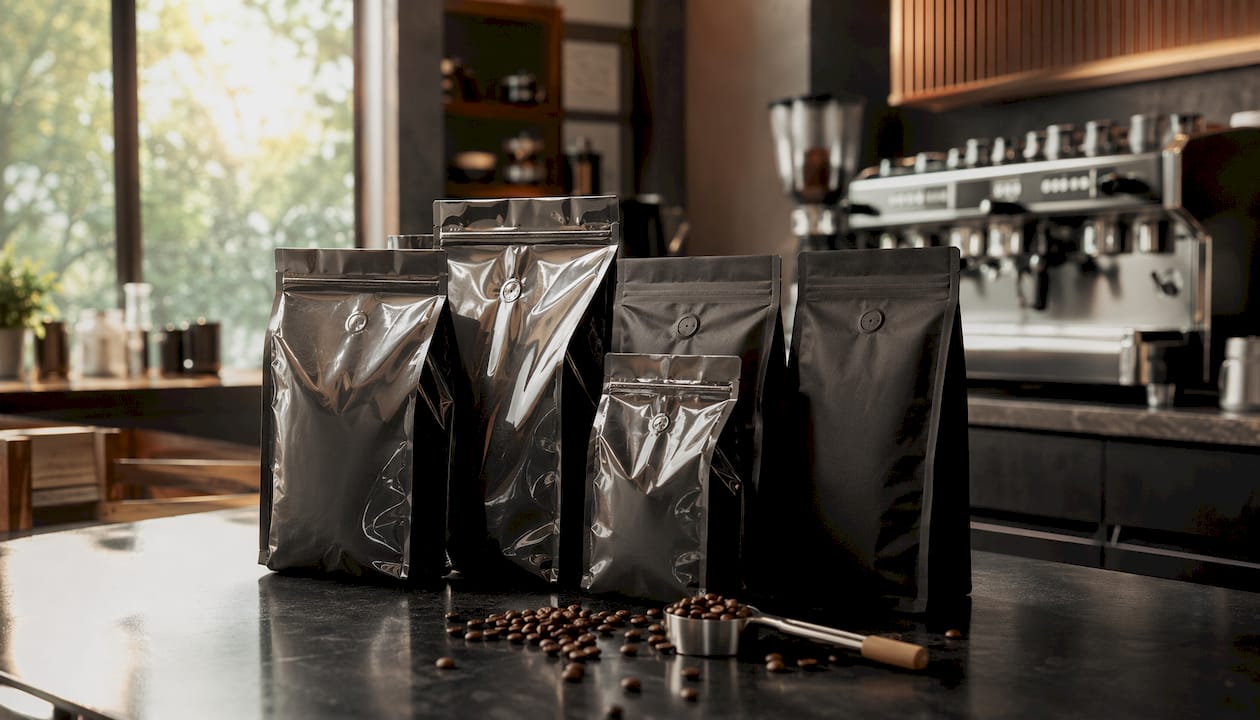
- Whole-bean retail: stand-up or side-gusset valve pouch, foil laminate or metallized film, 250g–1kg
- Ground espresso retail: valve pouch with high-barrier foil laminate; roast-to-pack timing is critical for shelf life
- Single-serve steep/drip bags: a typical single-serve inner filter inside a nitrogen-flushed outer sachet; ideal for gifting, hospitality, and subscriptions
Coffeebagsdirect offers samples, technical datasheets, and material guidance across all three formats.
Table of Contents
- Which espresso coffee bag format and material should you choose?
- Coffeebagsdirect makes it straightforward to test and scale
- Key Takeaways
Which espresso coffee bag format and material should you choose?
The table below maps the three main format and material classes against the decision dimensions that matter most for Australian roasters.
| Format / Material | Best For | Barrier & Shelf Life | Compostable Cert | Printing & Turnaround | MOQ / Price Band | Espresso Suitability | Lead Time |
|---|---|---|---|---|---|---|---|
| Foil-laminate valve pouch | Ground espresso retail, whole bean | High barrier; several months ground espresso | No | Digital (short-run) or rotogravure (large-run) | Low–mid MOQ / $ | Valve required for whole bean; excellent for ground | 2–4 weeks |
| Compostable valve pouch (AS 4736 / AS 5810) | Sustainability-led retail, café wholesale | Lower barrier; shorter typical shelf life | Yes — AS 4736 or AS 5810 | Digital or rotogravure | Mid MOQ / $$ | Valve compatible; confirm barrier spec with supplier | 3–5 weeks |
| Kraft/mono-poly pouch | Short shelf-life, local café direct | Moderate; shorter shelf life | Recyclable options available | Digital | Low MOQ / $ | Valve compatible; not ideal for extended retail | 2–3 weeks |
| Steep/drip sachet (~120×180 mm) | Gifting, hospitality, sampling | Outer pouch: same as bulk ground | Outer pouch can be certified | Digital express for proofing | Low MOQ / $ | Separate grind/dose needed; not a valve format | 2–4 weeks |
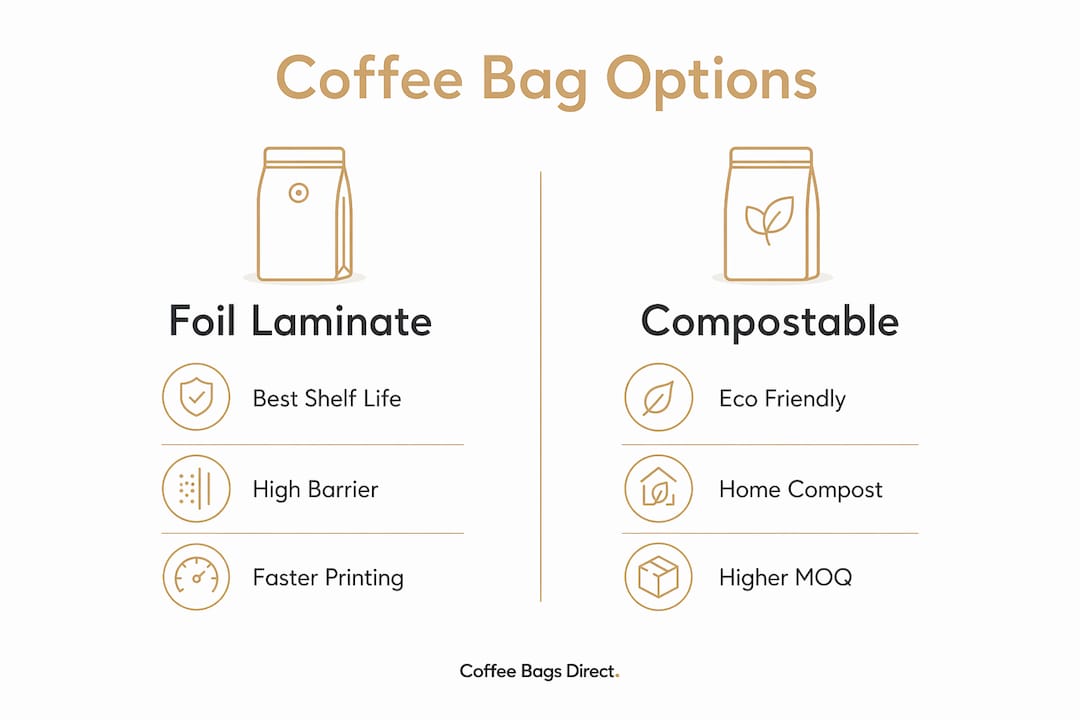
Barrier and shelf life in plain terms. Foil laminates deliver the oxygen and moisture protection that keeps ground espresso fresh for a relatively long period when roast-to-pack timing is controlled. Compostable substrates provide genuine sustainability credentials but lower barrier ratings, so realistic shelf life drops to a shorter period. That trade-off is the central decision for most roasters.
On compostable certification. AS 4736 covers industrial composting; AS 5810 covers home composting. Neither mark guarantees kerbside acceptance. Many councils do not accept certified compostable bioplastics in FOGO bins due to contamination risk, meaning a certified bag can still reach landfill. Verify your local council’s policy and print clear disposal instructions on pack.
Steep bags are a distinct product. The inner filter holds about a typical single-serve coffee dose; the outer sachet must provide the same barrier performance as bulk ground packaging. Critically, do not repackage your espresso grind directly into a steep bag. Adjust grind size, filter mesh, and dose to match the extraction profile the format requires.
Six questions to ask any supplier before ordering:
- What are the oxygen transmission rate (OTR) and moisture vapor transmission rate (MVTR) for this substrate?
- Can you provide a technical datasheet and third-party barrier test results?
- Which compostable certification does this material carry, and is it AS 4736 or AS 5810?
- What is your recommended roast-to-pack window for this substrate?
- Can I run a short digital proof before committing to a full rotogravure run?
- What are your sample policy, pilot-run MOQ, and typical production lead time?
For small sachets, design hierarchy matters: at roughly 120×180 mm, prioritize roast date, blend name, and brew instructions in high-contrast type. Over-designed small pouches are one of the most common and costly mistakes roasters make. FSANZ also requires net weight, best-before or roast date, country of origin, and contact details on any packaged coffee sold commercially in Australia.
Coffeebagsdirect makes it straightforward to test and scale
Coffeebagsdirect gives Australian roasters a single point of contact for custom coffee packaging, from foil-laminate valve pouches to certified compostable options, with express digital printing for short-run proofs before you commit to volume.
As an APCO member, Coffeebagsdirect backs every substrate recommendation with technical datasheets covering OTR and moisture barrier specs, so you are comparing real performance data, not marketing claims. Digital colour-matched proofs let you validate artwork before production. For FSANZ compliance, the team provides panel-sizing guidance and durable label stocks suited to oily bean surfaces and degassing environments.
Pro Tip: Run a small digital print batch first, distribute to a tight customer group, and collect feedback on both the packaging and the brew experience before scaling to a rotogravure run. This pilot cycle typically saves roasters from costly format or design changes at volume.
Request a sample pack and technical datasheet directly through the custom printing page to get started.
Key Takeaways
For Australian roasters, foil-laminate valve pouches remain the strongest performer for ground espresso shelf life, while certified compostable options (AS 4736 / AS 5810) offer genuine sustainability credentials at the cost of a shorter shelf window.
| Point | Details |
|---|---|
| Foil laminate leads on shelf life | High-barrier foil laminates support a relatively long shelf life for ground espresso when roast-to-pack timing is controlled. |
| Compostable certs require local verification | AS 4736 and AS 5810 marks do not guarantee kerbside acceptance; confirm your council’s FOGO policy before marketing as compostable. |
| Steep bags need their own spec | Inner filter holds 11–13 g; the outer nitrogen-flushed pouch must match bulk ground coffee barrier performance. |
| Digital proofing before scale | Short-run digital prints validate format and design before committing to higher-MOQ rotogravure production. |
| Coffeebagsdirect | Offers foil, compostable, and kraft substrates with APCO-backed datasheets, express digital printing, and sample packs for Australian roasters. |