
Waste Management for Cafes: A Practical Guide for Roasters

Separate your waste streams, run a seven-day food-waste audit, and contact a reporting-capable partner like REMONDIS Australia — that’s the essential first move for any Australian café serious about cutting costs and staying compliant. Start today with three actions: place a visible food-waste caddy in your kitchen, ask customers before serving sides, and freeze surplus prep items rather than binning them. The Australian Café Food Waste Action Plan (2024) confirms that small, low-cost changes like these deliver real, measurable reductions without heavy infrastructure. Coffeebagsdirect, aligned with the Australian Packaging Covenant Organisation (APCO), adds another lever: choosing certified compostable or recyclable packaging so your end-of-life story is as clean as your coffee.
- Place a labeled food-waste caddy next to the prep bench and coffee machine.
- Ask before serving common sides — toast, salad, sauces — to cut plate waste immediately.
- Freeze surplus sauces, pestos, and high-fat cheeses rather than discarding them at close.
Table of Contents
- What good waste management looks like for Australian cafes
- Low-cost waste-reduction steps you can start this week
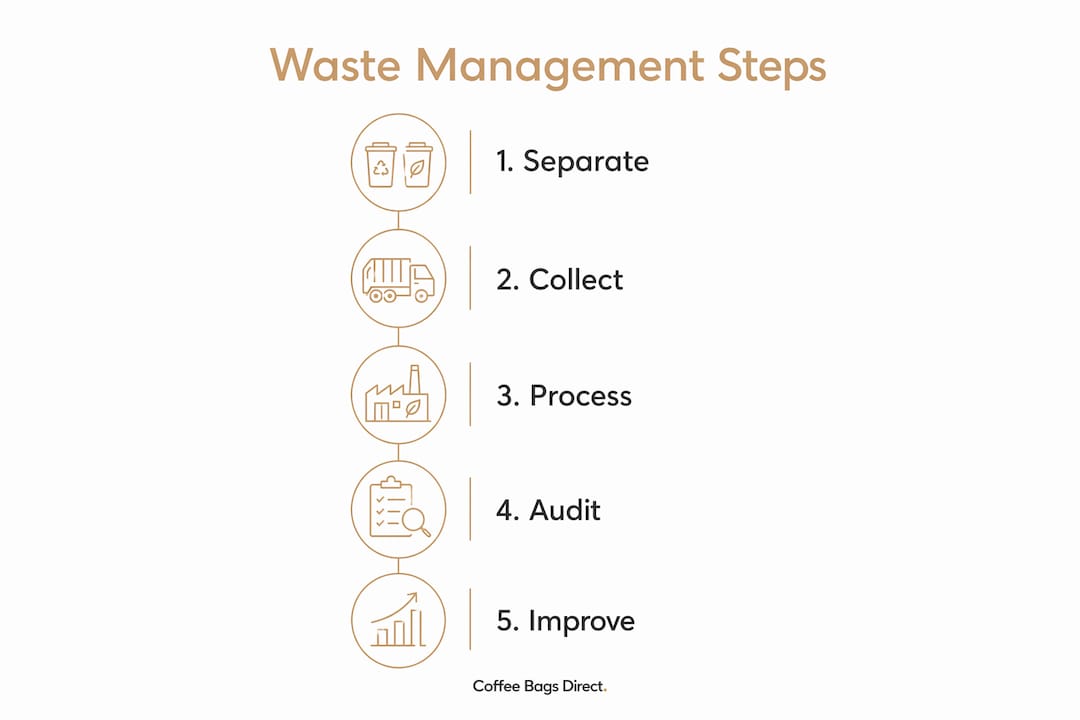
- How to set up bin streams and collection schedules that fit your cafe
- How to choose an Australian waste management provider
- How to measure waste and turn the data into cost savings
- How packaging choices reduce waste in your cafe
- A 30/90/180-day implementation plan for Australian cafes
- How to handle hazardous waste and chemical disposal in your cafe
- Key Takeaways
- Waste as a cost line, not a given
- Coffeebagsdirect helps you close the packaging waste loop
- Useful sources and further reading
What good waste management looks like for Australian cafes
Effective waste management for cafes means handling six distinct streams correctly, not just putting everything in one bin.
- Food and organics: prep scraps, plate waste, expired stock, coffee grounds, and spent milk.
- Dry mixed recycling: clean cardboard, paper, plastic bottles, tins, and glass.
- General waste: anything that cannot be composted or recycled.
- Liquid and grease: used cooking oil and grease-trap waste, which require licensed carriers.
- E-waste: spent equipment, batteries, and light globes.
- Hazardous chemicals: cleaning concentrates and sanitizers (covered in detail below).
REMONDIS Australia recommends that hospitality venues manage each of these streams separately, offering grease-trap servicing, organics collection, and digital reporting through a client portal so cafés can meet ESG and compliance expectations. APCO provides the packaging-side framework, setting standards for how materials should be labeled and recovered. Together, these two bodies define the compliance floor for Australian operators.
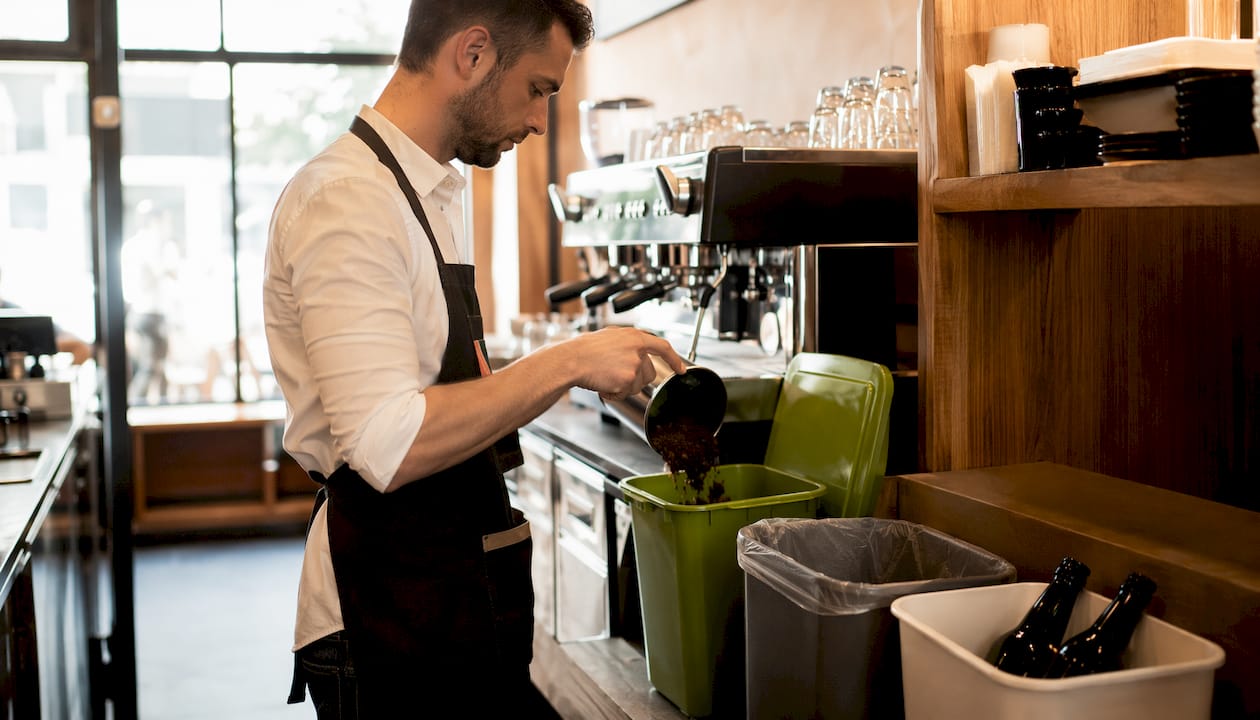
Pro Tip: Place the food-waste caddy where waste is actually generated — beside the prep counter and the espresso machine — not in a corner of the kitchen. Proximity is what drives correct sorting.
Low-cost waste-reduction steps you can start this week
The 2024 Action Plan is clear: menu simplification, optional sides, and a specials board to repurpose surplus are among the most cost-effective waste reduction strategies for cafes. None of these require capital expenditure.
- Simplify the menu. Fewer dishes mean tighter stock control and less spoilage.
- Ask before serving sides. Toast, salad, and sauces served unasked are a direct source of plate waste.
- Run a specials board. Use surplus ingredients in daily specials before they expire.
- Batch and freeze. Buy seasonal produce in bulk, portion it, and freeze — particularly effective for pestos, sauces, and high-fat cheeses.
- Portion control. Standardize weights for common items; eyeballing portions inflates both food cost and waste.
- Donate or discount end-of-day perishables. Apps and local food-rescue networks connect cafés with recipients quickly.
- Normalize takeaway containers. Encourage customers to take leftovers; it reduces plate waste with zero kitchen effort.
- Repurpose coffee grounds. Collect spent grounds for compost or farm pickup — a busy espresso machine produces a substantial amount of grounds each day, all of it suitable for anaerobic digestion or composting.
- Freeze leftover steamed milk into ice cubes for use in cold drinks or staff beverages.
Pro Tip: Freezer batching is underused in most cafes. Buying seasonally abundant produce in bulk and freezing it in portions stabilizes food cost and eliminates the mid-week spoilage spike that inflates your general-waste bin.
How to set up bin streams and collection schedules that fit your cafe
Right-sizing bins and collection frequency is where most cafés leave money on the table. Start with a simple checklist:
- Estimate daily food/organic volume (include coffee grounds).
- Measure cardboard output from bean, milk, and syrup deliveries.
- Assess general waste after organics and recycling are separated.
- Identify liquid waste needs: used cooking oil volume and grease-trap service frequency.
| Stream | Processing end-point | Handling notes |
|---|---|---|
| Food and organics | Composting or anaerobic digestion | Use compostable liners; empty caddy every shift |
| Coffee grounds | Anaerobic digestion or farm compost | High volume; consider dedicated collection |
| Dry mixed recycling | Materials recovery facility | Keep clean and dry; cardboard flattened |
| General waste | Landfill | Should shrink as organics and recycling grow |
| Used cooking oil | Licensed UCO carrier | Separate drum; never pour down drain |
| Grease-trap waste | Licensed liquid-waste carrier | Scheduled servicing; frequency set by volume |
REMONDIS highlights that right-sized bins and flexible collection schedules reduce overall spend while improving diversion rates. A café that switches to fewer general-waste lifts and more frequent organics collections typically pays less per month, not more.
Pro Tip: Trial a smaller general-waste bin first. The constraint forces correct sorting and often reveals that your actual landfill volume is a fraction of what you assumed.
How to choose an Australian waste management provider
Not every waste contractor serves small hospitality well. Use this checklist before signing anything:
- Organics collection available (not just general waste and recycling).
- Grease-trap and liquid-waste servicing in your postcode.
- Digital reporting portal with downloadable diversion data.
- Flexible bin sizes and collection frequencies.
- References from other cafés or hospitality venues.
| Dimension | What to ask |
|---|---|
| Streams handled | Do you collect organics, grease-trap waste, and e-waste separately? |
| Processing end-point | Where do organics go — compost or AD? Can you confirm in writing? |
| Service frequency | Can I adjust lift frequency as my volumes change? |
| Pricing model | Is pricing per lift, per bin size, or a flat subscription? |
| Reporting and audits | Do you provide weight reporting and diversion rates via a portal? |
| Compliance services | Do you service grease traps and provide waste-transfer documentation? |
Digital reporting matters more than most operators realize. Client portals and on-demand reporting let you download diversion metrics for ESG reporting and identify which streams are growing. When comparing pricing models, a per-lift structure suits low-volume sites; a subscription suits high-frequency collections where predictability matters.
How to measure waste and turn the data into cost savings
Start with a seven-day baseline audit: weigh what goes into each bin daily and record it in a simple spreadsheet.
| KPI | How to calculate | Target range |
|---|---|---|
| kg food waste per day | Total food-waste bin weight ÷ 7 days | Reduce week-on-week |
| Diversion rate (%) | (Organics + recycling) ÷ total waste × 100 | Aim above |
| Cost per kg general waste | Monthly general-waste invoice ÷ kg to landfill | Reduce by right-sizing bins |
| Food cost vs. waste ratio | Waste kg ÷ total ingredients purchased | Benchmark and trend down |
- Weigh each stream daily for seven days and record totals.
- Identify the two highest-volume streams and investigate their sources.
- Adjust menu, portioning, or ordering based on what you find.
- Re-audit after 30 days to measure change.
- Use the data to renegotiate collection frequency with your provider.
Measuring baseline waste volume before making changes is what separates operators who cut costs from those who guess. Once you can see the numbers, you can connect rising waste volumes to specific suppliers, menu items, or prep practices.
How packaging choices reduce waste in your cafe
Packaging is part of your waste stream whether you plan for it or not. The material you choose determines where it ends up.
- Certified compostable bags and pouches: go into the organics or food-waste stream; check that your local collection service accepts them.
- Recyclable mono-material pouches: go into dry mixed recycling; avoid multi-layer laminates that contaminate the stream.
- Kraft paper bags: recyclable in most Australian councils; avoid wax coatings.
- Foil-lined bags: generally landfill-bound; suitable where barrier properties are non-negotiable.
| Material | Waste stream | Diversion outcome |
|---|---|---|
| Certified compostable | Organics/food waste | Diverted from landfill |
| Recyclable mono-material | Dry mixed recycling | Diverted from landfill |
| Kraft (uncoated) | Paper recycling | Diverted from landfill |
| Foil-lined laminate | General waste | Landfill |
APCO alignment means packaging meets Australian standards for recyclability and compostability claims, reducing end-of-life confusion for your customers. Clear disposal labeling — “Compost me” or “Check local recycling” — printed directly on the bag is one of the most practical things you can do to improve correct disposal rates. Correct material selection and clear disposal labeling significantly improve customer disposal behavior. Coffeebagsdirect offers compostable and recyclable coffee bags with custom printing, so your sustainability message is built into the product itself.
Pro Tip: If you’re unsure which material suits your roast profile and waste goals, Coffeebagsdirect’s packaging selection guide walks through barrier requirements, shelf life, and end-of-life options side by side.
A 30/90/180-day implementation plan for Australian cafes
Days 1–30 (quick wins, near-zero cost)
- Place a labeled food-waste caddy in the kitchen.
- Run a seven-day waste audit and record weights by stream.
- Start asking before serving sides.
- Trial freezer batching for one or two high-waste prep items.
Days 31–90 (infrastructure and partners)
- Switch to right-sized bins based on audit data.
- Secure an organics collection partner with digital reporting.
- Update the menu based on waste findings.
- Begin packaging swaps: replace foil-lined bags with certified compostable or recyclable options.
Days 91–180 (reporting and brand)
- Formalize diversion reporting with your waste partner.
- Launch customer-facing sustainability messaging on packaging and in-store.
- Evaluate custom printing for disposal labels on bags and cups.
Indicative costs: a countertop food-waste caddy runs under AU$30; an additional 120L bin typically adds AU$10–$25 per lift to your waste contract. Organics collection is often cost-neutral once general-waste lift frequency drops. The Action Plan consistently shows that small operational changes deliver the fastest returns before any capital investment is needed.
How to handle hazardous waste and chemical disposal in your cafe
Cafés generate a narrow but legally significant category of hazardous waste that cannot go into general bins.
Used cooking oil must be collected by a licensed used-cooking-oil (UCO) carrier. Pouring it down a drain is an offense under Australian environmental protection legislation and will block your grease trap. Most carriers supply a dedicated drum and schedule regular pickups.
Grease-trap waste is classified as liquid trade waste in most Australian states. Your local water authority sets the servicing frequency and documentation requirements. REMONDIS and similar licensed operators provide scheduled grease-trap servicing with waste-transfer certificates for compliance records.
Cleaning chemicals and sanitizers — including oven cleaners, descalers, and concentrated sanitizers — are classified as hazardous under the National Environment Protection (Used Packaging Materials) Measure and relevant state EPAs. Never pour them down a sink in undiluted form. Contact your state EPA or local council for a licensed chemical-waste drop-off point or collection service.
Fluorescent tubes and batteries are e-waste and must not go into general bins. Most Australian councils operate free e-waste drop-off points, and the national Product Stewardship scheme covers many battery types.
Keep a waste-transfer certificate for every hazardous collection. Inspections by state EPA officers can request these records, and the business carries liability for any unlicensed disposal.
Key Takeaways
Separating organic waste, running a short baseline audit, and partnering with a reporting-capable provider are the three moves that deliver the fastest, most measurable cost reductions for Australian cafés.
| Point | Details |
|---|---|
| Separate streams first | Set up distinct bins for food/organics, recycling, general waste, and liquid waste before anything else. |
| Audit before you act | A seven-day weight audit reveals your highest-cost streams and guides every subsequent decision. |
| Right-size collections | Smaller general-waste bins and more frequent organics lifts typically reduce total spend while improving diversion. |
| Packaging choice matters | Certified compostable or recyclable materials with clear disposal labels reduce landfill contributions and customer confusion. |
| Coffeebagsdirect for packaging | Coffeebagsdirect supplies APCO-aligned compostable and recyclable coffee bags with custom disposal labeling to support your waste-diversion goals. |
Waste as a cost line, not a given
Most cafés treat waste as an unavoidable overhead — something that gets paid for and forgotten. That framing is expensive. When you measure waste by stream and weight, it becomes a cost line you can actually manage, the same way you manage food cost percentage or labor hours. Menu decisions, portioning standards, and ordering volumes all look different once you can see what they’re generating in the bin.
Packaging is part of that same equation. A bag that ends up in landfill because it carries no disposal instruction is a missed opportunity — both for diversion and for the brand signal it sends to your customer. Choosing certified compostable or recyclable materials, and printing clear end-of-life instructions directly on the pack, closes that loop. At Coffeebagsdirect, that’s the practical case we make for every packaging decision: the right material, clearly labeled, is the one that actually gets disposed of correctly.
Coffeebagsdirect helps you close the packaging waste loop
Packaging waste is the one stream most cafés and roasters can control from the moment of purchase. Coffeebagsdirect supplies certified compostable and recyclable coffee bags and custom pouches designed to meet APCO standards, so your packaging aligns with the waste-diversion goals you’re building in the rest of your operation.
Custom digital printing means you can add “Compost me” or “Check local recycling” directly to your bag in small runs, with fast turnaround. That single label change improves correct disposal rates and reinforces your sustainability credentials at the point of sale. If you’re ready to align your packaging with your waste-reduction plan, request samples or a custom print quote from Coffeebagsdirect today.
Useful sources and further reading
- Australian Café Food Waste Action Plan (2024) — End Food Waste Australia: primary source for menu simplification, audit methods, and low-cost operational changes.
- Cafes & Bars — REMONDIS Australia: waste stream guidance, grease-trap servicing, and digital reporting for hospitality venues.
- Compostable vs. Recyclable Coffee Bags — Coffeebagsdirect: material selection and end-of-life guidance for Australian roasters.
- Sustainable Packaging Insights — Coffeebagsdirect: packaging procurement tips and eco-labeling guidance.
- How to Reduce Packaging Waste — Spaceman: practical labeling and material-selection strategies supporting diversion.