
SOS Bags for Australian Coffee Roasters and Cafes

What are SOS bags, and why do they matter for your cafe?
An SOS bag is a Self-Opening Sack: a pre-glued paper bag with a flat, reinforced block bottom and accordion-style side gussets that snap open instantly and stand upright without any support. That single design feature changes how your team works at the counter. Instead of holding a bag open with one hand while loading with the other, staff can drop product straight in with both hands free.
For Australian coffee roasters and cafes, that translates directly to faster service. Switching to SOS bags improves packing speed by up to 40% in cafe environments, because the bag holds its position on the counter throughout the entire fill. The flat base also accommodates boxed or rectangular coffee products cleanly, keeping them level during transport.
Coffeebagsdirect, in partnership with the Australian Packaging Covenant Organisation (APCO), supplies SOS bags built specifically for the coffee industry’s sustainability and performance requirements.
Core advantages for Australian coffee businesses:
- Hands-free filling speeds up counter service during peak hours
- Flat base supports boxed coffee tins, gift sets, and multi-item orders
- Larger printable surface area on gussets and panels for branding
- Upright display position improves shelf presentation
- Recyclable and compostable options align with APCO sustainability targets
Table of Contents
- Key features and sustainability credentials of SOS bags
- How to choose the right SOS bag for your coffee business
- Why sustainable materials matter for your packaging decision
- How SOS bags are constructed
- How SOS bags protect coffee freshness and extend shelf life
- SOS bags vs. alternative packaging formats
- How Australian cafes and roasters use SOS bags successfully
- Coffeebagsdirect: sustainable SOS bags built for Australian coffee businesses
- Key Takeaways
Key features and sustainability credentials of SOS bags
The structural performance of an SOS bag depends on two measurable factors: GSM (grams per square meter) and fiber quality. High-GSM virgin kraft paper delivers superior tensile strength compared to lower-GSM recycled stock, which uses shorter, weaker fibers that tear more easily under load. For coffee packaging specifically, mid-weight bags in the 70–90 GSM range handle standard retail coffee pouches and boxed products reliably.
Packing speed callout: Cafe staff using SOS bags report up to 40% faster packing compared to pinch-bottom alternatives, with both hands free to load orders accurately.
On sustainability, SOS bags made from kraft paper are recyclable and compostable, meeting the rising consumer demand for plastic-free packaging across Australia. Coffeebagsdirect’s range includes compostable and recyclable material options that align with APCO’s national packaging targets. The environmental benefits of paper-based packaging for coffee businesses extend beyond compliance: customers actively notice and respond to sustainable choices at the point of purchase.
Sustainable material options and design benefits:
- Compostable kraft paper certified for food contact
- Recyclable options accepted in standard Australian curbside programs
- Grease-resistant coatings available for oily or moist coffee products
- Custom digital and rotogravure printing on gussets, panels, and base
- Stackable flat storage reduces under-counter space requirements
How to choose the right SOS bag for your coffee business
Selecting the wrong bag size or GSM is the most common and costly mistake. Match the bag’s gusset depth to your widest product first: a rigid coffee tin or gift box that exceeds the gusset width will split the side seams immediately. Once you have the correct dimensions, move to material specification.
Practical steps to choose and customize your SOS bags:
- Measure your product first. Width, depth, and height of your heaviest SKU sets the minimum bag dimensions.
- Choose GSM by product weight. Light retail coffee pouches suit 50–60 GSM; heavier boxed sets or glass jars need 70–90 GSM or above.
- Specify fiber quality. Virgin kraft holds more weight per GSM than recycled content. For products above 1 kg, virgin fiber is the safer choice.
- Add food-safe coatings where needed. Grease-resistant or FDA-approved coatings are necessary for oily or moist products to prevent base failure.
- Select your print method. Digital printing suits short runs and fast turnarounds; rotogravure delivers consistent color across large volumes.
- Order samples before committing to bulk. Test the bag under real counter conditions with your heaviest product before placing a full order.
- Confirm Australian compliance. Check that materials meet APCO guidelines and any relevant food-contact standards for your product category.
Pro Tip: Request a sample run with your actual product weight inside the bag. A bag that holds 500g of ground coffee on a flat surface may perform differently when carried by a customer for 20 minutes.
Why sustainable materials matter for your packaging decision
Australian consumers and regulators are moving in the same direction: away from single-use plastics and toward packaging that can re-enter the material cycle. APCO’s 2025 targets set clear expectations for businesses operating in the food and beverage sector, and packaging choices are now part of how cafes and roasters are evaluated by wholesale buyers and retail partners alike.
Choosing compostable or recyclable SOS bags is not just an environmental position. It reduces your exposure to incoming plastic packaging levies and positions your brand ahead of regulatory shifts rather than scrambling to catch up. For environmentally friendly cafe operations, packaging is one of the highest-visibility decisions you make, because every customer leaves with it in hand.
How SOS bags are constructed
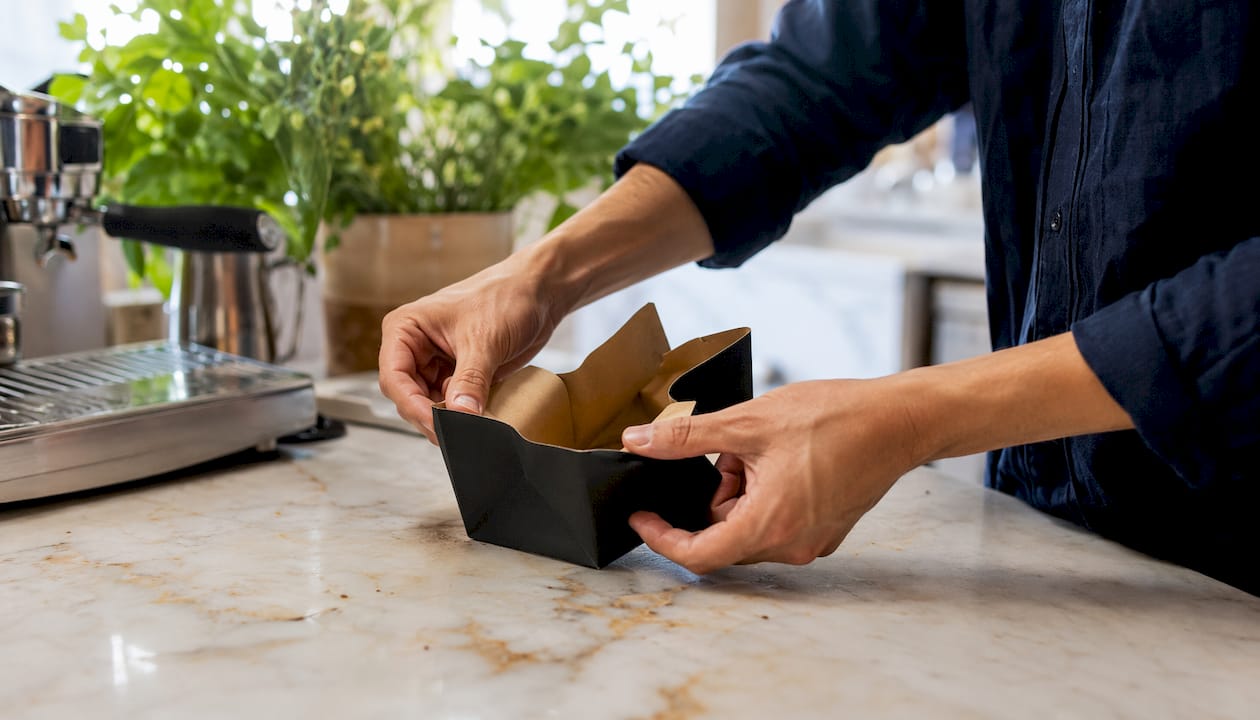
Every SOS bag is built from five components working together: front and back load-bearing panels, accordion side gussets, a bottom fold geometry, water-based adhesive seams, and an open top. The bottom fold is the most engineered part. Overlapping paper layers are pressed and glued to create a perfectly flat floor that distributes weight evenly across the base rather than concentrating it at a single point.
The gussets fold flat during shipping, then pop outward when the bag is snapped open. That snap-open function is what gives the SOS its name and its operational advantage. Water-based adhesives bind the seams without toxic chemical leaching, keeping the bag food-safe throughout its use.
How SOS bags protect coffee freshness and extend shelf life
The flat base keeps coffee bags upright during storage and transport, which matters more than it sounds. A bag that tips and compresses on its side puts pressure on seals and valves, accelerating oxidation. The rigid standing position of an SOS bag keeps degassing valves unobstructed and seals intact from roast to retail shelf.
For custom printed coffee bags with high-barrier materials, the SOS format pairs well with foil liners and resealable closures that lock out oxygen and moisture. The structural integrity of the bag also reduces the risk of puncture during handling, which is a real concern for bags moving through wholesale distribution.
SOS bags vs. alternative packaging formats
| Feature | SOS Bags | Pinch-Bottom Bags | Side Gusset Pouches |
|---|---|---|---|
| Stands upright | Yes | No | With stand-up zipper |
| Packing speed | Fastest (hands-free) | Moderate | Moderate |
| Branding surface | Large (panels + gussets) | Limited | Large (front + back) |
| Best for | Multi-item, boxed, display | Single-serve, grab-and-go | Retail shelf, resealable |
| Cost per unit | Higher | Lower | Medium–high |
| Recyclability | Yes (kraft options) | Yes | Depends on material |
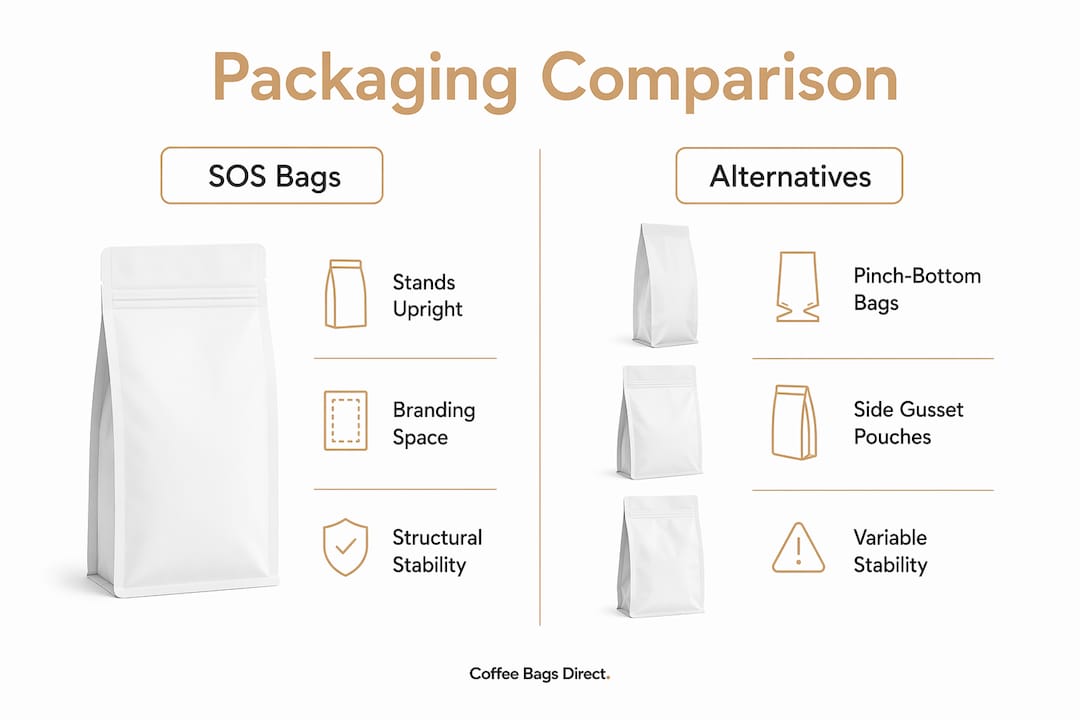
SOS bags provide superior structural stability and greater branding surface compared to pinch-bottom bags, making them the preferred format in food service environments where presentation and speed both count. Pinch-bottom bags cost less per unit and store flat, but they cannot stand on their own, which creates handling problems at busy counters.
How Australian cafes and roasters use SOS bags successfully
A specialty roaster packaging 250g and 500g retail bags for wholesale accounts uses SOS bags in the 70 GSM virgin kraft format: the flat base keeps bags upright on retailer shelves without additional display hardware, and the gusset surface carries full-color branding visible from multiple angles. The result is a bag that functions as a display unit, not just a container.
Cafes running high-volume takeaway service use SOS bags for multi-item orders: a boxed pastry, a coffee cup, and a sauce container all sit level inside the flat base without shifting. Staff load orders in under four seconds per bag, which keeps the queue moving during the morning rush. The coffee packaging options that perform best in these settings combine a mid-weight kraft base with custom digital printing for brand consistency across every customer touchpoint.
Coffeebagsdirect: sustainable SOS bags built for Australian coffee businesses
Coffeebagsdirect supplies food-grade kraft SOS bags with compostable and recyclable material options, backed by its partnership with APCO. The range covers everything from small boutique roasters needing short digital print runs to established cafes ordering in bulk with consistent rotogravure color across every carton.
Express digital printing means you can get branded bags with fast turnaround, without committing to large minimum orders. Every bag is designed for the specific weight and format requirements of coffee retail: the right GSM, the right gusset depth, and the right food-safe coating for your product. Sample requests are available so you can test performance before scaling.
Browse the full range of eco-friendly coffee packaging at Coffeebagsdirect, or get in touch to discuss custom printing options tailored to your brand.
Key Takeaways
SOS bags are the operationally and environmentally superior packaging choice for Australian coffee roasters and cafes that need speed, stability, and sustainable credentials in one format.
| Point | Details |
|---|---|
| SOS bag design | Flat reinforced block bottom and side gussets snap open instantly and stand upright for hands-free filling. |
| Packing speed gain | Cafes switching to SOS bags report up to 40% faster packing compared to pinch-bottom alternatives. |
| Material specification | Match GSM and fiber quality to product weight; virgin kraft outperforms recycled content at equivalent GSM. |
| Sustainability compliance | Recyclable and compostable kraft options align with APCO targets and Australian packaging regulations. |
| Coffeebagsdirect | Supplies food-grade SOS bags with express digital printing, APCO partnership, and options for bulk and small orders. |